
Enterprise Solutions
All About Business Rules Management Systems (BRMS)
Share
Overview
Some of these are rooted in common logic: “When In Doubt, Always Know Your Way Out” and “Check The Back Seat In An Unknown Car.” Some rules such as “Enjoy The Little Things” make the movie fun to watch and let the characters take a breather while being chased by a horde of zombies. While we cannot vouch for a scenario of zombie apocalypse, business rules can be quite helpful.
In fact, we believe that every business needs a set of rules based on business logic and existing strategies. Yes, we know, it’s challenging to draw up comprehensive rules and even more challenging to enforce them. That’s why we want to introduce you to Business Rules Management System (BRMS) – a nifty tool to help develop, record and fulfill business rules across the enterprise.
Read to know what it is, how it came about, its working, benefits and future!
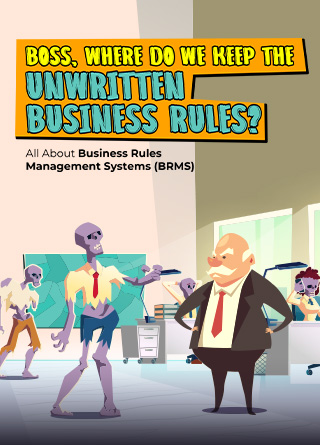
/BRMS-Website-1800-x-940-(-without-logo-).jpg.aspx "TechDogs-\"All About Business Rules Management Systems (BRMS)\" Boss, Where Do We Keep The Unwritten Business Rules?")
There is an exception to every rule – except that a business can run successfully without rules!
Every organization needs rules and regulations to operate successfully. We’re sure your HR explained some of them during the induction ceremony (that is if you paid attention!). To simplify rulemaking and its execution, businesses need to rely on comprehensive software. Business Rules Management System (BRMS) is their go-to solution.
BRMS software helps develop, store, modify and deliver business rules throughout the organization. Since business rules define the behavior, response and strategies of the entire business, being in control of business rules is very beneficial. For example, a rule might dictate that if a user tries canceling their subscription, they should receive an e-mail with a 10% subscription discount within 24 hours. However, informing each employee across departments and locations about it can be challenging – unless you deploy a BRMS. To ensure rules can be easily implemented, delivered, updated, scaled, or cloned across the enterprise at scale, businesses need BRMS.
Let’s dive into the details!
So, What Are Business Rules Management Systems (BRMS)?
A BRMS is a comprehensive software that executes business rules in a production environment. It acts as a central repository, allowing businesses to have a single source of truth to their rules. It even automates the deployment of these rules. Business decision-makers and stakeholders can then collaborate to develop, update and edit rules whenever needed. When the entire workforce operates on the same set of rules, it improves performance, streamlines communications and shortens turnaround time on policy changes. We mean, Columbus’ group survived the zombie apocalypse because he made the rules mandatory for everyone! #SticklerForRules
This system also helps simulate and validate business rules before they are implemented. Once finalized, the BRMS seamlessly deploys them across enterprise platforms. You must be thinking this tool is awesome but it was a long time in the making – here’s how it evolved!
Evolution And Origins Of Business Rules Management Systems (BRMS)
Business rules management was a concept that underwent many changes. Today it is deployed and enforced digitally through software but that wasn’t always the case. Let’s see how we got here:
In the 1990s, a consensus emerged among the originators of the business rule approach that business rules specifically involve terms, facts and regulations. These rules might come from legal limitations, business policies, industrial compliance guidelines, etc. An important breakthrough is credited to the GUIDE Business Rules Project and was originally reported in its 1995 paper. This was the starting framework for business rules management.
The "GUIDE Business Rules Project Report," published in 1995 is cited as the seminal paper for business rules management. Then in 1998, Business Rules Group released the draft of "The Business Motivation Model," which was also called "Organizing Business Strategy: The Standard Model for Business Rule Motivation." This framework aimed to create a directive that was intended to influence or guide business behavior through rules.
Then between 2000 to 2003, The Business Motivation Model (BMM) was developed. This was a meta-model for the concepts of business planning and how they interrelate, including business policies and business rules. At this time, most businesses started drawing up rules based on internal metrics that benefited them. In the period between 2005 and 2008, The Business Motivation Model (BMM) was finalized and accepted as the standard in business rules management. It was the basis of the modern BRMS - however, that’s all in the past!
Let’s look at how BRMS actually works.
How Does A Business Rules Management System Work?

Have you ever asked this about an employee or co-worker? If you have, this section will explain how a BRMS works in ensuring that you’ll never have to ask if someone knows the business rules!
Let's start with the fundamentals: business rules are directives that specify or regulate the business processes of an organization. They are crucial because they outline the objectives of the organization and offer instructions on how processes should be carried out. Most businesses have unwritten and unspoken business rules – remember some policy that your HR mentioned verbally? Well, that’s not binding! To guarantee that employees are aware of their responsibilities and proper business procedures, someone needs to be in charge of enforcing these rules and making sure they are recorded.
That is what BRMS does!
This software defines, delivers, executes, records and manages business rules and the logic behind them. It has a central repository where all the rules are stored. These rules are then executed in real-time using a runtime environment (a software infrastructure). It leverages a business rules engine to execute rules and enforce them across enterprise applications. As a result, businesses can be certain that all work is done in accordance with their rules. A BRMS also offers development tools so that business rules can be managed and created without coding. Heck, you could run a Zombieland-themed bakery chain without any technical knowledge!
Not needing technical expertise isn’t the only benefit though – here are some more!
Benefits Of Business Rules Management Systems (BRMS)

If you think your workforce needs to be better aware of business rules, a BRMS is your best bet. Here are some more benefits you’ll get along the way:
-
Improved Process Efficiency
A BRMS allows your company to manage, update and maintain business rules from a central platform to determine where changes are needed, pinpoint any bottlenecks and also look for what currently works well.
-
Enhanced Compliance
A BRMS can offer features where non-technical end users can also create, maintain and deploy business rules. Furthermore, all rules are documented, along with when they were applied, ensuring a high degree of compliance during audits.
-
Better Customer Service
A BRMS can help your employees learn the best practices for their tasks, whether it is analytics or marketing or baking!
-
Higher Flexibility
Changes to business rules can be easily implemented with a BRMS. It helps you change business logic much faster than traditional methods and scale it across applications, workflows and teams.
-
Analyzing And Improving Decision Logic
A BRMS helps organizations identify areas where decision logic can be improved. Once you analyze the effect of certain business rules on business outcomes, the rules can be tailored and implemented.
Now you know the benefits of BRMS – but did you know that Victor Halperin's 1932 movie, White Zombie, is widely considered the oldest zombie movie? Well, we can bet that the genre will be doing well in 2032 too, as will Business Rules Management Systems!
What’s The Future Of Business Rules Management Systems (BRMS)?
The global BRMS market size is expected to double from USD 1 billion in 2020 to roughly USD 2 billion by 2025. On its current course, BRMS will soon enable better insights into which rules contribute the most to optimizing business metrics like efficiency, time, expenses and ROI. Business executives will benefit from this while deciding how to create new rules. Additionally, Intelligent Process Modelling will assist organizations in developing a comprehensive understanding of the rules they want to enforce – before they put in into practice. Talk about increased operational effectiveness, enhanced employee satisfaction, improved compliance and higher profit margins!
Another emerging trend will be seen in the traditional outsourcing of business rule management. Through the use of open-source software, we're confident that organizations will understand and modify business rules in-house more easily. This will enable faster scaling and flexibility, as well as less reliance on hiring experts.
/not-bad-huh-awesome.gif.aspx "TechDogs-\"What’s The Future Of Business Rules Management Systems (BRMS)\"A GIF From Zombieland Showing Tallahassee Saying \"Not Bad, Huh?!\"")
Conclusion
We bet your business process has certain rules that are based on your business model and industry standards. You would want every employee to be aware of them, right? Using a BRMS will ensure that every rule is recorded, stored and delivered across the enterprise. This will allow for improved process efficiency, enhanced profitability, quicker turnaround time, etc. Moreover, with a unified "rulebook,” you will also see higher customer engagement and lower operational costs. Imagine not having to send out emails each time someone breaks a rule - we hope sending out such emails is one of your business rules!
Frequently Asked Questions
What Are Business Rules Management Systems (BRMS)?
Business Rules Management Systems (BRMS) are comprehensive software solutions designed to execute business rules within an organization's production environment. Acting as a central repository, BRMS allows businesses to store, develop, modify, and deploy rules across the enterprise. By ensuring a single source of truth for rules, BRMS facilitates collaboration among decision-makers and stakeholders, leading to improved performance, streamlined communications, and shorter turnaround times on policy changes. Essentially, BRMS empowers organizations to maintain control over their business rules, enhancing operational efficiency and effectiveness.
What Are The Origins Of Business Rules Management Systems (BRMS)?
The concept of business rules management has evolved significantly over the years. Originating in the 1990s, the notion of business rules was formalized through frameworks such as the GUIDE Business Rules Project and the Business Motivation Model (BMM). These frameworks aimed to define and organize business rules, laying the groundwork for modern BRMS. By the mid-2000s, the BMM had become the standard in business rules management, shaping the development of BRMS as we know it today. This evolution reflects the growing recognition of the importance of business rules in driving organizational behavior and strategy.
How Does A Business Rules Management System Work?
At its core, a Business Rules Management System (BRMS) functions as a tool for defining, delivering, executing, recording, and managing business rules and their logic. By maintaining a central repository of rules, BRMS ensures consistency and compliance across enterprise applications. Leveraging a business rules engine, BRMS executes rules in real-time, enforcing them seamlessly throughout the organization. One of the key advantages of BRMS is its accessibility to non-technical users, allowing for rule management and creation without the need for coding expertise. This accessibility, coupled with its ability to enforce rules consistently, makes BRMS a valuable asset for organizations seeking to improve operational efficiency and regulatory compliance.
Tue, Dec 20, 2022

Enjoyed what you read? Great news – there’s a lot more to explore!
Dive into our content repository of the latest tech news, a diverse range of articles spanning introductory guides, product reviews, trends and more, along with engaging interviews, up-to-date AI blogs and hilarious tech memes!
Also explore our collection of branded insights via informative white papers, enlightening case studies, in-depth reports, educational videos and exciting events and webinars from leading global brands.
Head to the TechDogs homepage to Know Your World of technology today!
Disclaimer - Reference to any specific product, software or entity does not constitute an endorsement or recommendation by TechDogs nor should any data or content published be relied upon. The views expressed by TechDogs' members and guests are their own and their appearance on our site does not imply an endorsement of them or any entity they represent. Views and opinions expressed by TechDogs' Authors are those of the Authors and do not necessarily reflect the view of TechDogs or any of its officials. While we aim to provide valuable and helpful information, some content on TechDogs' site may not have been thoroughly reviewed for every detail or aspect. We encourage users to verify any information independently where necessary.
Loading comments...