

Enterprise Solutions
What Is Composable Enterprise?
Share
Introduction
Well, if you’ve ever seen Henry Cavill (yes, Superman himself) building his own PC on YouTube, you know the joy. The satisfying click of a graphics card sliding in, the hum of power coming alive. Meanwhile, PewDiePie, too, is somewhere live-streaming his AI-powered rig, half joking that it might start thinking for itself.
These PC-building moments aren’t just about tech, but they’re about freedom. The freedom to choose every part, swap them out, and upgrade without starting over.
Now pause for a second. What do these PC-building moments have in common?
Well, that’s exactly what Composable Enterprise is all about.
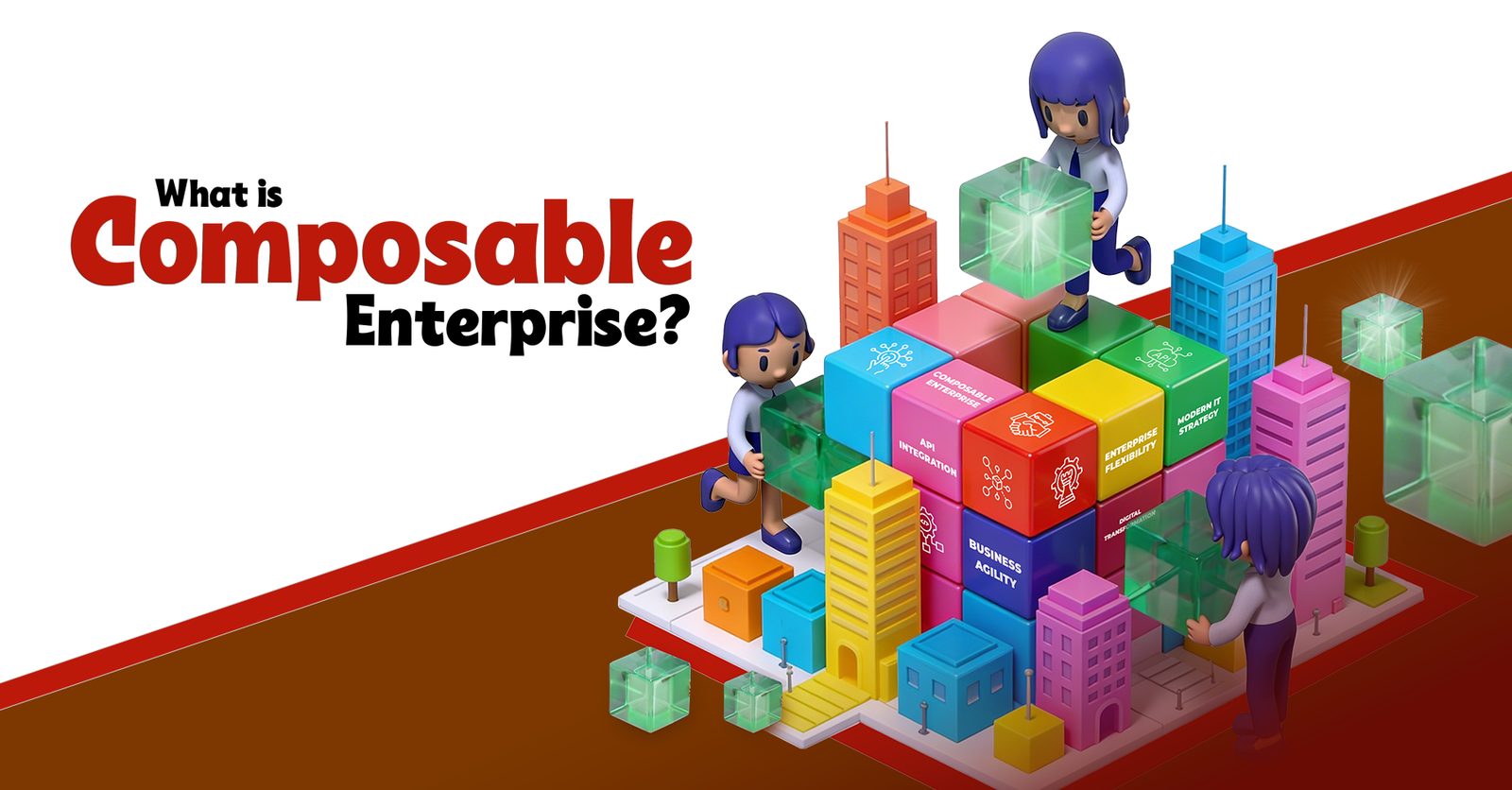
The result? A flexible, high-performance ecosystem that evolves as fast as the business itself.
In this article, we’ll explore what a composable enterprise is. We’ll explain why it’s becoming a dream setup for CIOs. We’ll also show how it’s redefining agility in the digital age.
Time to reboot your mind and learn about what this term actually means.
TL;DR
-
Composable Enterprises are businesses that build flexible systems using modular digital components.
-
Composable architecture enables faster innovation, upgrades, and scalability.
-
APIs and microservices connect independent tools into one agile, composable ecosystem.
-
The result is speed, freedom, and adaptability across the entire enterprise.
What Is Composable Enterprise?
In simple terms, Composable Enterprise is an organizational approach that builds business capabilities from modular, interchangeable components. Consider apps, API integrations, and digital services that you can plug in, swap out, or upgrade independently.
This modular design isn’t a trend; it reflects the evolution of modern business processes. For example, the global composable applications market may grow from about USD 7.5 billion in 2025. It may reach over USD 31 billion by 2034. Rising demand for enterprise flexibility drives this growth.
Each function, from marketing automation to customer support, becomes a building block that communicates via APIs and microservices. This means you can mix, match, and reassemble parts as business needs evolve, without tearing down the whole system.
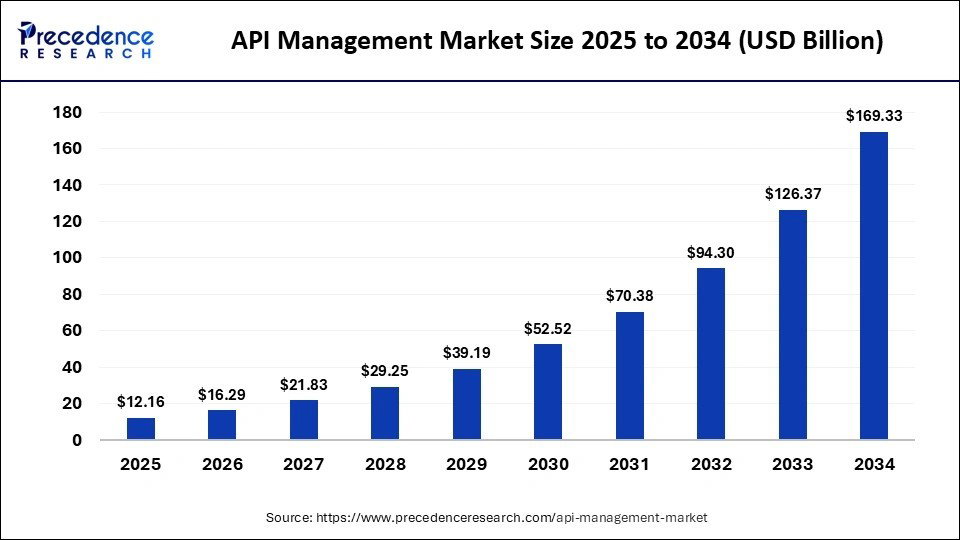
The API management market is booming. Analysts expect growth to rise from about USD 12.16 billion in 2025. It should reach over USD 169 billion by 2034. This highlights the critical role of APIs in modern enterprise architecture.
In essence, composability turns technology into a living, adaptable organism rather than a fixed machine. It’s how today’s leading enterprises stay nimble, scalable, and resilient—one digital brick at a time.
Before composable enterprises became a popular modular business strategy, enterprises faced growing pains.
Let’s rewind and see how we got here.
History Of The Composable Enterprise
The idea of composability didn’t appear overnight. It evolved as businesses tried (and often struggled) to keep up with change.
-
1960s–1990s
Enterprises relied on monolithic systems. Massive, centralized software built to do everything at once.
These systems were stable but rigid. Any change meant expensive upgrades and long downtime. For example, early IBM mainframes and similar enterprise apps set this model. It was stable but struggled to scale and remain agile. -
Early 2000s
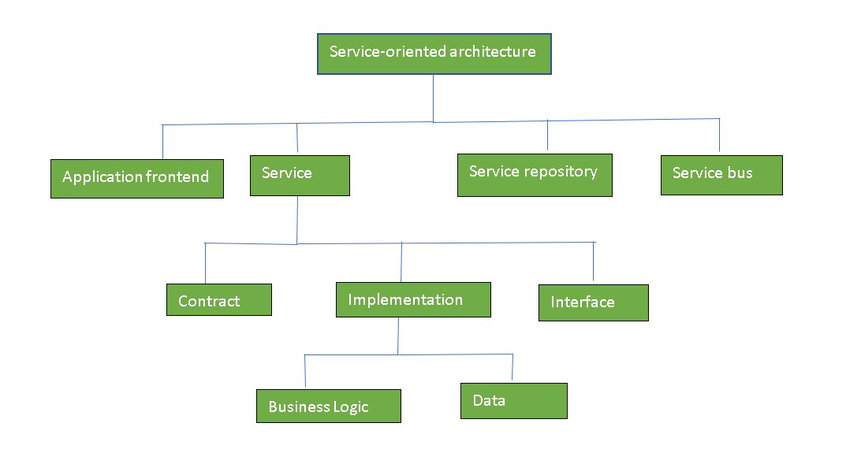
The rise of Service-Oriented Architecture (SOA) introduced the idea of breaking systems into services. While promising, SOA was often complex, slow, and heavily IT-driven.
-
2010–2015
Cloud computing, APIs, and microservices gained momentum. Companies began decoupling applications, making systems more flexible and scalable for digital transformation.
The European Journal of Computer Science and Information Technology Research reports that microservices can cut deployment time by 40%. It also states that scalability can increase by over 50%. These results show real-world gains from modular design. -
2016–2019
Businesses adopted headless platforms and best-of-breed tools. Front-end customer experiences were separated from backend systems, enabling faster experimentation and customization.
-
2020–Present
The concept of the Composable Enterprise emerged. Combining modular business architecture with business agility. Technology became something enterprises could assemble, evolve, and reassemble continuously. Gartner and industry research now show that composable strategies are becoming mainstream as organizations prioritize agility in uncertain markets.
From rigid monoliths to flexible building blocks, composability reflects decades of enterprise change. It is driven by the need for speed, adaptability, and resilience.
Now that we’ve built the foundation and explored the history of composable enterprise, let’s answer the big question next.
Why Composable Enterprises Matter Today
In today’s fast-moving digital world, businesses can’t afford to be static. Customer expectations shift overnight, markets evolve weekly, and new technologies emerge before last year’s updates are fully installed. The days of slow, monolithic systems are numbered.
That’s where Composable Enterprises shine. They enable organizations to move with the same agility as startups, replacing outdated tools, integrating innovations, and scaling operations instantly. Think of it as business plug-and-play: when market demands change, you reassemble your digital setup rather than rebuild it.
Industry research reinforces this shift. McKinsey & Company reports that organizations with modular, API-first architecture can reduce time-to-market by up to 50%, thereby significantly accelerating innovation cycles. Meanwhile, firms with mature API strategies generate up to 32% more revenue from digital initiatives, according to MuleSoft’s 2024 API report.
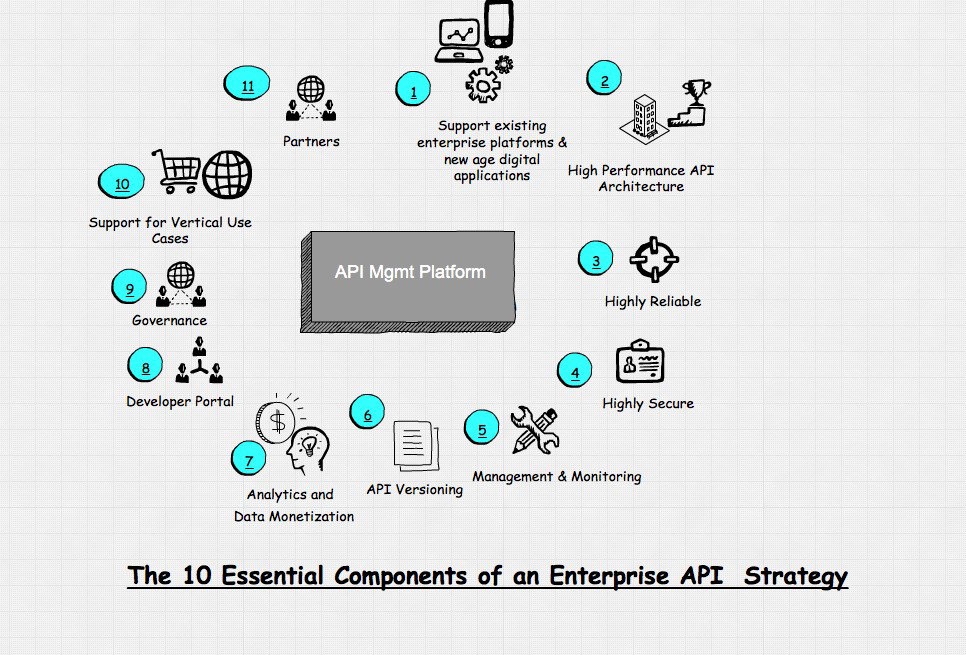
Echoing this, Brent Hayward, CTO at MuleSoft, notes that “APIs are no longer just integration tools. They are the foundation for creating digital products and unlocking new revenue streams.”
The accelerating cloud microservices market also reflects this trend, with a 2024 valuation of over USD 1.9 billion and rapid growth. It shows enterprises are shifting from monoliths to modular, scalable environments that underpin composability.
In short, a composable enterprise helps companies survive disruption and thrive amid change. It’s not just a modern IT strategy; it’s a blueprint for staying relevant in an unpredictable world.
Now that we understand why composability matters, let’s open the hood and see how a composable enterprise actually works behind the scenes.
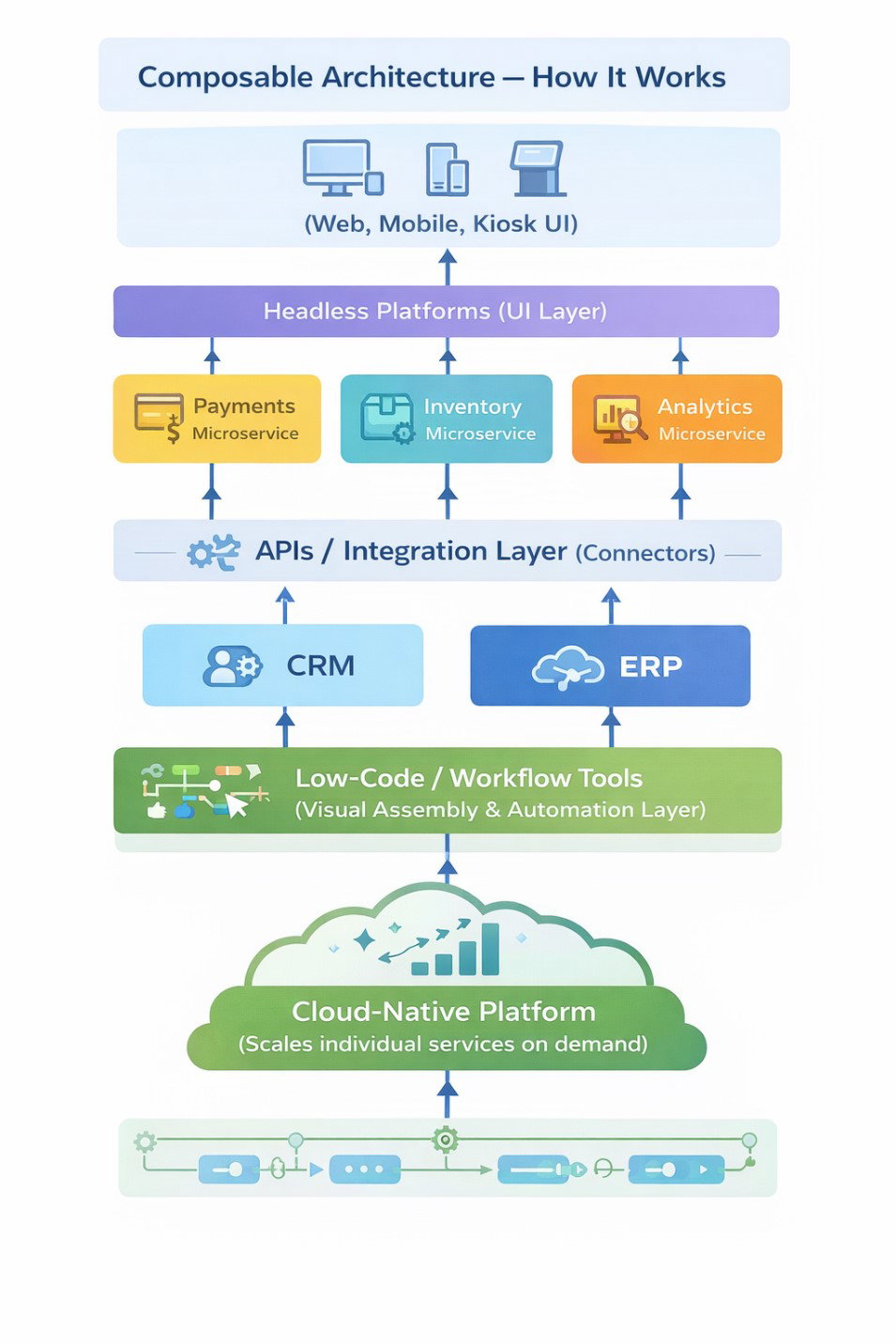
How Composable Architecture Works
A composable enterprise doesn’t run on magic. It runs on smart architecture. At its core, modern technologies power this business model by enabling businesses to build, connect, and reconfigure capabilities with ease.
-
Microservices Handle Specific Jobs
Payments, inventory, search, and analytics run as separate services. So updating checkout doesn’t disrupt order tracking or customer data. -
APIs Act As Digital Connectors
APIs enable systems such as CRM, ERP, and e-commerce platforms to communicate without being tightly coupled, accelerating and improving integration security. -
Cloud-Native Platforms Enable Scale
When traffic spikes during a sale or campaign, only the affected service scales—not the entire system. -
Headless Platforms Separate Experience From Logic
Businesses redesign websites, launch mobile apps, or add kiosks without touching backend systems. -
Integration Layers And Low-Code Tools Speed Assembly
Teams visually assemble workflows. Connecting apps and automations without writing everything from scratch.
Together, this architecture transforms IT from a rigid foundation into a flexible toolkit—ready to be assembled, reassembled, and scaled whenever the business demands it.
Now that we’ve seen how composable enterprises are built under the hood, let’s talk about the real payoff. What businesses actually gain from going composable.
Topics For More Insights
Benefits Of A Composable Enterprise
A composable enterprise isn’t just architecturally elegant. It delivers tangible business value. By assembling digital capabilities rather than hardwiring them, organizations unlock some powerful competitive advantages.
Here are the benefits this type of enterprise brings.
-
Agility
Composable enterprises can respond to change fast. For example, Weir Minerals transformed its operations by integrating modular systems, such as SAP Field Service Management with SAP ERP, enabling real-time communication between field teams and back-office functions and drastically reducing lag in decision cycles.
-
Scalability
Instead of scaling everything at once, businesses can scale up only what is needed. In composable commerce use cases, e-commerce platforms separate services like inventory, payments, and customer data so each can scale independently, reducing overhead during high-traffic events.
-
Innovation Speed
With reusable components already in place, team members spend less time building from scratch and more time experimenting. Case studies stated in the Troy Lendman study show organizations adopting composable practices report 30%–50% faster time-to-market for new capabilities and 2x–3x higher developer productivity when building and reusing components across initiatives.
-
Cost Efficiency
Composable systems reduce vendor lock-in and costly platforms. Modular ERP approaches allow businesses to adopt best-of-breed solutions and replace individual components without costly full-stack upgrades, lowering total cost of ownership over time.
-
Resilience
When one component fails, the rest of the system continues to run. Modern composable stacks isolate services such as customer auth, checkout, and fulfillment, so failures in one area don’t cascade across the whole system. This core factor improves uptime and stability.
In short, composability turns technology into a growth enabler.
Of course, composability sounds great on paper, but how different is it really from the traditional enterprise setups businesses have relied on for decades?
Let’s have a look.
Composable Vs. Traditional Enterprise Models
At a glance, both traditional and composable enterprises aim to run core business operations efficiently. The difference lies in how they’re built and how easily they adapt to change. One is designed for stability; the other is for speed and flexibility.
Here’s how they stack up:
| Aspect | Traditional Enterprise Model | Composable Enterprise Model |
| Architecture | Monolithic ERP suites like SAP ECC, where finance, HR, and supply chain are tightly bundled | Modular stacks using microservices and APIs, such as MACH-based commerce architectures |
| Flexibility | Updating checkout logic requires redeploying the entire system, which is common in legacy on-premise platforms | Swap payment providers or CMS without touching backend logic, common in headless setups |
| Scalability | Black Friday traffic forces scaling the entire application stack | Scale only checkout or search services during traffic spikes |
| Innovation Speed | Quarterly or yearly releases due to heavy regression testing | Weekly or even daily releases using independent service deployments |
| Customization | Vendor-locked customization within rigid ERP templates | Best-of-breed tools combined (CRM + CMS + analytics) via APIs |
| Risk Impact | A database outage brings down the whole application | A failed recommendation service doesn’t affect checkout or payments |
| Upgrade Effort | Full system upgrades take months or years | Incremental upgrades to individual services without downtime |
| Business Agility | Reactive changes after market shifts | Proactive experimentation, A/B testing, and rapid pivots |
So, as you can see, traditional enterprises are built to maintain, while composable enterprises are built to evolve.
Theory and tables are great, but composability really clicks when you see how businesses use it in practice.
Real-World Use Cases And Examples
Composable enterprises are already shaping how modern organizations operate across industries.
Here are a few examples:
-
Composable ERP
Enterprises like Siemens use modular ERP architectures to upgrade finance, analytics, or supply chain systems independently, since no one enjoys a full ERP reboot.
-
E-Commerce Stacks
Nike rebuilt its digital commerce using a headless, API-driven architecture, allowing faster launches and personalization.
-
Digital Experience Platforms (DXPs)
BMW combines headless CMS, customer data, and automation tools to deliver consistent user experiences across web, mobile, and even in-car systems. Yes, your car now has a tech stack.
-
Checkout And Payments Optimization
Amazon scales checkout, payments, and recommendations independently during peak events such as Prime Day because cart abandonment is detrimental to business and morale.
-
Multi-Channel Expansion
Starbucks uses a modular digital stack to power mobile apps, in-store systems, and loyalty platforms, proving your latte is backed by serious composable tech.

Of course, no architecture is flawless. While composable enterprises offer flexibility and speed, they also come with a few challenges that organizations need to plan for.
Challenges And Considerations For Composable Enterprise
While the composable enterprise model unlocks agility, it also introduces new complexities that businesses can’t ignore. Here are some of the challenges faced by enterprises:
-
Integration Management
Enterprises adopting composable architectures often struggle to connect dozens of services reliably. API-heavy organizations report delays due to inconsistent documentation and integration complexity, even large platforms like Amazon and Netflix invest heavily in integration tooling to avoid bottlenecks.
-
Governance And Control
Without strict rules for API ownership, versioning, and lifecycle management, modular systems can spiral into API sprawl. Many enterprises admit they lack full visibility into all their APIs, creating operational and compliance risks.
-
Security Risks
More components mean more attack surfaces. API-first enterprises have found that inconsistent security testing and limited visibility across services increase vulnerability exposure, forcing companies to adopt centralized security policies and monitoring.
-
Mindset And Operating Model Shift
Composability isn’t just technical. Companies like ING learned that modular systems work only when teams reorganize around products, not projects. Without cultural and workflow changes, composable stacks do not deliver promised speed.
Handled thoughtfully, these challenges don’t outweigh the benefits but ignoring them can stall even the most well-designed composable strategy.
Conclusion
Building a composable enterprise is a lot like building your own PC. You don’t buy a bulky, pre-assembled machine and expect it to keep up forever. You choose the right parts, assemble them with purpose, and upgrade whenever performance demands it.
That’s the power of composability. By breaking business systems into modular, interchangeable components, enterprises gain the freedom to adapt, scale, and innovate without tearing everything apart each time change occurs. APIs replace rigid dependencies; microservice architecture replaces monoliths, and flexibility becomes the default.
Of course, composability isn’t about chaos or constant rebuilding. It’s about intentional assembly: knowing what to plug in, what to swap out, and what to leave untouched.
In a world where markets shift fast, and expectations shift faster, composable enterprises aren’t just better prepared; they're also better positioned. They are built to evolve.
So, grab your digital toolkit. It’s time to stop fighting your tech stack and start assembling one that actually works for you.
Frequently Asked Questions
What Are The Types Of Composable Enterprise Systems?
Composable systems include modular CRM, ERP, e-commerce, analytics, and digital experience platforms, each operating independently and connected through APIs for flexibility and reuse.
What Is A Composable ERP System?
A composable ERP lets businesses assemble ERP capabilities such as finance, HR, and supply chain as independent modules, enabling them to replace or upgrade components without overhauling the entire system.
What Are The Top Platforms For Building A Composable Enterprise?
Popular platforms include SAP, Salesforce, MuleSoft, Composable Commerce, and Adobe, which support modular, API-driven architectures.
Wed, Feb 18, 2026

Enjoyed what you read? Great news – there’s a lot more to explore!
Dive into our content repository of the latest tech news, a diverse range of articles spanning introductory guides, product reviews, trends and more, along with engaging interviews, up-to-date AI blogs and hilarious tech memes!
Also explore our collection of branded insights via informative white papers, enlightening case studies, in-depth reports, educational videos and exciting events and webinars from leading global brands.
Head to the TechDogs homepage to Know Your World of technology today!
Disclaimer - Reference to any specific product, software or entity does not constitute an endorsement or recommendation by TechDogs nor should any data or content published be relied upon. The views expressed by TechDogs' members and guests are their own and their appearance on our site does not imply an endorsement of them or any entity they represent. Views and opinions expressed by TechDogs' Authors are those of the Authors and do not necessarily reflect the view of TechDogs or any of its officials. While we aim to provide valuable and helpful information, some content on TechDogs' site may not have been thoroughly reviewed for every detail or aspect. We encourage users to verify any information independently where necessary.
Loading comments...