

Data Management
A Quick Guide To Data Literacy
Share
Introduction
During his trippy moment with the world, for him, the stock market data tickers aren’t just numbers anymore. They form crystal clear patterns. Market shifts connect like puzzle pieces.
Insights appear where chaos once lived for him. This time, Eddie doesn’t get access to more data; he simply understands it better.
That’s the power of that pill in the movie.
Retrospectively, that’s also the real power of data literacy.
In today’s world, we’re surrounded by information. Dashboards, metrics, reports, charts, KPIs, forecasts, and endless notifications. Yet many professionals feel exactly like pre-NZT Edward: plenty of data around them, but not enough clarity to use it confidently.
A solid understanding of data literacy changes that. It helps you make sense of information, ask sharper questions, trust your decisions, and communicate insights in a way that actually drives action.
It’s not really a magic pill, but it’s the closest real-world skill you can build to unlock Edward-level clarity in your work and decisions.
So, with that understood, let’s get on to know what exactly we mean by Data Literacy.

TL;DR
-
Data literacy is the ability to understand, question, and communicate data to support better decision-making.
-
It is a core skill for modern work, not a technical or analyst-only capability.
-
Organizations struggle more with data understanding than data availability.
-
Data-literate teams make faster, clearer, and more confident decisions.
-
Building data literacy requires culture, training, and curiosity, not just tools.
What Is Data Literacy?
Data literacy is the ability to read, understand, interpret, and communicate data in context and then use it to make better decisions.
It’s about knowing what the numbers are saying, where they came from, and whether they actually support a conclusion. In other words, data literacy is the skill that turns charts into clarity and dashboards into direction.
As Clive Humby, who famously coined the phrase “data is the new oil,” once said: “Data is valuable, but if unrefined, it cannot really be used.”
Data literacy is the refining process. It helps people move beyond simply seeing data to actually understanding it.
Now that we know what data literacy is, the next logical question is simple: What does it actually consist of?
Let’s see that next.
Core Components Of Data Literacy
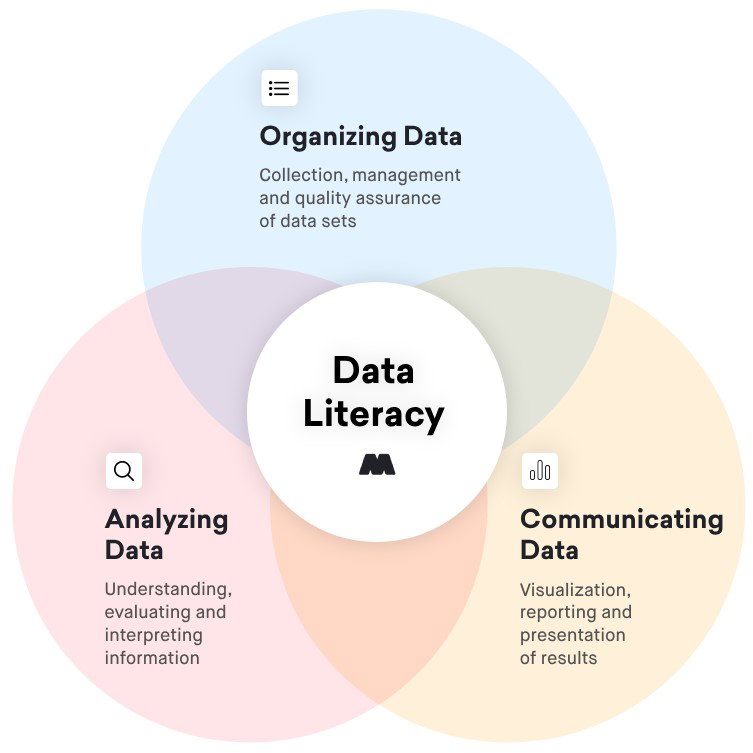
At a high level, data literacy is built on three core components:
-
Reading Data (Analysis)
Understanding charts, dashboards, and basic metrics without second-guessing what you’re seeing.
-
Interpreting Data (Organizing)
Recognizing and organizing patterns, trends, and outliers, and knowing what they might indicate.
-
Communicating Data (Information Exchange)
Explaining insights clearly so others can act on them.
This matters because misinterpretation is costly. Studies heading into 2026 show that poor data understanding leads to delayed decisions, internal misalignment, and missed opportunities, even when the right data is available.
In fact, many organizations report that employees spend more time arguing over numbers than acting on them. Strong data literacy fixes that by creating shared understanding, trust in metrics, and confidence in decision-making.
In short, these components turn data from a confusing asset into a practical business tool.
Now, understanding the skills behind data literacy is one thing, but why is it such a big deal? To answer that, we need to look at how data is shaping work, decisions, and technology.
Why Data Literacy Matters Today
Data literacy matters because decisions today are increasingly made with data, or at least claimed to be.
In 2026, data literacy is widely recognized as a business and workplace imperative, not just a buzzword. According to recent DataCamp research, 86% of leaders say data literacy is important for their teams’ day-to-day work, underscoring its role in day-to-day operations.
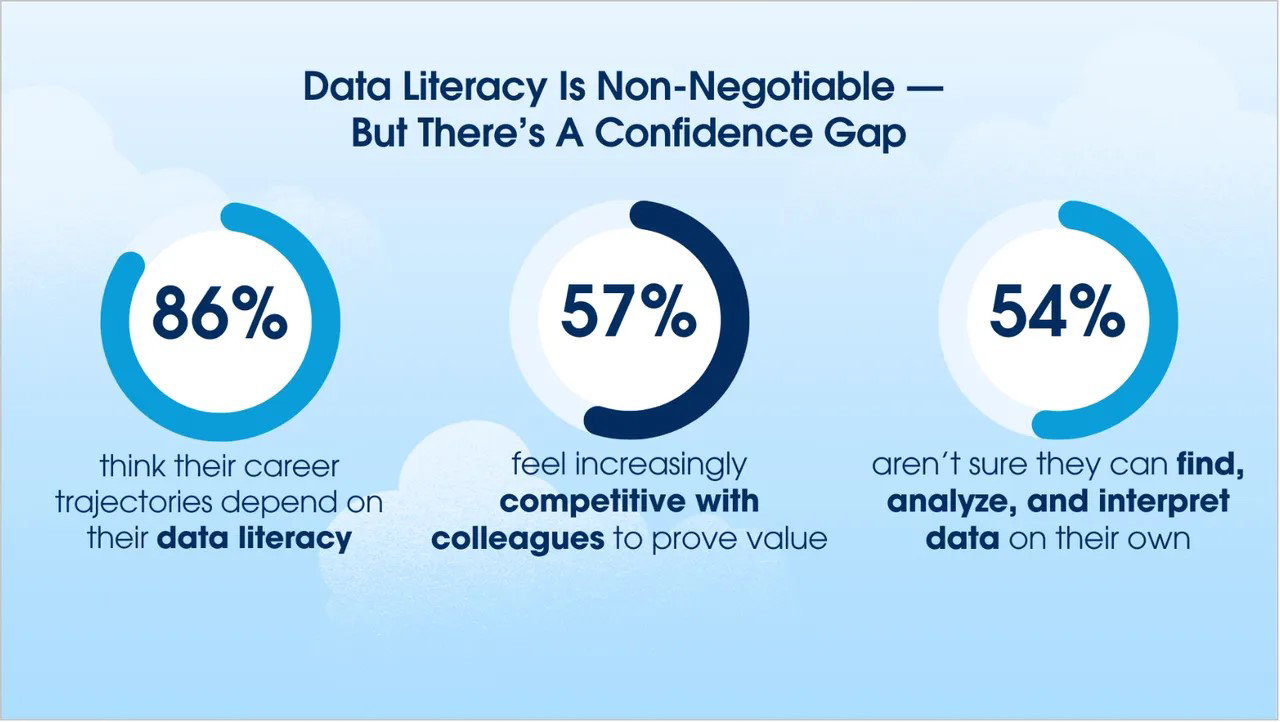
Despite this consensus, many organizations still face a gap: fewer than one in five employees feel confident in their data literacy, highlighting a significant barrier between having data and understanding it.
This gap matters because, in modern workplaces, employees are expected to interpret dashboards, question automated insights, and justify decisions with data, regardless of role or department. Data literacy enables these capabilities, turning information overload into meaningful action.
Now, the real value of data literacy becomes clear when we see how it is applied in everyday decision-making across industries.
Let’s see that next.
Topics For More Insights
Real-World Applications Of Data Literacy
Many high-performing organizations actively promote data literacy as a cultural principle rather than just a technical skill. Here are a few examples:
-
Netflix
The company empowers teams across content, product, and marketing to independently interpret viewer data. As former Netflix CEO Reed Hastings noted, the company focuses on enabling employees to make data-driven decisions rather than relying on top-down approvals.
-
Amazon
Amazon embeds data literacy into daily workflows. Teams are expected to justify decisions using metrics, experiments, and measurable outcomes, reinforcing their long-standing principle of being “customer obsessed” through data.
-
Airbnb
Airbnb invests heavily in internal data education to help non-technical teams understand dashboards and insights. Leaders have emphasized that shared understanding of data improves speed, trust, and alignment across the organization.
These examples show how data literacy enables faster decisions, clearer communication, and stronger accountability.
Now, if data literacy is so valuable, the obvious question follows. Why do so many organizations still struggle to build it at scale?
Let’s answer that next.
Common Challenges In Becoming Data Literate
Organizations face several recurring challenges when building data literacy at scale. Here’s how:
-
Lack Of Confidence With Data
Research cited by Gartner consistently highlights that many employees feel unsure about interpreting data, even when dashboards and reports are available.
-
Data Overload
Teams are often exposed to too many metrics at once. Without guidance, this leads to confusion, misinterpretation, or decision paralysis rather than clarity.
-
Poor Data Context
Numbers are often shared without explanations around data sources, assumptions, or limitations, making insights harder to trust.
-
Siloed Data Ownership
When data is seen as the responsibility of analysts or IT teams, non-technical employees hesitate to engage with it.
-
Tool-First Thinking
Organizations invest in analytics platforms but overlook training, storytelling, and decision-making skills.
Together, these challenges show why data literacy is a cultural shift, not a software upgrade.
Although the good news is that these challenges are not permanent. Organizations that treat data literacy as a skill to be built rather than assumed are already seeing measurable improvements.
Here’s how an organization can improve its data literacy skills.
How To Improve Data Literacy Skills
Improving data literacy starts with people, not platforms.
Research from McKinsey & Company shows that organizations that invest in data education alongside tools are far more likely to adopt data-driven decisions consistently.
Key approaches include:
-
Start With Questions, Not Tools
Teams that prioritize business questions are more effective than those trained solely on dashboards.
-
Make Data Training Role-Specific
PwC highlights that contextual training improves data confidence across non-technical roles.
-
Encourage Data Storytelling
Explaining insights in plain language builds trust and shared understanding.
-
Normalize Learning From Data Mistakes
Data-literate cultures reward curiosity, not just correct answers.
Together, these steps turn data literacy into a habit rather than a hurdle.
Conclusion
Data literacy is no longer a specialist skill reserved for analysts or technical teams. In 2026, it has become a foundational capability for anyone who works with information, makes decisions, or relies on digital tools.
As data continues to influence everything from business strategy to everyday choices, the ability to understand and question data is what separates confident decisions from educated guesses.
The organizations that succeed are not necessarily the ones with the most data, but the ones where people know how to use it responsibly. Building data literacy creates clarity, alignment, and trust, turning numbers into shared understanding rather than sources of confusion.
The good news is that data literacy is learnable. With the right mindset, training, and culture, anyone can develop it over time.
So, the next time a dashboard pops up, or a chart makes a bold claim, do not panic. Ask questions. Look for context. Remember, being data literate is not about knowing all the answers. It is about knowing how to find the right ones.
Frequently Asked Questions
How To Assess My Data Literacy Skills Using Online Tools?
You can assess your data literacy using online self-assessments, quizzes, and skill diagnostics offered by learning platforms and analytics vendors. These tools typically evaluate your ability to read charts, interpret insights, and apply data to real-world scenarios.
What Are The Core Components Of Data Literacy For Professionals?
For professionals, data literacy includes reading and interpreting data, evaluating accuracy and context, asking the right questions, and clearly communicating insights to support decisions across teams and business functions.
What Are The 5 Levels Of Data Literacy?
The five common levels are data awareness, data understanding, data interpretation, data application, and data-driven decision-making. Each level reflects increasing confidence in using data to explain insights, justify actions, and guide outcomes.
Wed, Feb 18, 2026

Enjoyed what you read? Great news – there’s a lot more to explore!
Dive into our content repository of the latest tech news, a diverse range of articles spanning introductory guides, product reviews, trends and more, along with engaging interviews, up-to-date AI blogs and hilarious tech memes!
Also explore our collection of branded insights via informative white papers, enlightening case studies, in-depth reports, educational videos and exciting events and webinars from leading global brands.
Head to the TechDogs homepage to Know Your World of technology today!
Disclaimer - Reference to any specific product, software or entity does not constitute an endorsement or recommendation by TechDogs nor should any data or content published be relied upon. The views expressed by TechDogs' members and guests are their own and their appearance on our site does not imply an endorsement of them or any entity they represent. Views and opinions expressed by TechDogs' Authors are those of the Authors and do not necessarily reflect the view of TechDogs or any of its officials. While we aim to provide valuable and helpful information, some content on TechDogs' site may not have been thoroughly reviewed for every detail or aspect. We encourage users to verify any information independently where necessary.
Loading comments...