Financial Technology
10-Minute Guide To Tax Automation Software
Share
Overview
Yet, by using intuitive Tax Automation Software, these challenges can be avoided. This tool helps manage local and federal tax calculations, automates reporting, processes tax returns and identifies changes to tax regulations for better tax compliance. There’s an automated tool for nearly everything today! Undoubtedly, the effect of using a Tax Automation Software is so noticeable that manual ways of managing taxes are no longer practical or effective. Instead, businesses rely on the comprehensive and adaptable approaches aided by Tax Automation Software.
If you’re evaluating whether your manual tax processes are too taxing (pun intended!), read on to know more about the Tax Automation Software.
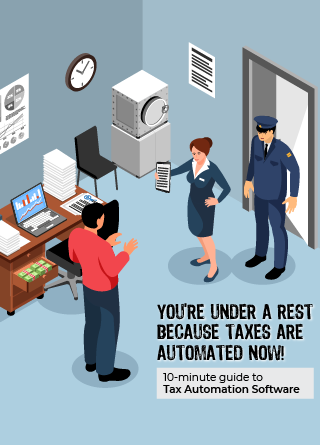
-01.png.aspx "TechDogs-You're Under A Rest Because Taxes Are Automated Now!-\"10-minute guide to Tax Automation Software\"")
What if we told you that Albert Einstein, one of the greatest physicists of all time, was no different than you?
We know you’d want to swell with pride but please note there’s no need. The similarity lies in struggling with taxes, not the IQ level. Taxes – the mere mention of the word causes many people to frown and others to purse their lips. That's where most of us are somewhat like modern-day Einsteins because the man who gave the world the Theory of Relativity once said, "The hardest thing in the world to understand is income tax!"
Most people look at taxes as a necessary evil that they must fend for every year. Some say you never know how much you earn till it’s time to pay taxes, while others say they pay just enough to not land in jail! Jokes aside, tax rules are often complicated and involve understanding hundreds of sections and slabs of legalities to categorize earnings.
“Thank God for Technology” (a mantra we repeat a few times every day!), for it has a solution for everything. Specially designed for managing and tracking taxes, Tax Automation Software (TAS) holds the key to conquering this necessary yet challenging task.
Join us as we unfold what Tax Automation Software is, how it works, its benefits and future!
What Is A Tax Automation Software (TAS)?
The name probably speaks for itself, Tax Automation Software aka TAS, is designed to automate tax filing processes for businesses. It is equipped with calculation algorithms (guidance for us unintelligent beings) that ensure we abide by government tax regulations, tax rate and declare our income within the stipulated timeline.
Now here’s something important – in addition to individual taxpayers, businesses too need to file their income taxes and they need to pay special attention to accuracy given the volume of their expenses and earnings. Considering all transactions, manual processes can become too time-taking and error-prone.
As such, a TAS can help organizations achieve three key value propositions – greater precision, efficiency gains and cost reductions.
All in all, a TAS is like the Infinity Gauntlet to Thanos - every taxpayer can wipe away tax problems with the click of their fingers (or the click of a few buttons in this case!).
Let's take a look at how Tax Automation Software evolved.
History Of Tax Automation Software
Before the advent of tax software, most activities revolving around the computation and filing of taxes involved manual and repetitive work like data entry, verification and report generation. Thus, the primary aim of using computers was to automate such repetitive manual work. That’s when computers that supported form-filling applications started becoming commonplace in tax filing offices. #ThanksTechnology
Holding true to the saying, one is never satisfied with what he has, people wanted more ease of work and accuracy from this software. So, after years of research and development, advanced algorithms, which could mimic accounting and taxing tasks without any taxation knowledge, were launched. However, the problem persisted (refer to the saying above). While such algorithms were easy to create, they weren’t smart. Human supervision was still needed to ensure the applications were working as expected when it came to tax compliance.
This is where the need for true computational intelligence cropped up. Software needed to become intelligent enough to require human intervention only in the rarest cases. So again, after tons of technical research and trials, a new breed of taxation applications was developed which made use of Machine Learning to “think” and “learn.” Also called RPA 2.0 (Robotic Process Automation 2.0), this breed of applications could learn how to perform tasks by relying on their understanding of patterns and inference.
It’s this kind of Tax Automation Software that we commonly encounter today to achieve a high degree of accuracy and speed. Well, how do its wheels roll? How do such programs actually work? Let’s find out in the next section.
How Do Tax Automation Software Work?
.gif.aspx "tax-day-taxes-due-(2).gif")
To understand the automation process for taxes, we need to first understand the basics of the taxation process. For this, imagine you’ve roped in a new tax automation tool for filing your taxes. You’d obviously need to input your income and expenses over the past year into the software, right? Once you’ve done this, however, you’ll expect the software to make all the computations for you without you having to lift a finger.
Well, there’s nothing wrong with that expectation. Only, the tax software will need to possess a few critical pieces of information:
-
Geographical locations (aka zip codes or geocodes)
To analyze which region you’re filing your taxes from; it is necessary for the software to know your zip code. Since different countries and different states have different tax rules and slabs, the tool picks the appropriate method based on your location.
-
All taxability rules
A online directory of every type of tax applicable in all geocodes supported by the software will help it to identify the specific tax rates applicable to your country and income slab.
Moving on, the gist of how it would work is this – once you have a summary of your income/ expense, depending on your geographical location the slab in which your income falls and the rules applicable to your state/ country, the tool will compute your tax amount automatically, accurately (and probably within a few minutes!).
That’s not all! It will also assist you in filing the tax by auto filling in the necessary forms and prompting you to upload the necessary documents along with your tax form submission. Now if that isn’t the very definition of “easy peasy lemon squeezy,” we don’t know what is!
The above description of working applies to individual taxpayers as well as enterprises. Although businesses might need to upload more forms, expense sheets and reports, the working remains the same. Moreover, a few tools enable businesses to calculate taxes for businesses operating in multiple locations simultaneously by uploading the relevant expense/ income reports for each location.
Yes, we know that’s an awesome feature - here are some more!
Key Features Of A Tax Automation Software
Here’s a quick look at a few of the primary features any tax automation tool should possess:
-
Location Awareness For Correct Tax Assessment
We do hope you were paying attention when we were talking about geocodes above! Without the correct local taxation rates and applicable rules, the tool won’t be able to accurately process and calculate the due taxes.
-
Reporting And Audit Trail
The software should provide clear records of current and historical filings, so that reports can be generated for internal auditing purposes.
-
Zero Dependency On Manual Work
The tool should be able to complete the taxation process with no need for manual checks, paperwork or stamps. That’s what we call true automation!
-
Integration Capabilities
Every Tax Automation Software should support integration with third-party accounting systems, Enterprise Resource Planning (ERP) systems and other Ecommerce platforms, so bottlenecks can be eliminated and taxation processes can become more streamlined.
-
Inbuilt Auto-Updates
Depending on frequently changing taxation laws, the software should be able to adapt itself to file taxes as per the “current” applicable taxation for every transaction.
Of course, the list doesn’t end there but for a tool to stand apart from its competitors, it should have the above-mentioned features. After knowing these awesome features of tax automation solution, it’s time to figure out how these features actually help businesses. Let’s go!
What Benefits Does Tax Automation Software Bring To The Table?

We’re sure you must have realized that the biggest advantage is the automation of previously manual tasks – this reduces the time, effort and resources used. However, we’ve compiled a list of other tangible benefits that Tax Automation Software can offer you.
-
Improved Operational Efficiency
One of the biggest benefits of tax automation is that it saves your time. No more making your accountants sit down for unbearable hours at the fiscal year’s end! Moreover, it eliminates the chances of errors and penalties (read: pesky humans make mistakes!). There’s no chance of calculation mistakes with an automated tool.
-
Ease Of Maintenance And Business Enablement
This application brings in more flexibility and gives you better control over taxation while adapting to changing business needs.
-
Audit Trail
It provides you with an accurate audit trail that allows you to find and share details of any transaction quickly with external or internal auditors.
-
Better Data Visibility
The software provides better control and insights into your financial data. This helps your company in planning and knowing where your tax liabilities lie and how to accurately reduce or eliminate them.
We’re sure you are thinking of investing in a TAS for yourself, aren’t you? Well, good for you. This software won’t just help your current business practices but will have major implications for the future of accounting and taxation – read on!
Future Of Tax Automation Software
The global tax automation market is on a boom and is expected to cross the $33.6 billion mark by 2030. Experts predict that we will see new ways in which businesses will use this software in the coming years for higher automated efficiency.
These tools will soon extract financial data from diverse sources like fixed asset systems, ERP software and other enterprise systems. They will then convert all extracted data into centralized and automated processes. This will give businesses visibility into the complete filing process without any human intervention. Moreover, the tools in the future will automatically send alerts regarding disparities in tax returns - and even provide a suitable form to rectify or report them. How cool is that, like having your very own tax manager?
Summing It Up
Tax Automation Software can make your life easier by simplifying document filing, computation and adherence to tax compliance rules. They’re already being used by several organizations and individuals globally to streamline the taxation process. When such software is efficient enough to eliminate errors and speed up manual work, why would you still want to do it all yourself?
Frequently Asked Questions
What is Tax Automation Software (TAS), and why do businesses need it?
Tax Automation Software, or TAS, is a specialized tool designed to automate tax filing processes for businesses. Equipped with calculation algorithms, TAS ensures compliance with government tax regulations and helps individuals and organizations declare their income accurately within the stipulated timeline. TAS is essential for businesses to manage their taxes efficiently, especially considering the complexity of tax rules and the volume of transactions. By automating tax processes, TAS offers greater precision, efficiency gains, and cost reductions, making it a valuable tool for businesses of all sizes.
How did Tax Automation Software evolve?
Before the advent of tax software, tax-related activities involved manual and repetitive work, such as data entry and report generation. The introduction of computers aimed to automate these tasks, but early solutions lacked sophistication. Over time, advanced algorithms were developed to mimic accounting and taxing tasks without human intervention. However, these solutions still required human supervision to ensure compliance. With the emergence of Machine Learning and Robotic Process Automation (RPA 2.0), a new breed of taxation applications was developed. These applications leveraged AI to learn and perform tasks autonomously, resulting in higher accuracy and speed. Today, Tax Automation Software utilizes intelligent algorithms and automation to achieve a high degree of accuracy and efficiency in tax-related processes.
How does Tax Automation Software work?
Tax Automation Software works by automating the computation and filing of taxes based on the user's input of income and expenses. The software utilizes geographical locations and taxability rules to calculate taxes accurately. By analyzing income, expenses, and applicable tax rates, the software computes the tax amount automatically within minutes. It also assists users in filling out tax forms and uploading necessary documents for submission. Whether for individual taxpayers or enterprises, Tax Automation Software streamlines the tax process, eliminating manual checks and paperwork. With features such as location awareness, reporting capabilities, and integration with third-party systems, TAS ensures efficient and accurate tax management for businesses.
Thu, Aug 18, 2022

Enjoyed what you read? Great news – there’s a lot more to explore!
Dive into our content repository of the latest tech news, a diverse range of articles spanning introductory guides, product reviews, trends and more, along with engaging interviews, up-to-date AI blogs and hilarious tech memes!
Also explore our collection of branded insights via informative white papers, enlightening case studies, in-depth reports, educational videos and exciting events and webinars from leading global brands.
Head to the TechDogs homepage to Know Your World of technology today!
Disclaimer - Reference to any specific product, software or entity does not constitute an endorsement or recommendation by TechDogs nor should any data or content published be relied upon. The views expressed by TechDogs' members and guests are their own and their appearance on our site does not imply an endorsement of them or any entity they represent. Views and opinions expressed by TechDogs' Authors are those of the Authors and do not necessarily reflect the view of TechDogs or any of its officials. While we aim to provide valuable and helpful information, some content on TechDogs' site may not have been thoroughly reviewed for every detail or aspect. We encourage users to verify any information independently where necessary.
Loading comments...