
OpenAI is expanding ChatGPT’s role in financial and spreadsheet workflows by launching a new Excel add-in and introducing integrations with major financial data providers.
The updates are designed to help analysts build models, run scenarios, and conduct research faster using AI directly within familiar tools.
TL;DR
- OpenAI introduced ChatGPT for Excel in beta, embedding AI directly into spreadsheets for modeling, analysis, and formula generation.
- The feature is powered by GPT-5.4, a model optimized for financial reasoning and Excel workflows.
- ChatGPT now integrates with financial data providers such as Dow Jones Factiva, MSCI, and Moody’s.
- The updates aim to reduce manual work and accelerate financial analysis, research, and due diligence tasks.
ChatGPT For Excel Brings AI-Driven Spreadsheet Modeling And Analysis
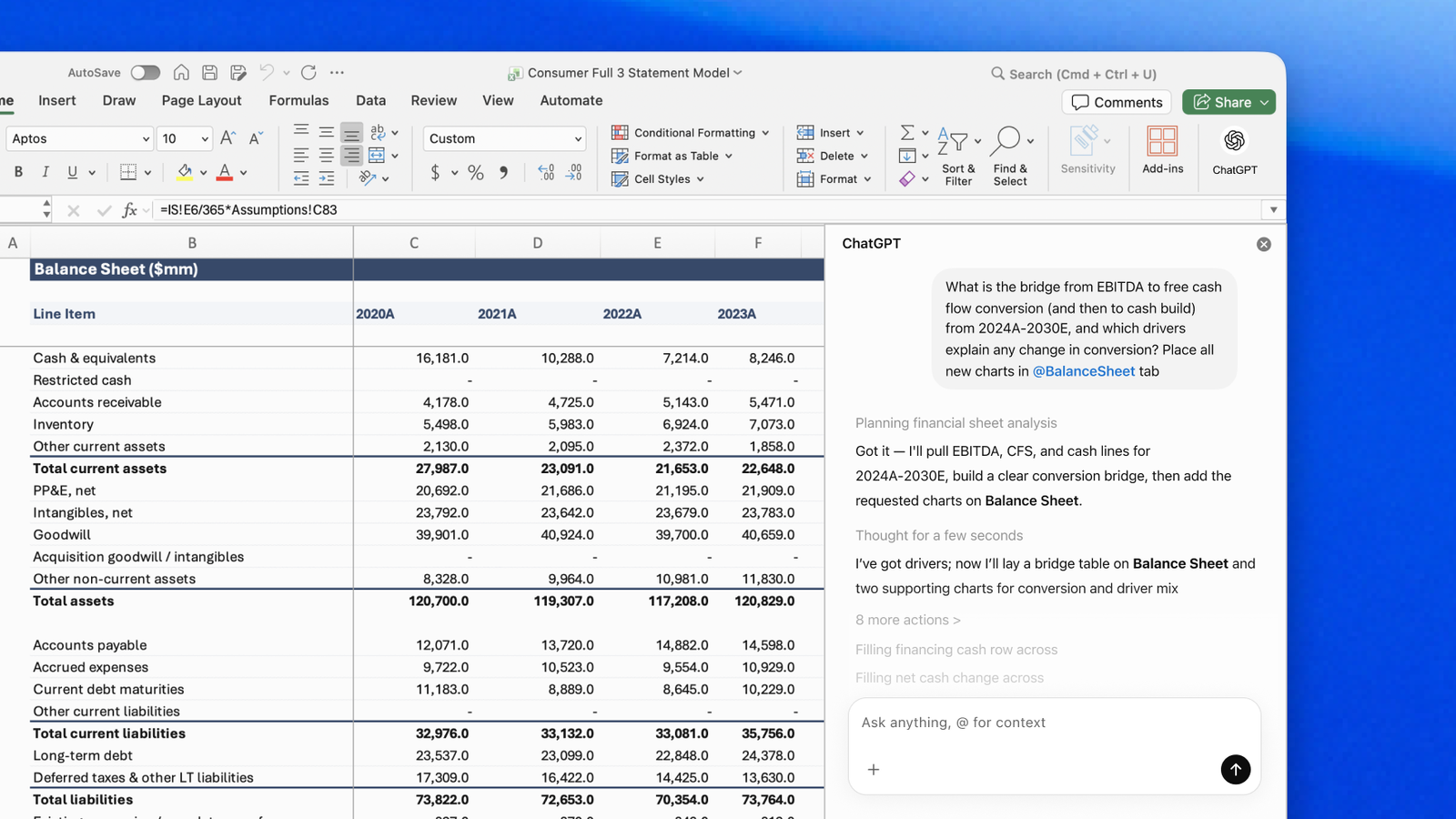
OpenAI introduced ChatGPT for Excel in beta, a new add-in that embeds ChatGPT directly inside Excel workbooks to help users build, update, and analyze spreadsheet models.
Powered by the newly launched GPT-5.4, the tool allows analysts, researchers, accountants, and strategists to interact with spreadsheets using plain language instead of manually writing formulas or restructuring models. The goal is to reduce repetitive tasks while enabling teams to focus more on interpretation and decision-making.
Instead of manually constructing spreadsheet models or running scenario analysis, users can describe what they want in natural language. ChatGPT can then generate or modify live models directly in the workbook while preserving the structure, formulas, and assumptions already in place.
The system can also analyze large spreadsheets and trace relationships between sheets, formulas, and outputs. This allows users to understand how results were generated, identify errors, and track how assumptions influence calculations across the workbook.
For teams inheriting legacy spreadsheets or complex templates, the assistant can help explain how the model works and why certain outputs change. Since calculations run directly in Excel, users can verify formulas, audit assumptions, and confirm how results were produced.
To maintain control, ChatGPT requests permission before making changes to a workbook, allowing users to review edits and undo them if needed.
GPT-5.4 Targets Financial Modeling And Spreadsheet Workflows
The Excel integration is powered by the newly launched GPT-5.4, a model optimized for financial reasoning and spreadsheet-based modeling tasks.
The model is available in ChatGPT, Codex, and the API, and has been trained to perform tasks commonly required by finance professionals. These include financial modeling, scenario analysis, extracting data from documents, and producing long-form research outputs.
According to OpenAI, the model was refined using real-world financial workflows that analysts often spend hours or days completing. The aim is to strengthen the model’s ability to interpret financial data, reason through calculations, and produce structured analysis.
By improving these capabilities, GPT-5.4 is designed to assist teams working with complex financial models and large datasets, enabling them to run scenarios, test assumptions, and generate reports more quickly.
ChatGPT for Excel is currently rolling out to ChatGPT Business, Enterprise, Edu, Teachers, Pro, and Plus users in the United States, Canada, and Australia. In Enterprise, Edu, and Teacher environments, access is disabled by default and can be enabled by administrators using role-based permissions.
A similar integration for Google Sheets is expected to follow.
Financial Data Integrations Expand ChatGPT’s Research Capabilities
Alongside the Excel launch, OpenAI is also introducing new financial data integrations that bring trusted market and company information directly into ChatGPT.
The integrations include providers such as Moody’s, Dow Jones Factiva, MSCI, Third Bridge, and MT Newswire, with FactSet support planned for the near future.
These connectors allow users to combine proprietary financial datasets with ChatGPT’s reasoning capabilities within a single workflow. Instead of switching between platforms to gather inputs, analysts can access market data, company information, and internal datasets from within ChatGPT.
This unified workflow enables users to generate outputs such as earnings summaries, valuation snapshots, and credit memos with citations tied to the underlying sources.
Topics For More Insights
New Research Tools Help Teams Conduct Due Diligence Faster
The platform’s research capabilities are also expanding with tools designed for financial analysis and due diligence.
Teams can use ChatGPT to pull information from filings, earnings transcripts, presentation decks, and spreadsheets to produce structured reports. These reports can then be exported to formats such as PDF or Microsoft Word.
Recent updates also provide more control over the research process. Users can select specific websites and datasets to focus on, shape the research plan before starting a task, and review sources and citations through a redesigned workspace.
OpenAI says it is already working with financial institutions using ChatGPT across workflows such as investment research, underwriting, auditing, operations, and client engagement. As adoption grows across banks, asset managers, and insurance companies, the company expects to continue refining the platform based on how organizations deploy AI in real-world financial operations.
