

Computing
What Is Meta Rebalancer? How To Optimize Task Placement At Scale
Share
TL;DR
-
Meta Rebalancer is an open-source optimization library designed to distribute computing tasks and resources efficiently across large-scale systems.
-
Meta Rebalancer analyzes task requirements, server capacities, and operational constraints to identify better workload assignments and prevent resource overload.
-
It combines high-performance C++ processing, Python support, and flexible optimization methods to solve complex assignment problems.
-
Businesses can use Meta Rebalancer to balance workloads, improve server utilization, optimize distributed clusters, and manage computing resources more effectively.
-
Meta open-sourced Rebalancer in September 2026 under the Apache 2.0 license, making its resource optimization technology available to developers worldwide.
Introduction
Remember the chaos from the series The Bear, where Carmy Berzatto and his team struggle to keep a busy Chicago kitchen running smoothly? With orders piling up, chefs juggling responsibilities, and everyone working against the clock, even the smallest misstep can throw the entire operation into chaos. The secret to keeping things moving? Making sure the right people handle the right tasks at the right time.
Now, imagine a similar challenge unfolding inside massive data centers, where millions of computing tasks compete for limited server resources. Assign too many tasks to one server, and performance suffers. Spread them inefficiently, and valuable computing power goes to waste.
That's where Meta Rebalancer enters the picture!
In September 2026, Meta open-sourced Rebalancer, a high-performance optimization library that had been helping manage resource allocation across its infrastructure for over nine years. Designed to solve complex assignment problems, it helps developers identify more efficient ways to distribute tasks while respecting resource limitations.
So, what is Meta Rebalancer, how does it optimize task placement at scale, and why should businesses care?
What Is Meta Rebalancer?
Meta Rebalancer is an open-source optimization library that helps organizations distribute tasks and resources efficiently while meeting operational requirements.
At its core, Rebalancer solves what computer scientists call an assignment problem. Simply put, it determines which task should go where, considering factors such as available capacity, resource requirements, and performance goals.
For example, imagine a company operating 100 servers that handle thousands of applications. Some servers might be overloaded while others have unused capacity.
Instead of manually deciding where every application should run, Rebalancer evaluates available resources and identifies a more efficient distribution.
The library is written primarily in C++ for high-performance processing, with Python bindings that make it accessible to developers. It also supports different optimization techniques depending on the problem's complexity.
Unlike a traditional scheduling tool, however, Rebalancer doesn't execute tasks or automatically manage servers. It calculates recommended assignments that other systems can implement.
This distinction becomes important when understanding how Meta Rebalancer task placement actually works.
How Does Meta Rebalancer Work?
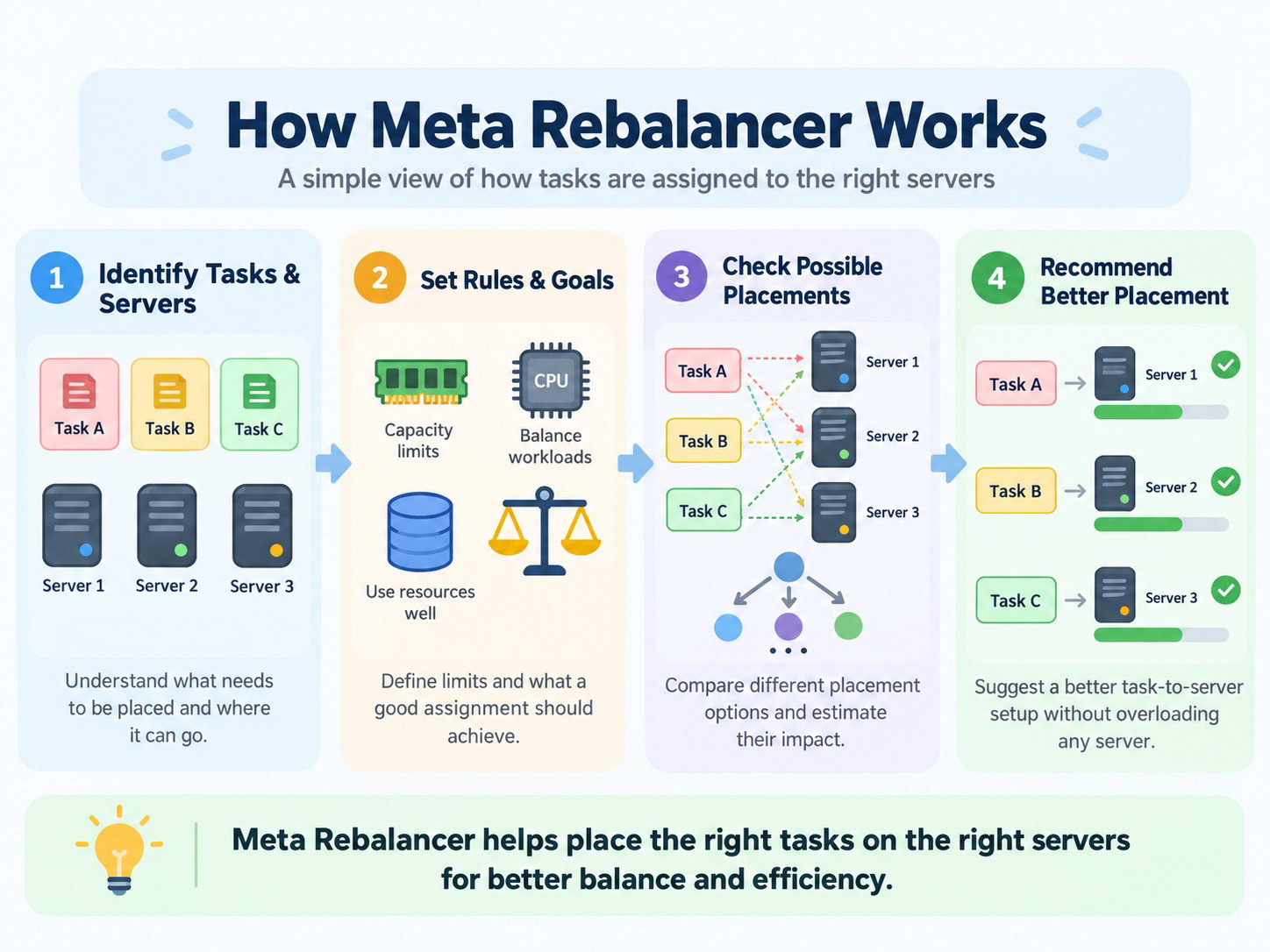
Meta Rebalancer approaches resource allocation by breaking a complicated problem into smaller, manageable decisions.
Rather than requiring developers to build mathematical optimization models from scratch, it provides a reusable framework for describing resources, limitations, and desired outcomes.
Here's how the process works.
-
Identify Tasks And Available Resources
First, Rebalancer needs to understand what must be assigned and where it can be placed.
In a distributed computing environment, tasks are considered objects, while the servers receiving those tasks are called containers.
Each task might require a certain amount of memory, processing power, or storage. Similarly, every server has limits on how much it can handle. -
Define Constraints And Goals
Next, users establish rules for the assignment process.
Constraints represent requirements that should not be violated, such as preventing a server from exceeding its memory capacity.
Goals describe desirable outcomes, such as balancing workloads, reducing unnecessary task movement, or improving resource utilization.
Think of constraints as the rules of a game and goals as the strategy for winning it. -
Evaluate Possible Assignments
Once the requirements are defined, Rebalancer translates them into an internal representation called an expression graph.
This allows the system to evaluate different task placements and understand how each potential change affects overall performance.
For larger problems, it can examine promising adjustments without having to calculate every possible arrangement. -
Generate An Optimized Placement
Finally, Rebalancer searches for a better assignment while respecting the defined rules.
It can start with an existing task distribution and recommend changes that improve the desired outcome.
The result is a suggested placement that balances operational requirements with optimization goals.
Of course, how Rebalancer finds that placement depends on the optimization method and inherent features.
What Are The Key Features Of Meta Rebalancer?
Meta Rebalancer combines several capabilities that make it suitable for complex resource allocation challenges.
-
High-Performance Optimization
Rebalancer is designed to handle large-scale assignment problems. Its local search approach can work with millions of objects, making it particularly useful for spatial computing environments.
-
Two Optimization Approaches
Rebalancer supports two major solving methods:
Local Search Solver: Iteratively improves an existing assignment by evaluating potential changes. It works well for large problems but doesn't guarantee the mathematically best solution.
Optimal Solver: Uses mixed-integer programming to find a provably optimal solution when feasible. It's generally better suited to smaller problems because of its computational requirements. -
Flexible Resource Constraints
Developers can define requirements involving CPU, memory, storage, server placement, and other resources.
This flexibility allows the same framework to support different infrastructure configurations. -
Python And C++ Support
The Meta Rebalancer Python interface helps developers build optimization models without working directly with the underlying C++ implementation.
Meanwhile, C++ provides the performance needed for demanding workloads. -
Rebalancer Explorer
The library includes a debugging interface called Rebalancer Explorer.
It helps developers investigate why particular assignments were selected, identify restrictive constraints, and explore how changing requirements could affect results.
Together, these features make Rebalancer useful beyond individual task placement decisions.
How Do You Use Meta Rebalancer For Task Placement In Distributed Clusters?
To understand how Meta Rebalancer task placement works in practice, consider a distributed cluster containing four servers and 12 computing tasks. Initially, most tasks might be concentrated on one server, creating performance bottlenecks while other servers remain underutilized.
Rebalancer can help identify a more balanced arrangement. Here's a simplified process for getting started.
-
Install Meta Rebalancer
Developers can find the project in the Meta Rebalancer GitHub repository and install its Python package using 'pip install rebalancer.'
Package compatibility and supported environments should be checked before installation. -
Create A Task Placement Model
Next, define the tasks, available servers, and current assignments. For example, each task might require 10 units of memory, while each server supports a maximum of 30 units. These details help Rebalancer understand which assignments are possible.
-
Set Optimization Rules
Developers can specify objectives such as distributing memory usage evenly and preventing servers from exceeding capacity. They can also add placement restrictions when certain tasks must remain together or be separated.
-
Run The Solver And Review Results
After configuring the model, developers select an optimization method and run the solver. Rebalancer then returns a recommended task-to-server assignment.
Teams can review the results, validate resource requirements, and integrate the proposed changes into their infrastructure management workflows.
The crucial point is that Rebalancer identifies improved assignments, while the surrounding infrastructure handles their implementation. This makes it ideal for multiple use cases.
Where Can Meta Rebalancer Be Used?
Although Meta Rebalancer was developed for large-scale infrastructure, its assignment-based approach can support several applications.
| Use Cases | How Rebalancer Helps |
| Data Center Management | Distributes workloads while considering server capacity and infrastructure restrictions. |
| Cloud Computing | Identifies resource placements that can improve utilization and workload balance. |
| AI And Machine Learning | Helps allocate training workloads across available computing resources. |
| Network Traffic Management | Supports traffic assignment decisions involving network load and routing requirements. |
| IT Operations | Can assist with assigning support tickets or operational tasks based on defined rules. |
| Business Resource Planning | Can model assignments involving meeting rooms, desks, or other limited resources. |
These possibilities demonstrate that the underlying challenge isn't exclusive to technology infrastructure. Whenever limited resources must be distributed among competing demands, assignment optimization can become valuable.
However, using Rebalancer effectively also requires understanding its merits and demerits.
What Are The Benefits And Limitations Of Meta Rebalancer?
The biggest advantage of Meta's open-source Rebalancer is its ability to make complicated resource allocation problems easier to model and optimize. Organizations can potentially reduce manual assignment work, improve resource utilization, and adapt optimization rules as their needs evolve.
Topics For More Insights:
Its production history also provides useful evidence of its capabilities. At the time of its September 2026 release, Meta reported using Rebalancer to solve approximately 40 million assignment problems daily, across more than 30 different problem formulations.
However, there are some critical considerations. Rebalancer isn't a plug-and-play cloud management platform. Developers must understand their workloads, define appropriate constraints, and connect its recommendations to operational systems.
Additionally, its local search method prioritizes practical improvements rather than guaranteeing the best possible mathematical solution.
Poorly defined constraints can also produce results that don't reflect real-world operational needs. Therefore, while Rebalancer provides a powerful optimization foundation, successful deployment still depends on careful configuration, testing, and monitoring.
Conclusion: The Future Of Resource Optimization With Meta Rebalancer
As cloud environments expand and AI workloads become more demanding, efficient resource allocation is becoming increasingly important. Meta Rebalancer offers developers a flexible way to address this challenge without building an optimization framework entirely from scratch.
Its combination of scalable algorithms, customizable constraints, Python accessibility, and debugging capabilities could make sophisticated assignment optimization more approachable for organizations.
More importantly, Meta's decision to open-source the technology under the Apache 2.0 license creates opportunities for developers to improve and adapt it. Ultimately, Meta Rebalancer isn't about making every computing task faster.
It's about helping organizations make better decisions about where those tasks belong. And when thousands or millions of assignments are involved, even small improvements in those decisions can make a meaningful difference.
Frequently Asked Questions
What Is Meta Rebalancer Used For?
Meta Rebalancer is used to optimize how tasks and resources are assigned to available containers, such as servers. It helps organizations balance workloads, respect resource limits, and improve assignment decisions across complex computing environments.
Is Meta Rebalancer Available On GitHub?
Yes. Meta Rebalancer is an open-source project available on GitHub under the Apache 2.0 license. Developers can explore its code, documentation, examples, and Python integration to build customized assignment optimization solutions.
Can Meta Rebalancer Automatically Optimize Distributed Clusters?
Meta Rebalancer can calculate optimized task placements for distributed clusters, but it doesn't independently manage cluster operations. Developers must integrate its recommendations with systems that deploy, move, or manage workloads.
Fri, Oct 16, 2026

Liked what you read? That’s only the tip of the tech iceberg!
Explore our vast collection of tech articles including introductory guides, product reviews, trends and more, stay up to date with the latest news, relish thought-provoking interviews and the hottest AI blogs, and tickle your funny bone with hilarious tech memes!
Plus, get access to branded insights from industry-leading global brands through informative white papers, engaging case studies, in-depth reports, enlightening videos and exciting events and webinars.
Dive into TechDogs' treasure trove today and Know Your World of technology like never before!
Disclaimer - Reference to any specific product, software or entity does not constitute an endorsement or recommendation by TechDogs nor should any data or content published be relied upon. The views expressed by TechDogs' members and guests are their own and their appearance on our site does not imply an endorsement of them or any entity they represent. Views and opinions expressed by TechDogs' Authors are those of the Authors and do not necessarily reflect the view of TechDogs or any of its officials. While we aim to provide valuable and helpful information, some content on TechDogs' site may not have been thoroughly reviewed for every detail or aspect. We encourage users to verify any information independently where necessary.
Loading comments...