

Artificial Intelligence
Meta Unveils Muse Wonder Models To Rival OpenAI And Anthropic
Share
TL;DR
-
Both models combine Active Memory, Active Focus, computer use and long-running agent capabilities.
-
Muse Wonder is available through the Meta Model API and Muse Code, while Wonder Full is limited to paid Muse Code plans.
-
Wonder Full leads several published agentic and long-horizon coding benchmarks, including DeepSWE and SWE-Marathon.
-
It does not dominate every test, with Claude Opus 5.5 and GPT-6 Astra leading some categories.
-
OpenAI o3 is no longer the most relevant comparison because Meta benchmarks Wonder against newer frontier models.
Introduction
Meta’s AI story has had a little Rocky energy lately. After falling behind the frontier-model conversation, Meta has stepped back into the ring with two new contenders.
On October 12, 2026, Meta introduced Muse Wonder and Muse Wonder Full, calling them its most capable AI models yet. Built for personal and professional agents, they target coding, computer use, memory and long-running work.
More importantly, Meta is comparing them directly with OpenAI’s GPT-6 Astra and Anthropic’s Claude models. So, what is Meta Muse Wonder, what separates Wonder from Wonder Full and do the results really put Meta back beside its biggest rivals?
What Is Meta Muse Wonder?
Meta Muse Wonder is a proprietary frontier-model family designed for agents that need to reason, remember context, operate computers and stay on difficult tasks for longer. Both models build on Muse Spark but shift from lightweight assistance toward work spanning tools, files or hours.
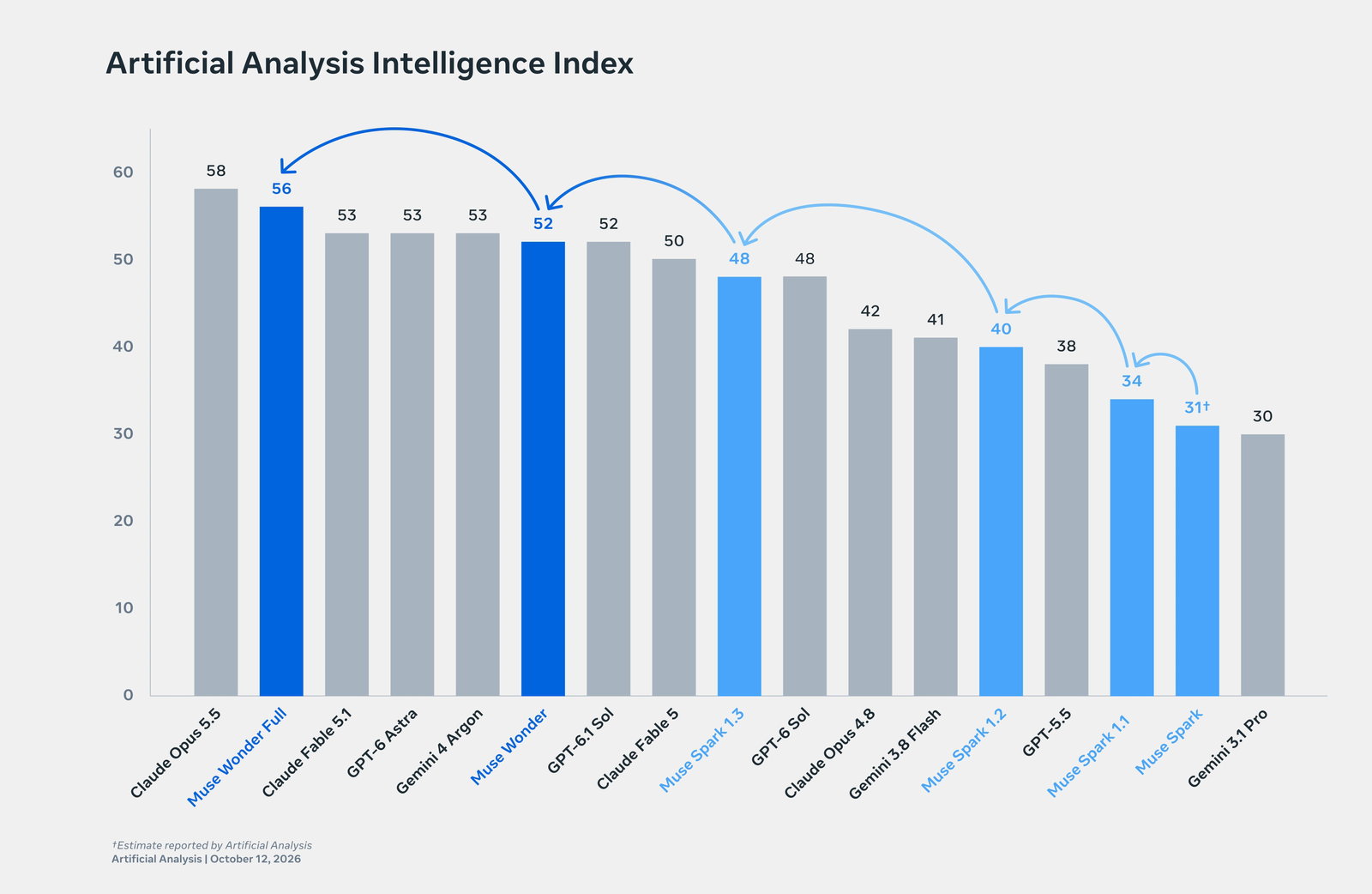
Meta highlights four core capabilities:
-
Active Memory carries useful context across conversations.
-
Active Focus helps the model persist, retry and recover from errors.
-
Long-running agents can plan, delegate subtasks and call tools in parallel.
-
Advanced computer use supports browsers, desktop software and mobile apps.
Both models support multimodal input and a one-million-token context window.
What Are The Key Differences Between Meta Muse Wonder And Muse Wonder Full?
Muse Wonder is available through the Meta Model API and Muse Code at $4 per million input tokens, $0.20 per million cached input tokens and $20 per million output tokens.
Muse Wonder Full is the higher-capability variant. It is not offered through the standard Model API and is available through Muse Code on the Power Usage and Maximum Usage plans.
The split is simple:
-
Muse Wonder offers broader API and coding access.
-
Wonder Full targets heavier, long-running coding workflows.
-
Both use Active Memory, Active Focus and the same one-million-token context window.
Wonder Full is a separate model, not simply Muse Wonder running at maximum reasoning. Meta’s own developer documentation explicitly distinguishes the two variants and their access methods.
How Strong Are Meta Muse Wonder Full Benchmarks?
Meta compared the Wonder models with GPT-6 Astra, Claude Fable 5.1 and Claude Opus 5.5. The results support frontier status, especially in agentic coding, but Meta does not win everywhere.
Wonder Full leads DeepSWE, SWE-Marathon, Harvey LAB-AA and AutomationBench here. Claude Opus 5.5 remains ahead on HealthBench Pro and Terminal-Bench, showing why model choice remains workload-dependent.
On the Artificial Analysis Intelligence Index, Wonder Full scores 56 and Wonder 52, versus 58 for Claude Opus 5.5 and 53 for GPT-6 Astra.
| Benchmark | Wonder Full | Wonder | GPT-6 Astra | Claude Opus 5.5 |
| Harvey LAB-AA | 13.1 | 10.0 | 8.6 | 4.2 |
| AutomationBench-AA | 45.4 | 39.1 | 41.6 | 41.2 |
| DeepSWE 1.1 | 79.0 | 78.8 | 74.1 | 74.2 |
| SWE-Marathon | 57.5 | 53.1 | 42.5 | 46.3 |
| HealthBench Pro | 62.3 | 60.5 | 65.3 | 65.6 |
| Terminal-Bench 4.0-AA | 57.1 | 52.0 | 59.1 | 59.6 |
Wonder Full leads DeepSWE, SWE-Marathon, Harvey LAB-AA and AutomationBench here. Claude Opus 5.5 remains ahead on HealthBench Pro and Terminal-Bench, showing why model choice remains workload-dependent.
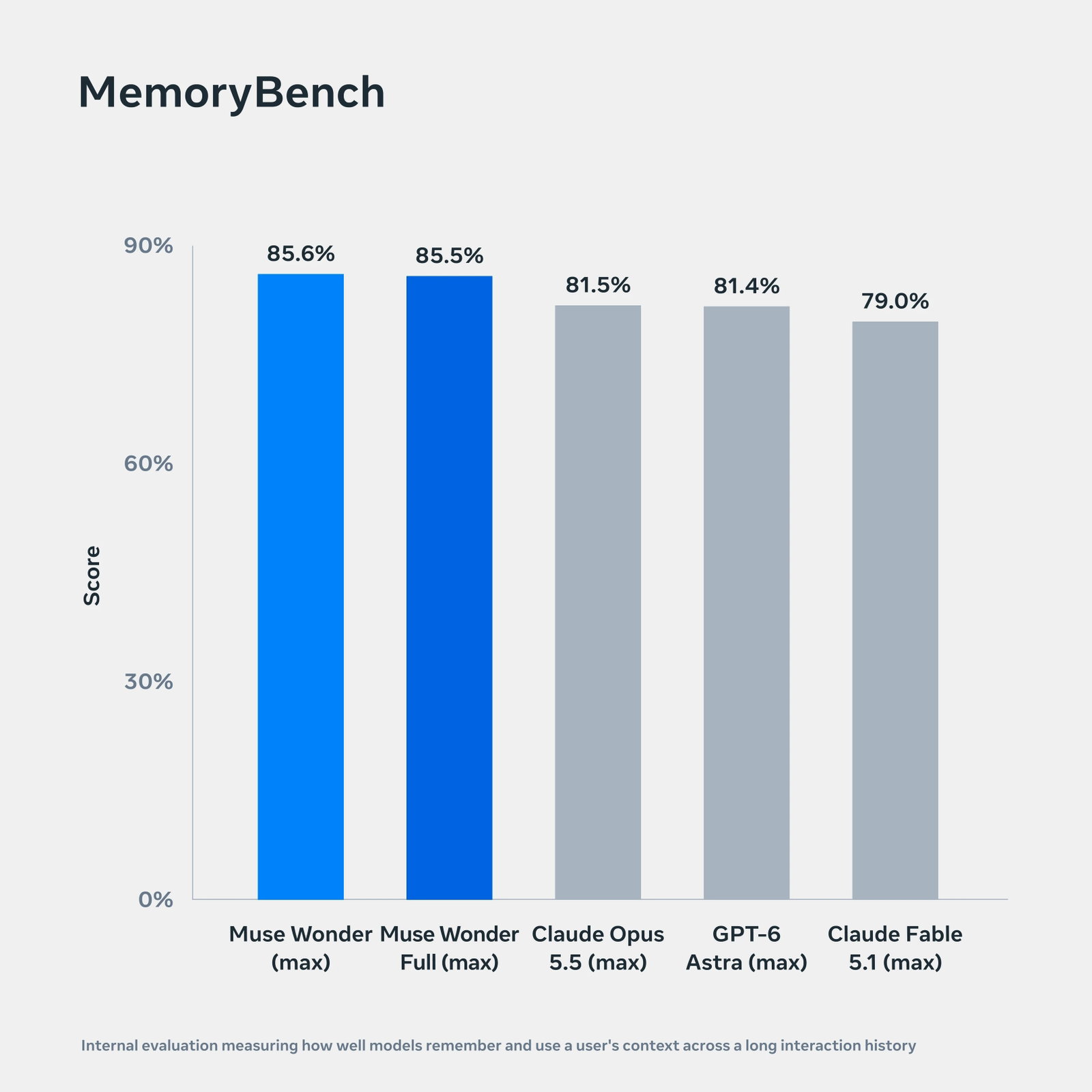
On the Artificial Analysis Intelligence Index, Wonder Full scores 56 and Wonder 52, versus 58 for Claude Opus 5.5 and 53 for GPT-6 Astra.
What Are Meta Muse Wonder’s Agentic Coding Capabilities?
Meta Muse Wonder’s agentic coding capabilities go beyond generating code snippets. Wonder can work across repositories, modify multiple files, verify changes, delegate tasks to sub-agents and recover from failed approaches.

Meta demonstrates the model building a playable 3D kitchen game from image inputs and provides developer patterns for multi-agent orchestration, GitHub agents and computer use. Meta’s developer resources also position the family around long-running software workflows.
That is why DeepSWE and SWE-Marathon matter: they test longer software-engineering loops involving inspection, changes, testing and recovery rather than one-shot code generation.
What Do Active Memory And Active Focus Actually Add?
Active Memory preserves useful context across conversations, while Active Focus helps Wonder persist, change approaches, recover from errors and ask for clarification when needed.
Together, they support Meta’s broader idea of personal superintelligence: an AI that remains useful across ongoing work rather than treating every prompt as an isolated task.
The distinction matters for agentic AI. A model can produce an impressive answer once and still struggle as an assistant if it forgets earlier decisions or abandons a task when the first approach fails.
Meta Muse Wonder Vs OpenAI o3: Is That Still The Right Comparison?
The Meta Muse Wonder vs OpenAI o3 comparison is understandable, but o3 is no longer the most useful 2026 rival.
OpenAI launched o3 in April 2025, and OpenAI now states that o3 is no longer available in ChatGPT and is deprecated in the API. Meta therefore compares Wonder against newer GPT-6 Astra.
Standard Muse Wonder is cheaper at published API list prices, at $4 per million input tokens and $20 per million output tokens versus GPT-6 Astra at $10 and $50.
Still, benchmark results show different leaders across health, terminal coding, long-horizon engineering and automation. Price alone does not tell us which model will finish a particular workload more reliably.
Is Meta Really Back At The AI Frontier?
Muse Wonder Full competes closely with top OpenAI and Anthropic models across several agentic and coding evaluations, which is why Reuters described the models as a challenge to OpenAI and Anthropic and TechCrunch called them Meta’s first attempt at a frontier model.
Still, the numbers need context. Meta’s table mixes evaluation sources and conditions, Wonder Full’s SWE-Marathon result uses extra-high reasoning effort and Meta’s Personal Superintelligence Index is internal. A fuller safety report is also still pending.
The launch is meaningful, but independent production use will matter more than one leaderboard.
Conclusion
Muse Wonder shows what Meta now wants its strongest AI systems to optimize for: persistence, memory, computer use and longer work.
Muse Spark emphasized speed. Wonder emphasizes staying with the job.
That brings us back to Rocky. Returning to the ring is not the same as taking the championship belt, and Meta’s own results show OpenAI and Anthropic still lead important categories.
However, the Meta Muse Wonder Full benchmarks make one thing difficult to dismiss: Meta is competing at the frontier again.
The next round will depend less on benchmark headlines and more on whose agents can reliably finish real work.
Frequently Asked Questions
Will Muse Wonder Eventually Be Available Inside The Consumer Muse Assistant?
Yes. Meta says Muse Wonder will soon power more experiences inside Muse, with the rollout beginning with subscribers. This means the model family is not limited to developers using Muse Code or the Meta Model API.
Can Developers Use Muse Wonder With OpenAI Or Anthropic-Compatible Tools?
Yes. Meta’s Model API supports OpenAI-compatible and Anthropic-compatible agent frameworks, allowing developers to connect tools such as Codex-style agents or Claude Agent SDK workflows to Muse Wonder with Meta’s API endpoint and model credentials.
Is Muse Wonder An Open-Weight AI Model?
Meta does not currently offer Muse Wonder as a downloadable open-weight model. It is served through Meta Model API and Muse Code. Meta separately identifies models such as Muse Glimmer as downloadable open-weight models, making the deployment approach different.
Wed, Oct 14, 2026

Enjoyed what you've read so far? Great news - there's more to explore!
Stay up to date with the latest news, a vast collection of tech articles including introductory guides, product reviews, trends and more, thought-provoking interviews, hottest AI blogs and entertaining tech memes.
Plus, get access to branded insights such as informative white papers, intriguing case studies, in-depth reports, enlightening videos and exciting events and webinars from industry-leading global brands.
Dive into TechDogs' treasure trove today and Know Your World of technology!
Disclaimer - Reference to any specific product, software or entity does not constitute an endorsement or recommendation by TechDogs nor should any data or content published be relied upon. The views expressed by TechDogs' members and guests are their own and their appearance on our site does not imply an endorsement of them or any entity they represent. Views and opinions expressed by TechDogs' Authors are those of the Authors and do not necessarily reflect the view of TechDogs or any of its officials. While we aim to provide valuable and helpful information, some content on TechDogs' site may not have been thoroughly reviewed for every detail or aspect. We encourage users to verify any information independently where necessary.
Loading comments...