
Extended Reality
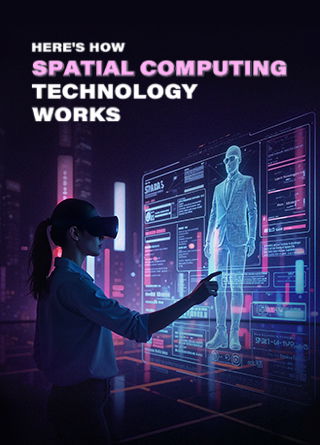
Here's How Spatial Computing Technology Works
Share
Overview
Suddenly, your smartphone wasn’t just showing maps; it could recognize buildings, guide you with arrows on the street, and even let you watch the "street view" by placing you anywhere you wanted virtually.
It was no longer just about getting from point A to B—it was bringing the physical and virtual worlds together!
That was the moment Spatial Computing became real. Just like GPS maps roads, Spatial Computing maps physical spaces, making digital objects part of our physical world. It powers AR navigation, VR gaming, smart homes, and AI-driven industries, turning everyday experiences into something smarter and more interactive.
In this article, we’ll look at what exactly Spatial Computing is, how it works, the tech behind it, real-world applications, and what comes next. Let’s explore!
The doorbell rings. You aren’t expecting anyone, but when you check the door camera on your AR glasses, there was no one there—just a floating notification. A virtual assistant then pops up, showing a live feed of a package being delivered at your doorstep. You reach out, and with a simple tap in the air, the door unlocks.
This isn’t a scene from a sci-fi movie—it is Spatial Computing in action. A world where digital and physical blend seamlessly, letting you see, touch, and control virtual objects in real-time. From AR navigation and smart homes to surgeons using 3D overlays in operations, this technology is changing how we interact with everything around us.
Welcome to a world where the digital and physical no longer exist apart!
Let’s explore how it all comes together. Read on!
What Is Spatial Computing?
Spatial Computing is a field of technology that combines the digital and real world. That means computers can "think outside the screen" and connect with the world around them in the same way that people do.
Think of it this way: you don't have to use a screen, keyboard, or mouse to interact with digital objects. You can simply use your voice or gestures, the same what makes Virtual Reality (VR), Augmented Reality (AR), and smart gadgets tick.
Now, various industries are tapping into this potential, especially in media and entertainment content. For instance, Disney is bringing interactive sports experiences to life on Apple Vision Pro, changing how fans connect with their favorite game.
To put it simply, Spatial Computing makes technology feel more real, engaging, and immersive. Yet, the question remains: how?
How Does Spatial Computing Work?
When you use traditional computers, you're looking through a set window, aka your screen. It stays in that frame while you type, scroll and click. Well, what if the window went away and the real world and the computer world became one?
Sensors, cameras, AI, and real-time mapping help Spatial Computing systems understand and connect with real spaces instead of just screens. It differs from regular computers in that it allows you to move your body and even speak to control digital items in your surroundings. Think navigating using AR-based directions, designing in a 3D space, or managing a smart home with gestures.
In short, Spatial Computing doesn’t replace traditional computing—it expands beyond the screen!
What Are The Core Technologies Powering Spatial Computing?
Spatial Computing relies on several key technologies that enable computers to understand and interact with real-world environments. Let’s dive into the key technologies behind Spatial Computing, along with real-world examples of how they are being used.
-
Sensors & Cameras
Devices use LiDAR, depth sensors, and cameras to scan the environment and detect objects, surfaces, and movement in real time.
Example: AR devices like Apple’s Vision Pro and Microsoft HoloLens use LiDAR for precise spatial awareness. -
Artificial Intelligence (AI) And Machine Learning (ML)
AI/ML helps analyze the surroundings, recognize objects, track gestures, and even predict user behavior.
Example: AI-powered hand tracking in VR allows users to interact without controllers. -
Augmented Reality (AR), Virtual Reality (VR), And Mixed Reality (MR)
AR overlays digital objects onto real spaces, VR creates immersive virtual worlds, and MR blends both for interactive experiences. These technologies power AR navigation, VR gaming, and MR-assisted engineering, among others that help 3D models interact with real-world objects.
Example: Pokémon GO adds virtual creatures to real-world locations (AR), Meta’s Quest 3 immerses users in a fully digital space (VR), and Microsoft HoloLens overlays 3D models onto real objects for interactive use (MR).
-
Spatial Mapping And Simultaneous Localization and Mapping (SLAM)
SLAM enables devices to map their environment while tracking their position within it, crucial for AR and autonomous navigation.
Example: Self-driving cars and AR navigation use SLAM to understand their surroundings in real-time. Companies like Tesla, Waymo, and NVIDIA’s DRIVE platform leverage SLAM to map environments, detect obstacles, and navigate safely without human intervention. -
5G And High-Speed Connectivity
Faster data speeds ensure seamless real-time interaction between devices and cloud-based services, allowing quicker rendering of digital overlays.
Example: AR cloud applications need 5G networks to overlay digital content instantly over real-world locations.
With these technologies working together, Spatial Computing maps environments, processes real-time data, and enables seamless digital interactions. From self-driving cars to AR-enhanced experiences, it's reshaping how we interact with the world.
Yet, how does this affect everyday life and industries? Let’s understand through the key benefits of Spatial Computing!
What Are The Benefits Of Spatial Computing?
Spatial Computing is transforming how we interact with technology, making digital experiences more immersive and intuitive. Let's explore its game-changing benefits.
-
Enhanced User Interaction
Spatial Computing allows users to interact with digital content in 3D space, making experiences more natural and engaging. This is especially beneficial for industries like gaming, education, and design.
-
Improved Productivity And Collaboration
Remote teams can collaborate in shared virtual workspaces, visualizing data and designs in real-time. This is particularly useful in engineering, architecture, and corporate settings.
-
Advanced Data Visualization
Spatial Computing makes complex data more understandable by transforming it into 3D visual models, aiding decision-making in industries like healthcare, finance, and logistics.
-
Enhanced Design And Prototyping
From architects to product designers, Spatial Computing enables 3D modeling and real-time prototyping, reducing costs and time required for physical iterations.
-
Cost-Effective And Scalable Training
Spatial Computing reduces training costs by eliminating physical resources and commuting costs. It enables scalable, immersive learning in spatial context, allowing employees to train anytime, anywhere, with consistent, risk-free, and adaptive experiences across multiple locations.
-
Optimized Retail And Customer Experience
Retailers use AR and VR to allow customers to visualize products in their space before purchasing, improving customer satisfaction and reducing return rates.
As Spatial Computing continues to revolutionize industries, its potential is vast. However, like any emerging technology, it comes with challenges and opportunities that will shape its future. Let’s explore!
What Are The Challenges Of Spatial Computing?
While Spatial Computing is transforming industries with immersive experiences and real-time interactions, its adoption isn’t without hurdles. Let’s dive into the key challenges that need to be overcome for this technology to reach its full potential.
-
High Implementation Costs
Creating AR/VR hardware and software costs a lot of money, which makes it hard for companies to use on a large scale.
-
Hardware Limitations
AR and VR devices are still quite large and need better battery life, comfort, and processing power.
-
Data Privacy And Security
As Spatial Computing captures massive volumes of user data, guaranteeing privacy, security, and ethical usage is critical.
-
Technical Complexity
Integrating Spatial Computing into existing systems necessitates expertise in AI, cloud computing, and 3D modeling, which can be a hurdle in many sectors.
-
User Adaptation And Accessibility
Many people may struggle to use immersive technology, and promising universal accessibility remains a difficulty.
While these challenges come with obstacles, they also drive innovation. The future of Spatial Computing holds immense potential to transform industries and everyday experiences. Let’s explore what lies ahead.
What Is The Future Of Spatial Computing?
Breaking boundaries between the digital and physical worlds will define Spatial Computing's course going forward. Imagine sliding on a lightweight AR headset that swiftly changes your surroundings, enhancing the immersion of shopping, learning, entertainment and work.
Interactions will seem more natural, almost organic as artificial intelligence and the Internet of Things contribute intelligence to digital interactions. Stronger security policies will guarantee data privacy while advances in 5G and cloud technologies will provide seamless real-time spatial experiences.
What once felt futuristic will soon become an everyday reality and transform how we engage with technology—in ways we’re only beginning to imagine!
Final Thoughts
From guiding us with digital arrows on the street to bringing entirely new worlds to life, Spatial Computing is reshaping reality as we know it—kind of like giving the real world a software update, but with way cooler features!
One thing is certain whether you're designing in mid-air, unlocking doors with a wave, or entering a virtual boardroom—the future is already here, waiting for you to walk in!
Frequently Asked Questions
What Is Spatial Computing?
Spatial Computing is the technology that blends digital and physical worlds, allowing computers to understand and interact with real-world spaces. It enables AR, VR, and AI-powered experiences, making digital interactions more immersive, natural, and intuitive.
What Are Some Real-World Applications Of Spatial Computing?
Spatial Computing is used in AR navigation, VR gaming, smart homes, industrial training, remote collaboration, medical surgeries, self-driving cars, and retail experiences like virtual try-ons and immersive shopping. It enhances user interaction, productivity, and decision-making across industries.
How Is Spatial Computing Different From Augmented Reality (AR) And Virtual Reality (VR)?
Spatial Computing is the broader concept that enables AR, VR, and Mixed Reality (MR) by integrating digital objects into physical spaces, allowing seamless interaction. AR overlays digital elements onto the real world, while VR creates fully immersive digital environments.
Fri, Mar 7, 2025

Liked what you read? That’s only the tip of the tech iceberg!
Explore our vast collection of tech articles including introductory guides, product reviews, trends and more, stay up to date with the latest news, relish thought-provoking interviews and the hottest AI blogs, and tickle your funny bone with hilarious tech memes!
Plus, get access to branded insights from industry-leading global brands through informative white papers, engaging case studies, in-depth reports, enlightening videos and exciting events and webinars.
Dive into TechDogs' treasure trove today and Know Your World of technology like never before!
Disclaimer - Reference to any specific product, software or entity does not constitute an endorsement or recommendation by TechDogs nor should any data or content published be relied upon. The views expressed by TechDogs' members and guests are their own and their appearance on our site does not imply an endorsement of them or any entity they represent. Views and opinions expressed by TechDogs' Authors are those of the Authors and do not necessarily reflect the view of TechDogs or any of its officials. While we aim to provide valuable and helpful information, some content on TechDogs' site may not have been thoroughly reviewed for every detail or aspect. We encourage users to verify any information independently where necessary.
Loading comments...