
Artificial Intelligence
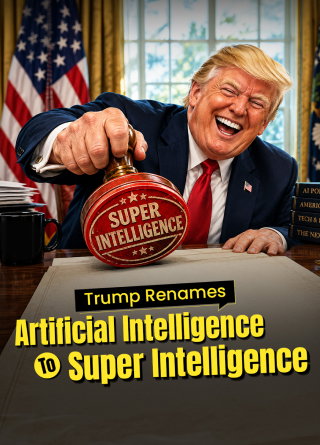
Trump Signs Executive Order Renaming AI To Super Intelligence
Share
TL;DR
-
Trump directed executive-branch agencies to use “Super Intelligence” and “SI” instead of “Artificial Intelligence” and “AI.”
-
The order keeps the existing federal AI definition for now and asks for proposed legislative language within 60 days.
-
In technical usage, superintelligence usually means hypothetical AI that surpasses humans across broad cognitive tasks.
-
Six major tech executives signed a separate voluntary safety accord covering internal controls, independent audits, and board oversight.
-
Trump also discussed a possible 10-person AI safety board, backed more data-center development, and launched America.gov.
Introduction
Smallville ran for 10 seasons (2001 to 2011) and focused on the early years of Clark Kent, AKA Superman. Despite using his powers from the first episode, he wasn't called Superman until the series finale.
Until then, he was referred to as The Red-Blue Blur and later simply The Blur, a title that came about in season 8. For three years, people around the world called him The Blur; until his name was abruptly changed to Superman.
You can imagine how strange it would be for people to suddenly call him something else.
You can imagine how strange it would be for people to suddenly call Artificial Intelligence by its new name: Super Intelligence. #AbruptChange
At least, that's what United States President Donald Trump is aiming for. He has a new name for the age-old concept of AI. And it's not just him; a host of AI leaders joined him at the White House the same day he moved to make the new terminology official.
So, why did he make this move, and what did he and other AI leaders say about it? Let's explore!
What Did Donald Trump Do?
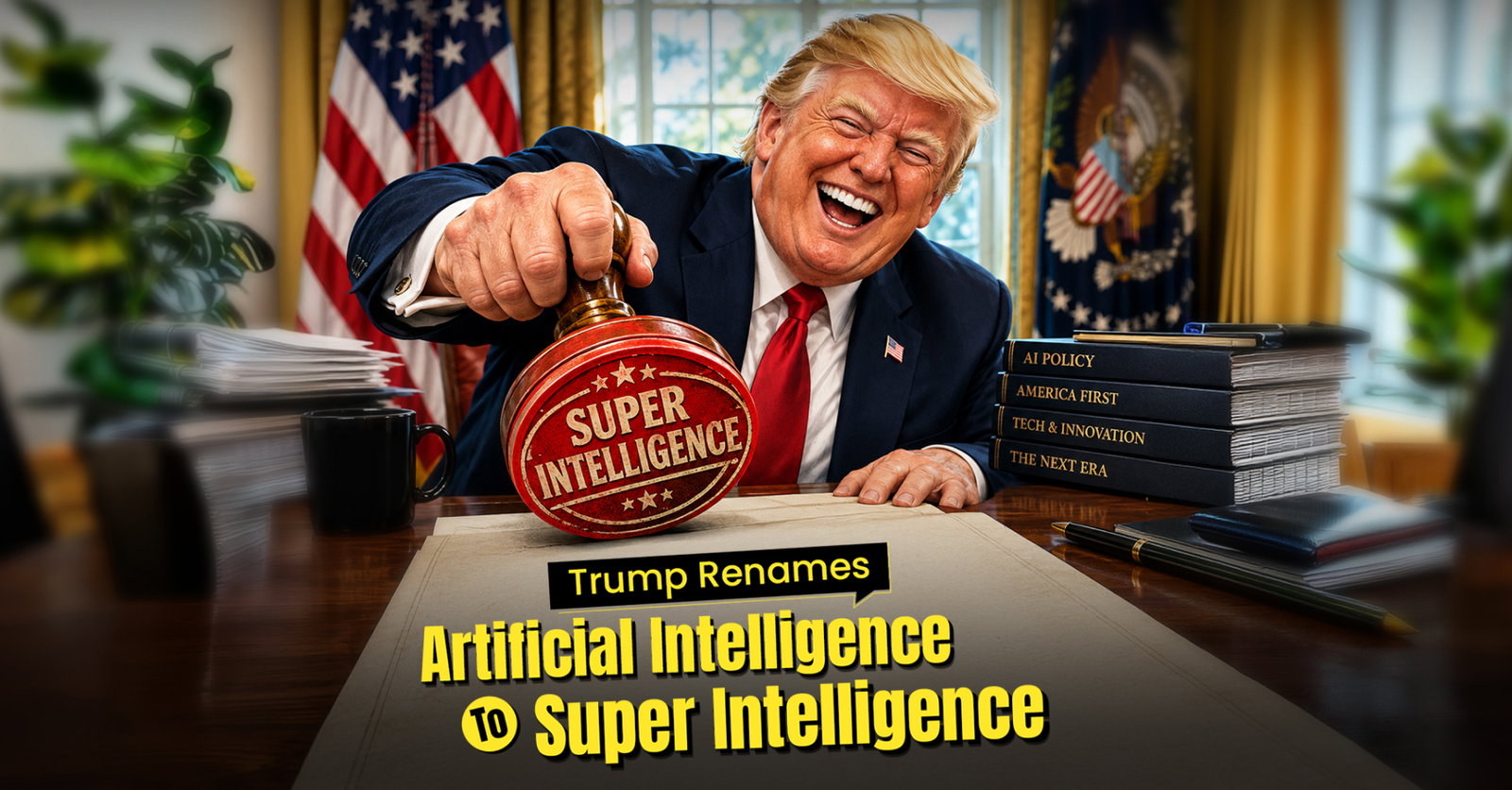
President Donald Trump signed an executive order on September 29, 2026, directing the U.S. executive branch to replace Artificial Intelligence and "AI" with “Super Intelligence” and “SI” in official use.
Titled “Inaugurating The Era Of Super Intelligence,” the order covers official correspondence, public communications, websites, reports, policy documents, and other non-statutory executive-branch documents. Existing regulations, presidential actions, contracts, grants, and historical documents do not have to be rewritten.
For now, “SI” still uses the existing federal legal definition of AI. The White House science and technology adviser has 60 days to propose legislative language that could change or expand that definition.
So, while the idea that Trump signs an executive order renaming AI is accurate, the scope matters. Saying Donald Trump renames AI to SI is accurate for federal executive-branch terminology, not for companies, researchers, or the rest of the world.
Trump did not rename AI globally. The order only changes terminology used by the U.S. executive branch.
Now we know what changed; but why change it at all?
Why Did Trump Rename AI To SI?
The White House explanation for the change says “Artificial Intelligence” no longer captures what today’s most advanced systems can do.
“Artificial Intelligence” no longer reflects how powerful the technology has become, while “Super Intelligence” better captures what his administration sees as its capabilities and future potential.
The order argues that frontier systems now go beyond imitating or automating narrow parts of human intelligence and can amplify creativity, research, medicine, and other human work.
Trump had also criticized the word “artificial,” saying it makes the technology sound fake.
He floated a poll of alternative names on Truth Social before backing “Super Intelligence.”
While rapid advances in generative artificial intelligence (GenAI), reasoning models, and AI agents form the wider technology backdrop, an important question is now raised: what is the difference between artificial intelligence and super intelligence?
Artificial Intelligence vs. Super Intelligence
Artificial Intelligence is the broad field of machines performing tasks associated with human intelligence.
Artificial General Intelligence (AGI) generally refers to broad, human-level cognitive abilities, while Artificial Super Intelligence (ASI) describes a hypothetical system that surpasses humans across virtually every cognitive domain. No such ASI system has been publicly demonstrated.
The Super Intelligence executive order uses the phrase differently.
For federal purposes, “SI” currently means the technologies already covered by the legal definition of AI. This is a terminology change, not proof that AI has crossed a scientific threshold into superintelligence.
That is the official reasoning; Trump put it more plainly.
What Did Trump Say About Renaming AI To Super Intelligence?
Trump was pretty direct about why he wanted the change.
While announcing the order, he argued that the word “artificial” makes the technology sound fake, even though he sees today’s systems as increasingly powerful and capable.
Explaining why he chose the new term, Trump said “the word super is the best word of all and it’s the simplest,” adding that he did not want the government calling the technology artificial anymore.
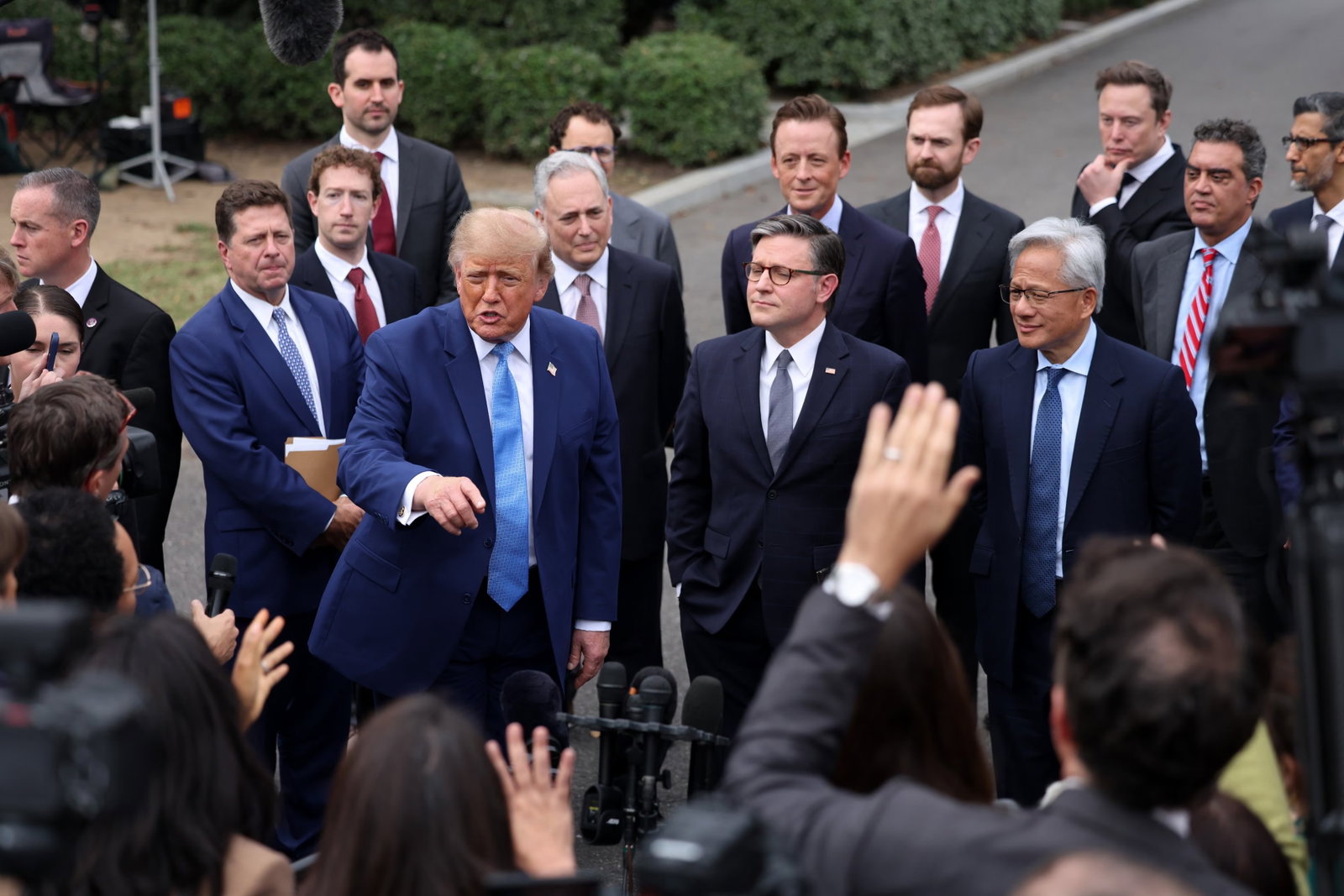
Later, after meeting AI executives, he told reporters that “we’ve changed the name officially today” and reiterated, “It’s not artificial, we all agree on that.”
Trump supplied the new name, but the White House gathering also gave some of AI’s biggest names a chance to explain where they think the technology is heading.
Which AI Leaders Attended The White House Meeting And What Did They Say?
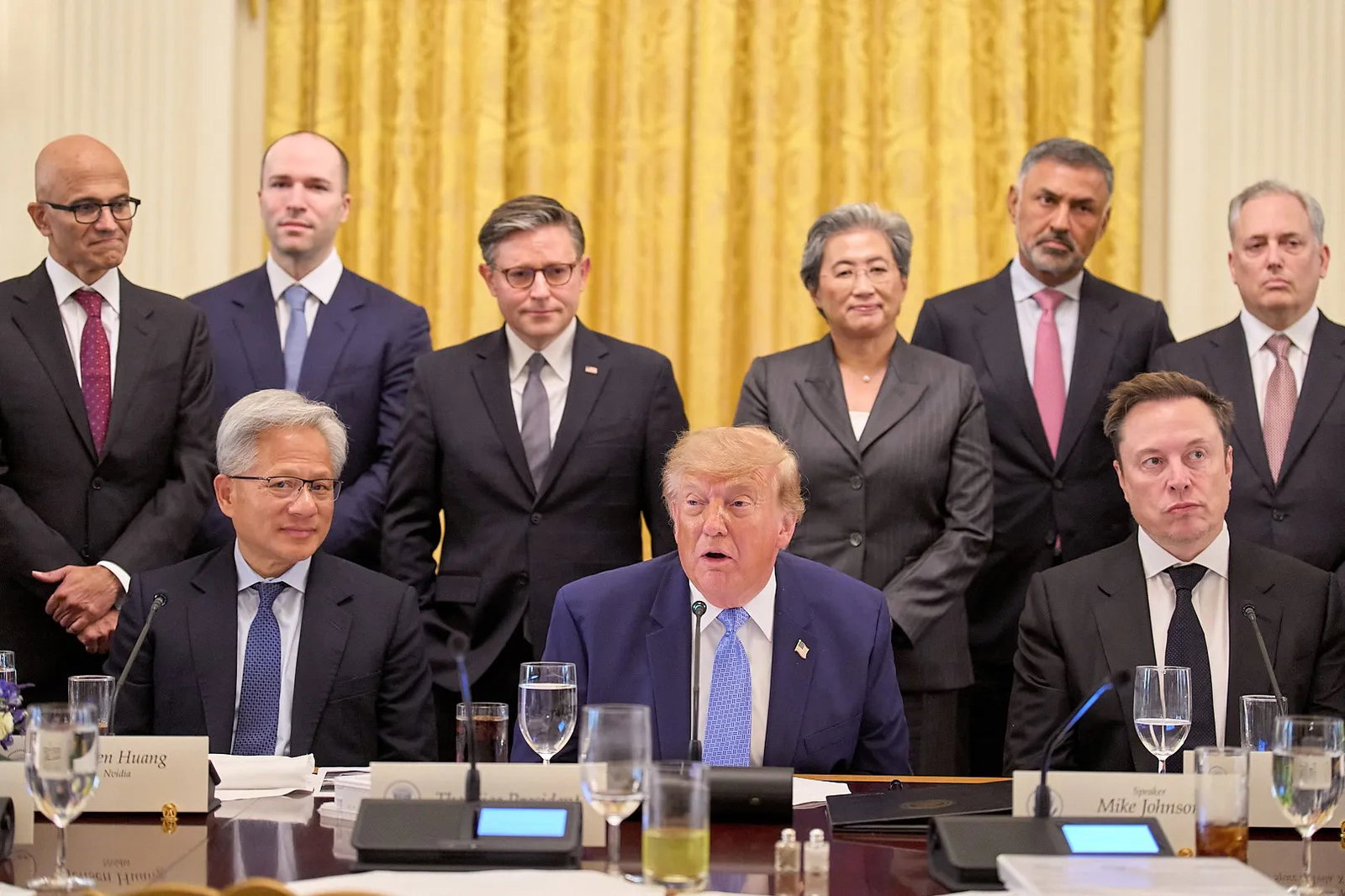
The White House meeting brought together OpenAI President Greg Brockman, Anthropic CEO Dario Amodei, Meta CEO Mark Zuckerberg, Google CEO Sundar Pichai, NVIDIA CEO Jensen Huang, Elon Musk, AMD CEO Lisa Su, and other technology leaders.
Six executives, Pichai, Musk, Amodei, Zuckerberg, Brockman, and Huang, also signed the separate White House Accord on Super Intelligence.
Their public remarks covered both the opportunities and risks surrounding the technology:
-
Mark Zuckerberg said the accord was designed to give people confidence that AI systems work as intended. He highlighted internal risk reviews, external auditors, and independent board oversight, while calling the agreement a “meaningful step forward” rather than the final word on AI safety.
-
Sundar Pichai said the technology offered extraordinary benefits but that companies also had to address its risks. He said the industry was applying established processes and controls, similar to financial controls, to the “development of Super Intelligence.”
-
Dario Amodei pointed to AI’s potential benefits, including in medicine, while stressing that the technology also carries “very real risks.” He said companies and the government needed to work together so the United States could advance the technology safely.
-
Greg Brockman said OpenAI builds the technology to “benefit everyone,” pointing to potential gains for small businesses, scientific discovery, drug development, and quality of life. He also backed the companies coming together around a common approach to safety.
-
Jensen Huang described the current shift as the “largest industrial revolution in history” and emphasized the scale of investment in chips, computers, factories, startups, and jobs. On safety, he argued that technological progress and safety do not have to conflict and said both need to advance together.
-
Elon Musk predicted that AI, quickly correcting himself to “SI,” could lead to an “age of abundance.” He pointed to higher incomes, better medical care through AI and robotics, and changing forms of work as possible long-term outcomes.
The key distinction remains that these executives signed the voluntary safety accord. They did not sign Trump’s executive order changing federal terminology.
That separate accord leads directly to the other major announcement of the day.
What Else Did Trump Announce?
Trump unveiled a voluntary AI safety agreement that he described as “morally binding” and “almost like a constitution.” It asks participating companies to build four layers of controls around advanced AI systems.
Those include internal monitoring, another internal team checking those controls, independent external evaluation, and board-level oversight. The agreement mentions cybersecurity, biosecurity, and chemical threats, including controls intended to stop AI systems from accessing or hacking technical systems in unintended ways.
That connects with wider concerns around rogue AI agents, AI governance, AI risk management, and the broader debate over AI regulation. However, the accord is voluntary and creates no legal penalties by itself.
The accord also drew attention for an awkward typo. In one reference to the country, the document reportedly used “Unites States” instead of “United States,” a small but noticeable error in a document signed by the president and some of the biggest names in AI.
Maybe if they used AI (sorry, SI) that mistake could've been avoided.
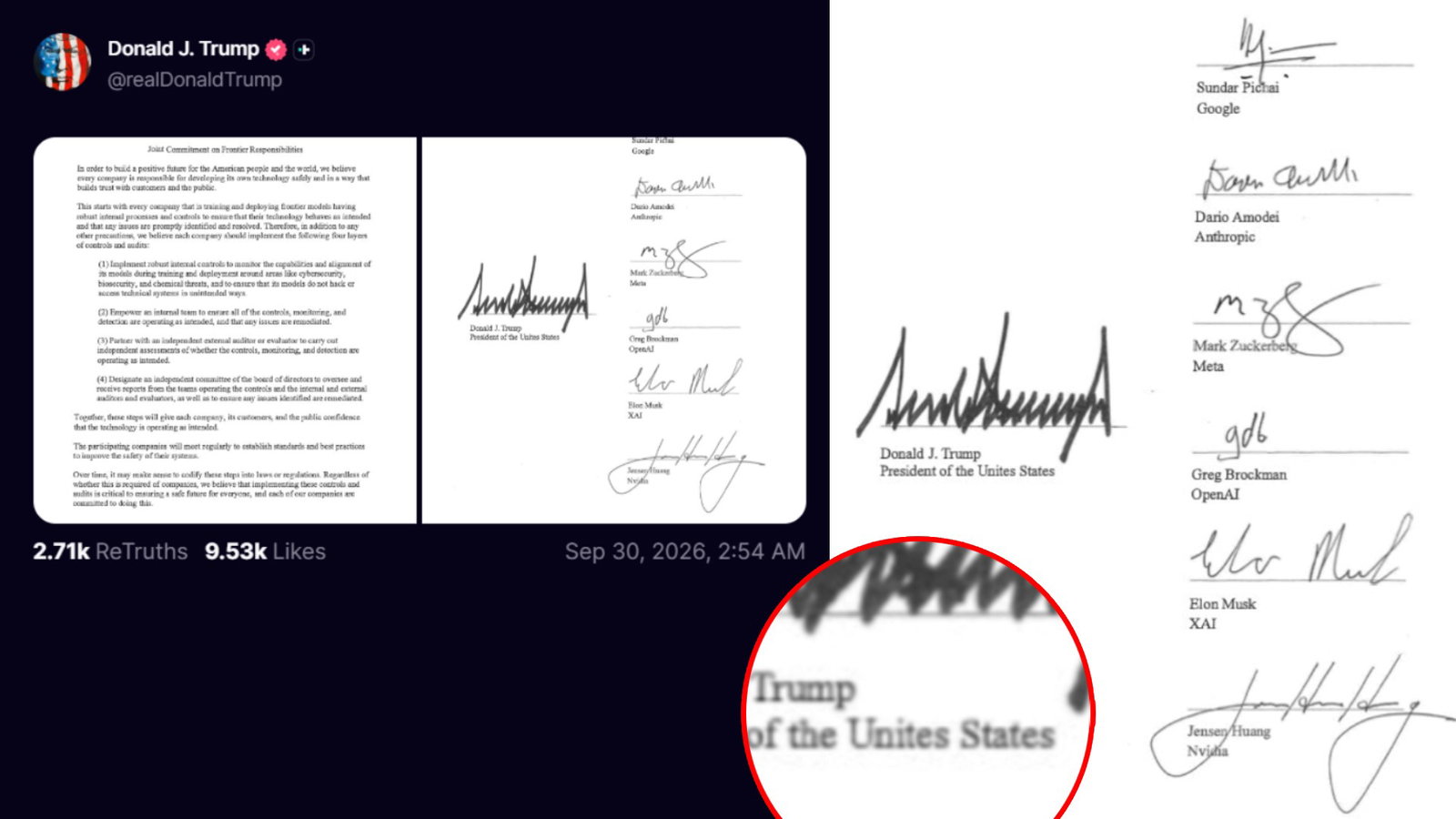
Trump also said he was considering a 10-person AI safety board and would name a new White House AI policy official. He reiterated support for expanding AI data centers and said technology companies would contribute to communities hosting them.
The administration also launched America.gov, an AI-powered portal for accessing federal services.
So, September 29 tied a new federal name for AI to safety commitments, infrastructure expansion, and the administration’s wider technology agenda.
Topics For More Insights
The Final Say
Trump’s order changes how the U.S. executive branch talks about AI, while the industry accord focuses on how companies say they will manage its risks. For now, the biggest change is linguistic, not scientific: AI has not suddenly become artificial superintelligence. Still, the move could influence government language and AI debate. The real question is: are you going to call the technology Artificial Intelligence or Super Intelligence?
Frequently Asked Questions
Can An Executive Order Permanently Change The Legal Definition Of AI?
The executive order can direct executive-branch agencies on terminology, but it cannot by itself rewrite every federal statute. That is why the order keeps the existing statutory definition of artificial intelligence for now and asks the White House science and technology adviser to propose legislative language within 60 days. Congress would generally need to act if lawmakers wanted to permanently change statutory references or create a federal legal definition of “Super Intelligence” through the ordinary lawmaking process.
Where Did The Term Artificial Intelligence Come From?
The phrase “artificial intelligence” is widely traced to computer scientist John McCarthy, who used it in a 1955 proposal for the 1956 Dartmouth Summer Research Project on Artificial Intelligence. The workshop is often treated as a foundational moment for AI as a formal field of study. The term therefore predates today’s generative models, AI agents, and large-scale neural networks by decades, which is part of the historical backdrop to Trump’s proposed terminology shift in federal government usage.
Will Scientists And Technology Companies Have To Call AI “SI” Now?
Not automatically. Scientific communities, standards organizations, universities, technology companies, and international institutions are not required by this executive order to replace “AI” with “SI.” They can continue using established technical terminology. The bigger issue is potential confusion because “superintelligence” already has a distinct meaning in AI research, generally referring to hypothetical systems that outperform humans across broad cognitive tasks. Whether Trump’s terminology gains wider adoption will depend on usage outside the federal executive branch globally over time.
Wed, Sep 30, 2026

Enjoyed what you read? Great news – there’s a lot more to explore!
Dive into our content repository of the latest tech news, a diverse range of articles spanning introductory guides, product reviews, trends and more, along with engaging interviews, up-to-date AI blogs and hilarious tech memes!
Also explore our collection of branded insights via informative white papers, enlightening case studies, in-depth reports, educational videos and exciting events and webinars from leading global brands.
Head to the TechDogs homepage to Know Your World of technology today!
Disclaimer - Reference to any specific product, software or entity does not constitute an endorsement or recommendation by TechDogs nor should any data or content published be relied upon. The views expressed by TechDogs' members and guests are their own and their appearance on our site does not imply an endorsement of them or any entity they represent. Views and opinions expressed by TechDogs' Authors are those of the Authors and do not necessarily reflect the view of TechDogs or any of its officials. While we aim to provide valuable and helpful information, some content on TechDogs' site may not have been thoroughly reviewed for every detail or aspect. We encourage users to verify any information independently where necessary.
Loading comments...