
Artificial Intelligence
Google Launches DeepMind Institute To Address Societal Impacts Of AGI
Share
TL;DR
-
The institute is led by Shane Legg, James Manyika, and Demis Hassabis, with Legg serving as managing editor.
-
It is a research and discussion platform, not a new frontier-model development lab.
-
Its initial work covers economic policy, reasoning transparency, human flourishing, and frontier AI evaluation.
-
One essay examines 11 policy options for responding to possible economic disruption from advanced AI.
-
The institute says contributors may disagree, encouraging interdisciplinary debate rather than presenting one corporate position.
Introduction
If Jurassic Park taught us anything, it is that building something powerful and deciding how to live with it are two different jobs. Artificial general intelligence, or AGI, is not a dinosaur problem, but the timing question feels familiar: what happens if capability moves faster than the rules, institutions, and public understanding around it?
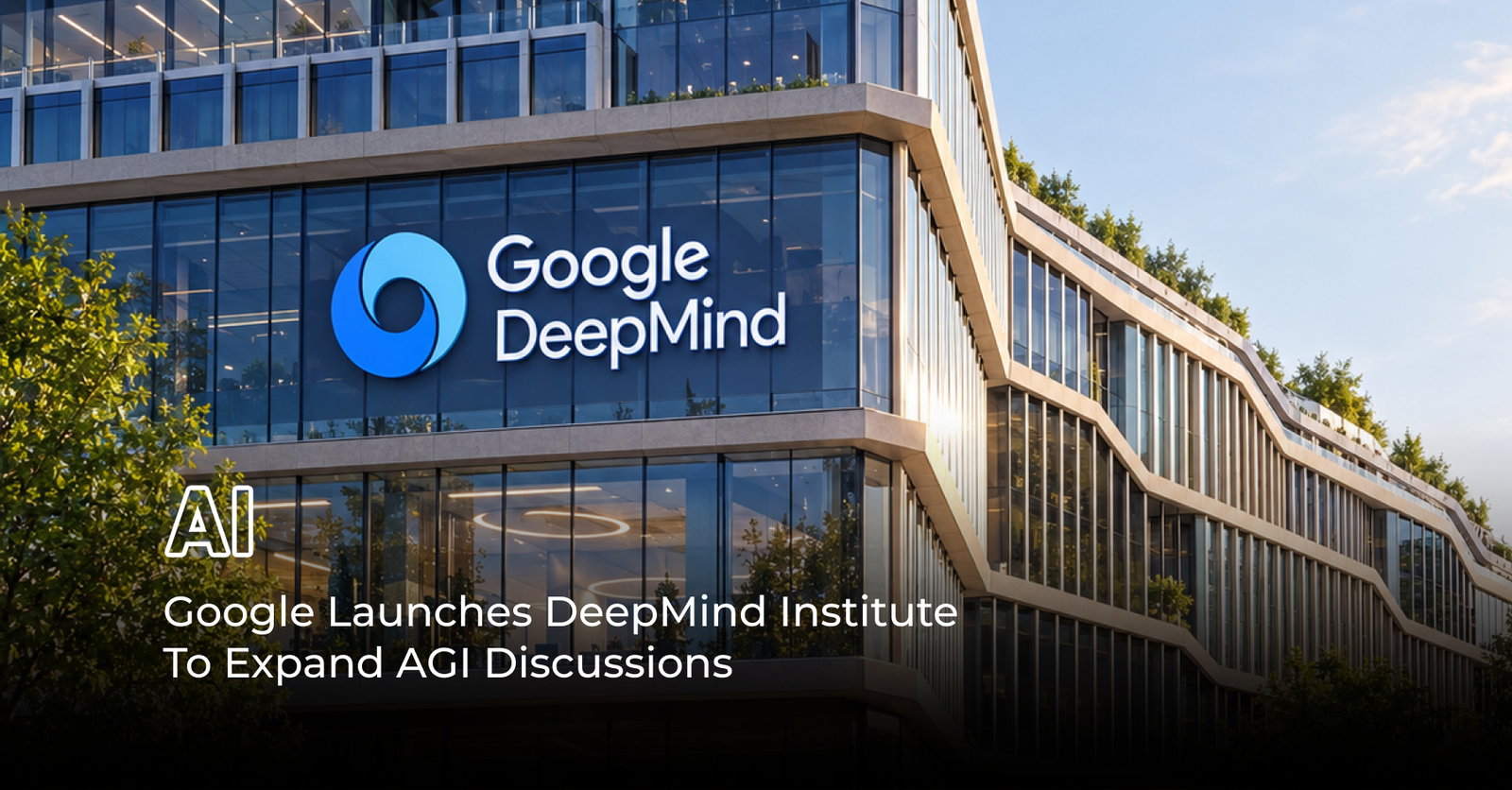
That is the gap the new DeepMind Institute wants to examine. Launched by researchers from Google and Google DeepMind, the institute is designed as an interdisciplinary platform rather than another model-building lab. Its focus spans technology, economics, policy, philosophy, education, and human flourishing.
So, what is the Google DeepMind Institute, why has it launched now, and what could it add to the wider AGI debate?
What Is The Google DeepMind Institute?
The Google DeepMind Institute, or DMI, is a platform created to study the safe development, beneficial use, and societal impact of AGI. Its directors are Google DeepMind co-founder and Chief AGI Scientist Shane Legg, Google executive James Manyika, and Google DeepMind Chair Demis Hassabis. Legg also serves as managing editor.
Calling it a Google AGI research institute can make it sound like another group focused on building frontier models. That is not its stated role. DMI is designed to publish research and arguments, invite disagreement, and connect technical questions with broader social ones.
Its founding statement makes another important distinction: essays published by the institute reflect their authors' ideas and should not automatically be treated as Google's official position.
In simple terms, DMI is asking a second question alongside "Can we build AGI?" It is asking, "What should society do if we can?"
Why The DeepMind Institute Launch Matters Now
The timing is significant because the AGI debate has moved beyond raw model performance.
Google DeepMind has previously said AGI could arrive within the coming years while stressing that current systems still have important limitations. Meanwhile, more capable AI agents can write code and complete multi-step tasks.
That raises broader questions around oversight, misuse, alignment, and control. Shane Legg has warned that AI capabilities should not advance faster than safety measures.
The DeepMind Institute launch therefore comes as artificial general intelligence governance is becoming as important a conversation as the technology itself.
What Is The Purpose Of The Google DeepMind Institute?
The purpose of the Google DeepMind Institute goes beyond safety testing. Its founding work asks how AGI could affect institutions, employment, economic systems, human values, and human flourishing.
Its early agenda can be grouped into four areas:
-
Economic preparedness: DMI is examining how governments and institutions could respond if advanced AI changes employment, productivity, income distribution, or the structure of work.
-
Transparency and oversight: Its work on reasoning transparency explores whether human-readable reasoning can help researchers understand and monitor powerful AI systems.
-
Human flourishing: The institute asks how people can retain agency, meaning, and social value if highly capable AI becomes deeply embedded in daily life.
-
Frontier AI governance: Demis Hassabis has outlined a framework for frontier AI that examines how innovation and responsible development can progress together.
This is where the societal impact of AGI becomes less abstract. Instead of simply saying AGI may change society, DMI is asking what could change, how those changes may happen, and what institutions might need to prepare for.
What Research Has The Institute Published So Far?
The institute's first essays show how wide that scope is.
One paper on economic policy for AGI examines 11 policy options for responding to economic disruption from advanced AI. Another argues that reasoning transparency could help researchers monitor frontier systems for deceptive or strategic behavior.
A separate essay considers human flourishing, while Hassabis' frontier AI framework focuses on evaluating increasingly capable systems responsibly.
Together, these topics show that economics, transparency, safety, and human values become connected if AGI begins influencing work, decisions, services, or institutions. DMI also says contributors may disagree and revise their positions as evidence changes.
That flexibility is notable in a field where predictions about AGI timelines, capabilities, and consequences can differ sharply even among researchers.
How DMI Fits Into Google DeepMind's Existing AGI Safety Work
The Google DeepMind Institute is not starting from zero.
Google DeepMind already operates an AGI Safety Council and a Responsibility and Safety Council. It also maintains a Frontier Safety Framework for identifying severe risks from powerful models, tracking capability thresholds, evaluating risk, and preparing mitigations.
The difference is scope:
-
Google DeepMind's existing safety structures focus largely on developing, evaluating, and governing advanced AI systems.
-
DMI widens the conversation to economics, institutions, governance, public policy, and society.
-
Technical safeguards can reduce risks inside development pipelines, but they cannot alone decide how economies should adapt or how powerful AI should be governed.
Its social and policy focus therefore tackles questions that model evaluations cannot answer alone.
What The DeepMind Institute Adds To The AGI Debate
AGI discussions often split between excitement over scientific and economic gains and concern about systemic risk. DMI is attempting to place both conversations in the same room.
Its agenda treats safety, economics, artificial general intelligence governance, human values, and beneficial use as connected questions rather than separate debates.
Still, DMI is not a regulator or an independent watchdog. It is an initiative created by researchers from Google and Google DeepMind. Its work should therefore be distinguished from external oversight or public regulation.
Its contribution may lie in starting these discussions early, while AGI remains a developing technological goal rather than a settled milestone.
Conclusion
The DeepMind Institute launch shows that Google DeepMind sees preparation for AGI as more than an engineering challenge. Building increasingly capable systems is one job. Deciding how those systems should fit into economies, institutions, and everyday life is another.
That brings us back to Jurassic Park. The important question is not only whether a powerful technology can be built. It is whether the safeguards, incentives, and institutions around it are ready when it arrives.
DMI will not settle the AGI debate on its own, and its work is not official Google policy. What it can do is make the debate broader, more interdisciplinary, and more concrete before society has to answer those questions under pressure.
Frequently Asked Questions
Can Researchers Outside Google Contribute To The DeepMind Institute?
Yes. The DeepMind Institute says it is intended for researchers and thinkers from Google DeepMind, Google, and the wider global research community. This means its publishing platform is designed to incorporate perspectives beyond Google's internal research teams.
How Does The DeepMind Institute Define AGI?
The institute describes artificial general intelligence as a system that exhibits all the cognitive capabilities of the human brain. It also acknowledges that today's AI systems do not yet meet that standard because they can still fail at basic tasks and lack sufficient consistency and creativity.
Does The DeepMind Institute Want AGI Research To Be Accessible Beyond Academia?
Yes. One stated aim of the initiative is to make complex academic thinking around AGI more accessible to the wider public, while presenting different perspectives on its development and societal implications rather than limiting the discussion to specialist research circles.
Mon, Sep 21, 2026

Liked what you read? That’s only the tip of the tech iceberg!
Explore our vast collection of tech articles including introductory guides, product reviews, trends and more, stay up to date with the latest news, relish thought-provoking interviews and the hottest AI blogs, and tickle your funny bone with hilarious tech memes!
Plus, get access to branded insights from industry-leading global brands through informative white papers, engaging case studies, in-depth reports, enlightening videos and exciting events and webinars.
Dive into TechDogs' treasure trove today and Know Your World of technology like never before!
Disclaimer - Reference to any specific product, software or entity does not constitute an endorsement or recommendation by TechDogs nor should any data or content published be relied upon. The views expressed by TechDogs' members and guests are their own and their appearance on our site does not imply an endorsement of them or any entity they represent. Views and opinions expressed by TechDogs' Authors are those of the Authors and do not necessarily reflect the view of TechDogs or any of its officials. While we aim to provide valuable and helpful information, some content on TechDogs' site may not have been thoroughly reviewed for every detail or aspect. We encourage users to verify any information independently where necessary.
Loading comments...