
IT Security
Understanding AI TRiSM: Trust, Risk, And Security Management
Share
TL;DR
Here are the key insights from the article:
-
AI without guardrails can create serious business risks, from biased decisions and hallucinated outputs to data leaks and compliance gaps.
-
AI TRiSM brings trust, risk, and security controls directly into the AI lifecycle instead of treating them as afterthoughts.
-
The framework helps organizations monitor models continuously for drift, misuse, vulnerabilities, and unreliable behavior.
-
Strong AI TRiSM practices make AI easier to audit, explain, govern, and align with regulatory expectations.
-
As AI becomes business-critical, AI TRiSM is no longer optional; it is becoming the foundation for scaling AI responsibly.
Introduction
Have you watched Jurassic Park?
Most people remember the moment the dinosaurs escaped. However, the real problem started much earlier. The scientists were so focused on what they could create that they spent far less time thinking about what could happen if things went wrong.
The park had groundbreaking technology, brilliant minds, and seemingly foolproof systems. Yet when those systems behaved in unexpected ways, the safeguards were not strong enough to keep everything under control.
In many ways, today's AI boom feels remarkably similar.
Organizations are racing to deploy AI across customer service, software development, cybersecurity, marketing, operations, and decision-making. Every week brings more powerful models, more automation capabilities, and more ambitious use cases. The opportunities are enormous.
Yet alongside those opportunities come important questions.
What happens when an AI model makes a biased recommendation? Exposes sensitive data? Produces inaccurate outputs? Operates beyond intended guardrails? Or makes decisions that nobody can fully explain?
That is where AI TRiSM comes in.
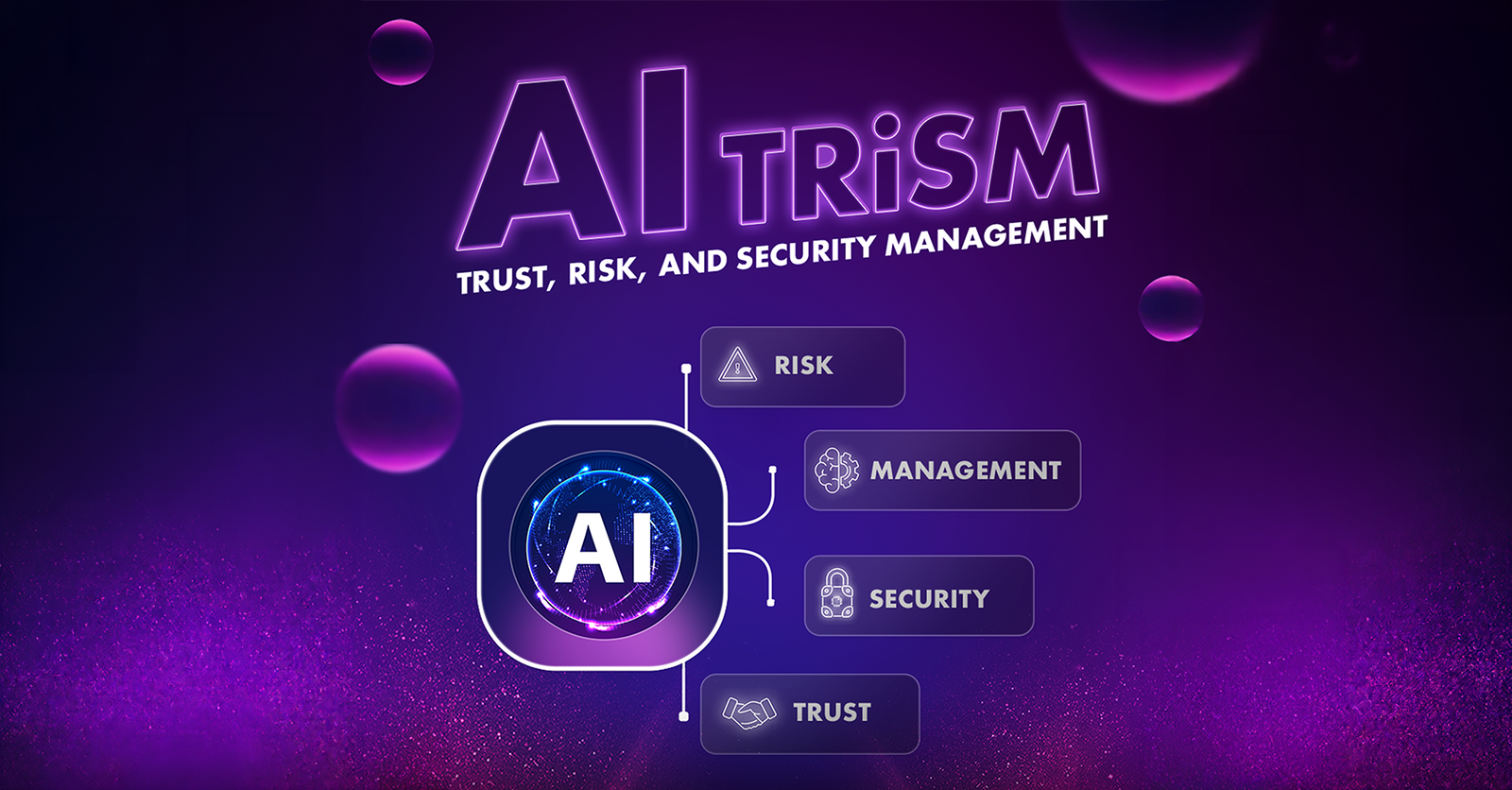
AI Trust, Risk, and Security Management (AI TRiSM) provides a structured framework for helping organizations develop, deploy, monitor, and govern AI systems responsibly.
Before we jump into the complete guide to AI TRiSM, let's first understand what it actually is.
What Is AI TRiSM?
AI TRiSM, short for AI Trust, Risk, and Security Management, is a framework that helps organizations build and use AI responsibly by establishing governance, security, monitoring, and risk-management controls throughout the AI lifecycle.
As AI systems become more deeply embedded in business operations, organizations need to ensure that these systems are not only accurate but also explainable, secure, compliant, reliable, and aligned with organizational goals. Without proper oversight, AI can introduce risks such as bias, hallucinations, model drift, privacy violations, regulatory issues, and cybersecurity vulnerabilities.
AI TRiSM addresses these challenges by bringing together several critical disciplines, including risk management, governance, cybersecurity, privacy, ModelOps, explainability, and continuous monitoring. Instead of treating these areas separately, the framework creates a unified approach to managing AI from development and deployment through ongoing operation and optimization.
Now that we understand what AI TRiSM is, the next question becomes even more important: why has it become essential for organizations embracing AI today?
Why Is AI TRiSM Important?
AI introduces challenges that traditional security controls were never designed to handle. Most AI models make decisions, generate outputs, and process massive amounts of context in ways that create entirely new risk patterns. As a result, organizations need stronger controls and safeguards that can understand, monitor, and manage AI behavior effectively.
What makes the situation even more complex is that many AI-related risks do not originate from external attackers. In many cases, they stem from internal misuse, poor governance, or inconsistent access controls. When permissions are weak or data policies are unclear, AI systems can expose sensitive information far faster than teams can identify and respond to the problem.
Organizations also face growing concerns around inaccurate, biased, or inappropriate outputs that can create operational, legal, reputational, and compliance risks. This has increased the demand for mechanisms that can evaluate AI-generated responses in real time and prevent unsafe outputs from reaching users.
This is exactly why AI TRiSM emerged. It provides organizations with a structured framework to monitor AI systems, understand their risks, enforce governance, and maintain control before small issues evolve into larger business problems.
Now that we have established AI TRiSM, let’s understand the AI TRiSM framework.
How Does AI TRiSM Work?
AI TRiSM functions by organizing AI governance controls into a unified, structured model. It consolidates data protection, governance expectations, and runtime assessment so that they can be applied consistently across multiple applications, models, and agents. Its functional framework is based on:
-
Clarity
Organizations record key details about their AI systems, including the data they use and the scenarios in which they are intended to operate. This creates a clear baseline for what the system’s “normal” or expected performance should look like.
-
Alignment
Governance rules, data policies, and acceptable usage requirements are brought together instead of being managed in isolation. This alignment gives the later control layers the right context to assess AI activity accurately.
-
Enforcement
An AI TRiSM framework for trust and security connects documentation, access controls, and evaluation standards directly to the places where AI interactions take place. This enables AI activity to be assessed against predefined policies and flagged for escalation when potential risks emerge.
These processes are guided by a set of core principles that define how AI TRiSM builds trust, reduces risk, and strengthens security across AI systems.
Principles Of AI TRiSM
According to Gartner, AI TRiSM ensures the following fundamentals:
-
AI Governance
AI governance is the set of processes, standards, and guardrails that ensure AI systems are safe, ethical, compliant, and trustworthy. It offers risk management, bias reduction, data privacy protection, continuous monitoring, and data governance to maintain secure, high-quality data while supporting responsible innovation.
-
Fairness
Fairness in AI means identifying and reducing bias in models and training data throughout the AI lifecycle. Since AI can reflect discrepancies in its data, unchecked bias may lead to unfair outcomes in areas like hiring, lending, and access to services. Strong AI governance helps address this through clear policies, oversight, and responsible development practices.
-
Trustworthiness
Trustworthy AI is often defined by principles such as accountability, explainability, and interpretability. When users cannot understand how an AI model works or why it produces certain outputs, trust becomes difficult.
-
Data Protection
Data protection focuses on keeping sensitive data secure, private, and available when needed. It includes preventing unauthorized access, corruption, theft, or loss, while ensuring individuals retain control over their personal data. Strong data protection also helps organizations meet regulatory requirements such as GDPR.
-
Reliability
Reliability in AI refers to a system’s ability to perform as expected under defined conditions over time. This means consistently producing accurate, dependable outputs throughout its operational lifecycle.
-
Explainability
Explainability helps build trust by making AI decisions easier to understand instead of leaving models as “black boxes.” Techniques such as feature importance analysis and continuous monitoring help reveal what influences outputs, detect anomalies or bias, and correct unfair decisions over time.
-
ModelOps
Model Operations, or ModelOps, helps manage AI models through both automated and manual checks for performance, reliability, and consistency. It includes version control, lifecycle testing, monitoring, and regular retraining with fresh data to keep models accurate, relevant, and scalable as business needs evolve.
When these principles are applied consistently, they translate into measurable benefits for organizations adopting and scaling AI.
Benefits Of AI TRiSM
With AI TRiSM, organizations can turn responsible AI from a policy goal into practical business advantages. Below are some of the key benefits of AI TRiSM:
-
Improved Trust
Demonstrating transparency in the explainability and monitoring of model decision-making develops user confidence in AI systems, fostering broader integration and acceptance.
-
Reduced Risks
AI-related hazards, such as security breaches and system failures, are proactively managed, minimizing the potential impact and risks to the organization.
-
Enhanced Regulatory Compliance
AI TRiSM helps businesses adhere to legal requirements and regulatory standards, reducing the risks of reputational damage and penalties.
These benefits become even more meaningful when seen in real-world applications where AI TRiSM helps organizations manage risk, strengthen trust, and scale AI responsibly.
Use Cases Of AI TRiSM
AI TRiSM has practical use cases across industries where organizations rely on AI to make decisions, automate processes, protect data, and deliver reliable outcomes.
-
Protecting Healthcare Data
Healthcare professionals are increasingly using AI-powered solutions for analyzing imagery and automating medical devices. An AI TRiSM program can help protect the clinical data used in these systems from data breaches. Measures such as access controls can mitigate potential risks of unauthorized access.
-
Improving Fintech Customer Experiences
When AI models are trained on biased demographic data, they can produce unfair outcomes, especially in areas like loan approvals and interest rates. To address this, the Danish Business Association used AI TRiSM practices such as fairness testing to validate financial transaction models and strengthen customer trust.
-
Preventing Banking Frauds
Beyond improving fairness in financial transactions, AI TRiSM also helps protect fraud detection systems from adversarial attacks. It further supports banks in meeting consumer protection rules and safeguarding sensitive data.
Now that we have understood what AI TRiSM is, let’s wrap up this one.
Summing Up
As AI penetrates more deeply into business operations, AI TRiSM is no longer just a technical safeguard but a strategic mandate. It helps organizations sustain innovation with accountability by ensuring AI solutions are fair, secure, reliable, explainable, and compliant.
By unifying trust, risk, and security into every stage of the AI lifecycle, AI TRiSM enables organizations to scale AI confidently while securing data, users, and business reputation. In a future shaped by intelligent systems, the companies that succeed will be those that make responsible AI a foundation, not an afterthought.
Frequently Asked Questions
How Does AI TRiSM Strengthen Enterprise AI Governance?
AI TRiSM connects governance policies with model monitoring, risk controls, data protection, and security practices.
This helps organizations manage AI systems consistently across development, deployment, and real-world use.
Why Is AI TRiSM Important For High-risk AI Applications?
High-risk AI systems can influence sensitive decisions in finance, healthcare, hiring, cybersecurity, and compliance.
AI TRiSM helps reduce bias, improve explainability, detect anomalies, and prevent harmful or non-compliant outcomes.
How Does AI TRiSM Support Scalable AI Adoption?
AI TRiSM creates a structured framework for testing, securing, monitoring, and improving AI models over time.
This allows businesses to expand AI use while maintaining trust, reliability, accountability, and regulatory readiness.
Thu, Jun 11, 2026

Liked what you read? That’s only the tip of the tech iceberg!
Explore our vast collection of tech articles including introductory guides, product reviews, trends and more, stay up to date with the latest news, relish thought-provoking interviews and the hottest AI blogs, and tickle your funny bone with hilarious tech memes!
Plus, get access to branded insights from industry-leading global brands through informative white papers, engaging case studies, in-depth reports, enlightening videos and exciting events and webinars.
Dive into TechDogs' treasure trove today and Know Your World of technology like never before!
Disclaimer - Reference to any specific product, software or entity does not constitute an endorsement or recommendation by TechDogs nor should any data or content published be relied upon. The views expressed by TechDogs' members and guests are their own and their appearance on our site does not imply an endorsement of them or any entity they represent. Views and opinions expressed by TechDogs' Authors are those of the Authors and do not necessarily reflect the view of TechDogs or any of its officials. While we aim to provide valuable and helpful information, some content on TechDogs' site may not have been thoroughly reviewed for every detail or aspect. We encourage users to verify any information independently where necessary.
Loading comments...