
On the first day of CES 2026 in Las Vegas, NVIDIA set the tone for the next era of Artificial Intelligence (AI). The company unveiled its most ambitious roadmap yet, combining AI computing, autonomous driving, and robotics into one integrated vision.
Led by CEO Jensen Huang, NVIDIA outlined its plan to bring cloud intelligence to the physical world, bridging the gap between digital AI and real-world machines.
Here's everything you need to know.
TL;DR
- NVIDIA launched Vera Rubin, its next-generation AI computing platform designed for large-scale, cost-efficient AI model training.
- Introduced Alpamayo, a reasoning-based AI driving model that can explain its decisions and handle complex traffic scenarios.
- Presented Physical AI, a framework where robots and machines perceive, reason, and act in real-world environments.
- Confirmed new collaborations with partners like Mercedes-Benz and leading robotics companies such as Boston Dynamics and Caterpillar.
A New Foundation For AI Computing With Vera Rubin
NVIDIA’s most significant announcement was the launch of Vera Rubin, a next-generation AI supercomputing platform. The system integrates six specialized chips into a single architecture to meet the growing demands of advanced AI workloads.
Vera Rubin’s design enables faster model training, lower energy consumption, and better performance for massive AI models used in scientific research, robotics, and enterprise computing. It is a step toward creating what NVIDIA calls AI factories (data centers that continuously train and refine intelligent systems).
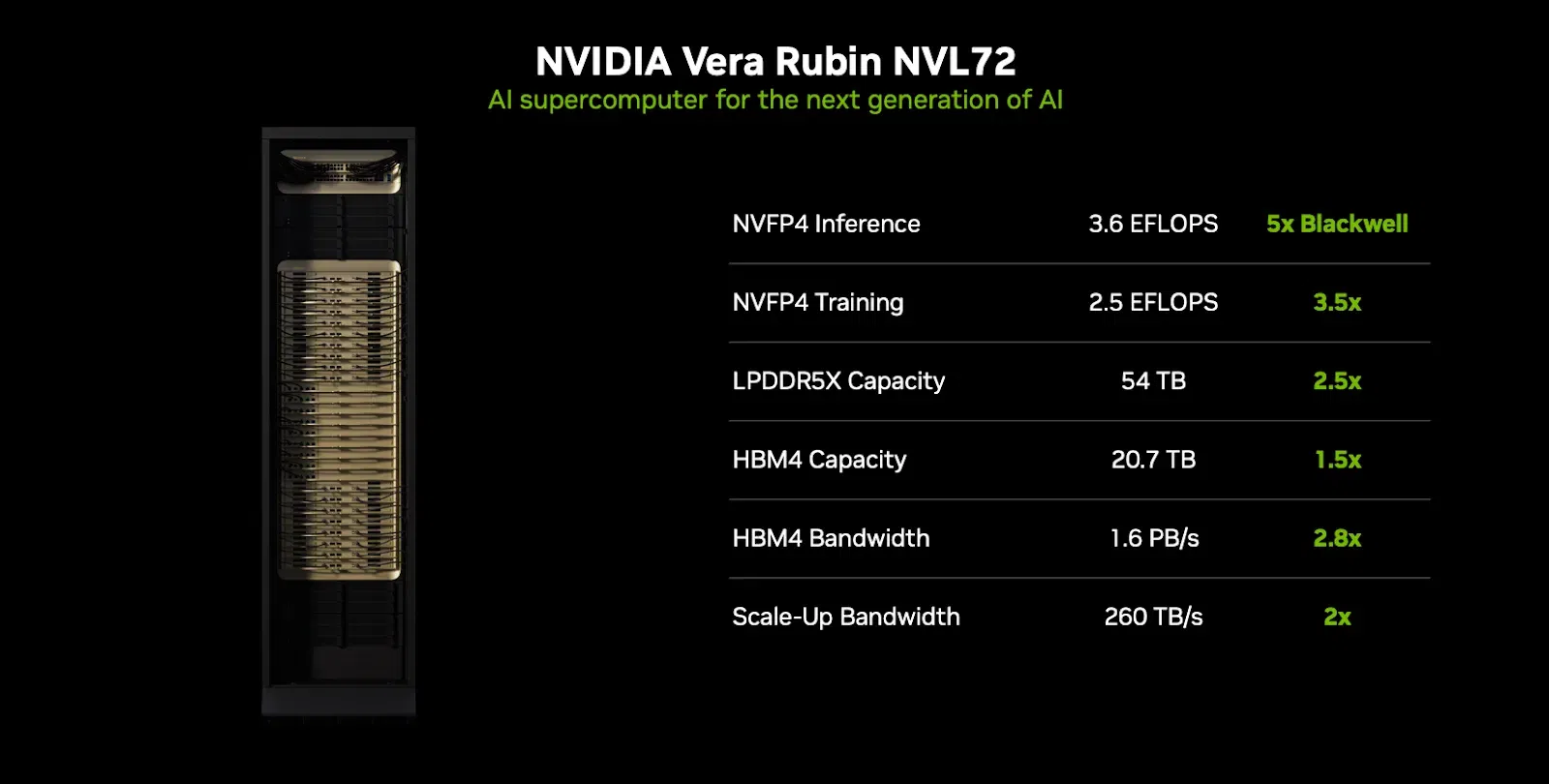
During his CES keynote, Jensen Huang confirmed that the new platform is ready for deployment, saying, “Vera Rubin is now in full production and set to ship later this year.”
This signals that NVIDIA’s next-generation AI technology has moved from research to real-world application, ready for use by cloud providers, research institutions, and industry partners.
Analysts note that this platform will serve as the computational engine for the largest AI models, including those used for reasoning, natural language processing, and autonomous control.
In simpler terms, Rubin is the power grid for the AI age, connecting data, computing, and intelligence into a single ecosystem.
NVIDIA's Push Towards Autonomous Intelligence
Transitioning from infrastructure to application, NVIDIA revealed its Alpamayo series (AI models for autonomous vehicles that go beyond seeing and reacting to actually reasoning like human drivers).
The Alpamayo 1 model features ten billion parameters and uses advanced transformer-based systems to predict traffic behavior and navigate dynamic road conditions. It can also explain its decisions, an essential advancement for safety and transparency.
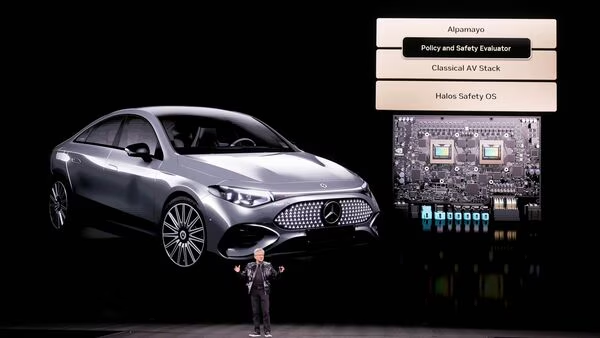
Jensen Huang emphasized that this marks a philosophical shift in AI for vehicles, saying, “We’re teaching cars not just to see, but to think.”
This statement encapsulates NVIDIA’s broader mission: to develop AI that understands intent and context, not just perception.
According to NVIDIA, Mercedes-Benz will be the first automaker to integrate the full Alpamayo stack into its upcoming CLA 2025 model. The technology aims to enable Level 3+ autonomous capabilities, where the car can manage most driving tasks without constant human supervision.
This move is not only technological but strategic. By embedding reasoning AI into vehicles, NVIDIA is positioning itself as the central supplier of intelligence across the automotive industry.
It moves the company beyond chips into software and decision-making systems that define the future of mobility.
Topics For More Insights
NVIDIA Moves Beyond Code Into The Physical World
After redefining computing and mobility, NVIDIA turned attention to Physical AI (a suite of frameworks and open-source models designed to help robots understand and act in the physical world).
The company demonstrated how this technology enables robots to perceive their surroundings, reason through tasks, and perform coordinated actions. This includes humanoid robots, industrial machines, and delivery bots, all powered by NVIDIA’s AI stack.
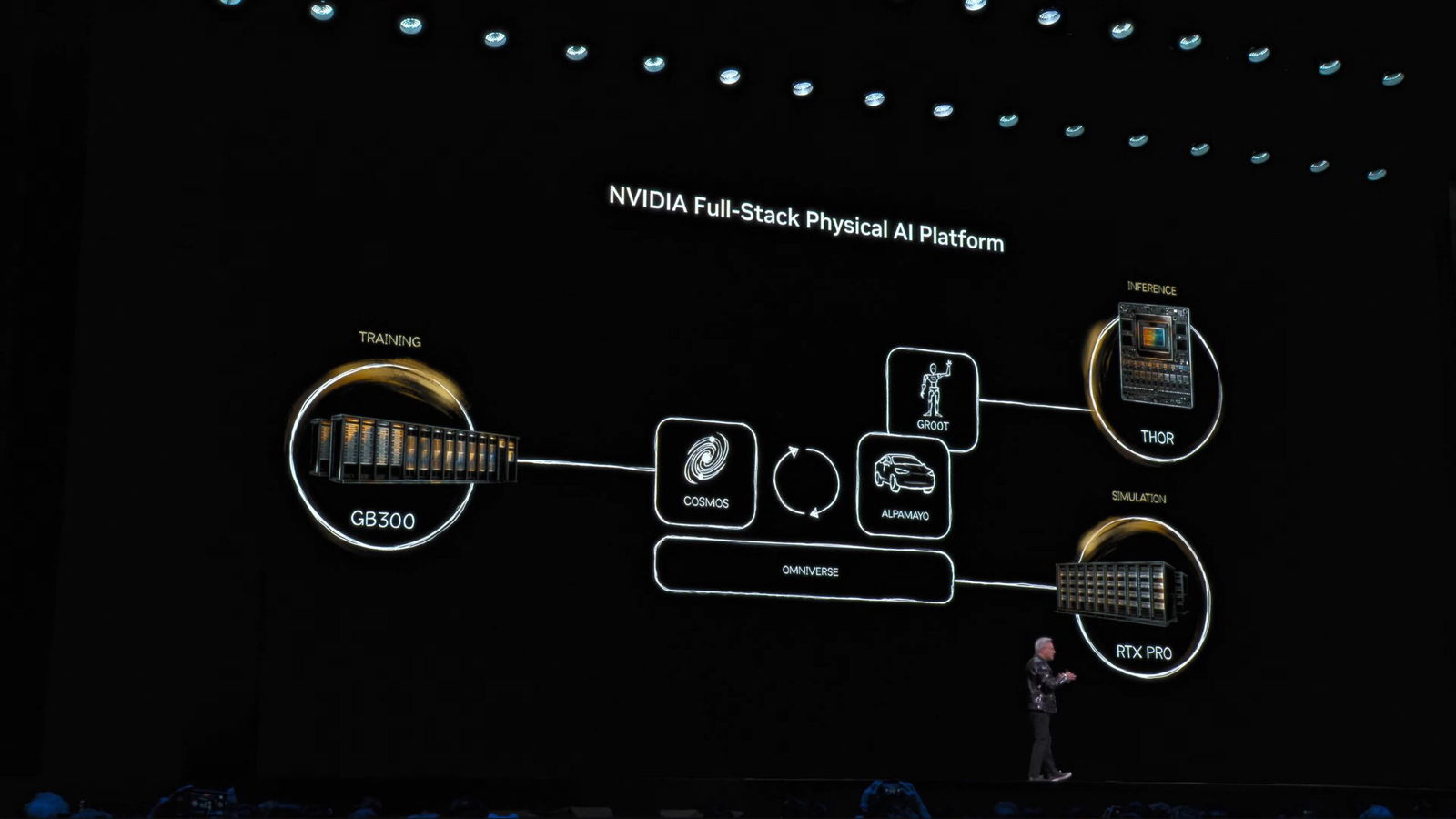
The company introduced several new open models:
- Cosmos Reason 2, a reasoning model for vision and spatial understanding.
- Isaac GR00T N1.6, a control model for humanoid robotics.
- Cosmos Transfer 2.5, a data generation tool for training robotic systems.
NVIDIA’s Vice President of Robotics and Embedded Systems, Deepu Talla, explained, “From industrial arms to humanoid assistants, our open AI models will let anyone build intelligent machines that can perceive, reason, and act safely in the real world.”
This marks a significant step in making robotics more accessible. Instead of requiring vast custom datasets, developers can use NVIDIA’s models to jumpstart their own AI-driven robots and automation systems.
Even companies such as Boston Dynamics, Caterpillar, and LG have demonstrated robots built on NVIDIA’s AI frameworks. These examples show how AI (especially driven by NVIDIA hardware) is crossing from data centers to factory floors and homes, powering machines that physically engage with their surroundings.
The theme of “Physical AI” represents the logical next phase of AI’s evolution. After mastering text, image, and speech, AI is now moving into the realm of touch, motion, and environmental understanding (essentially, machines that can do more than compute; they can participate).
Industry And Market Reactions
The announcements resonated across both the technology and investment communities. Many see NVIDIA’s moves as a natural extension of its dominance in AI computing. With the Vera Rubin platform expected to underpin the next generation of AI factories and autonomous systems, investors and analysts view the company as central to how AI will operate in practical settings.
Huang’s remarks were described by attendees as visionary yet grounded. He said, “AI will be everywhere, in every industry, transforming everything we touch.”
This statement reflects not just NVIDIA’s ambitions, but a shared industry sentiment: AI is no longer a separate category—it’s the foundation of all future technology.
Financial analysts noted that NVIDIA’s strategy aligns with the global shift toward integrating AI into every process (from logistics and energy to entertainment and manufacturing).
By providing the computing foundation and model frameworks, NVIDIA is building what one analyst called “the infrastructure of intelligence.”
What This Means for the Future
The overarching message from NVIDIA’s CES 2026 announcements is clear: AI is no longer abstract software—it’s becoming a living system within physical environments.
The Vera Rubin platform gives enterprises the computing backbone to train and deploy large AI models efficiently. Alpamayo redefines how cars understand and interact with the world, and Physical AI shows that the future of robotics will be powered by open, scalable, and collaborative intelligence.
NVIDIA’s approach positions it not only as a chip manufacturer but also as a builder of a comprehensive AI ecosystem (powering everything from data centers and cars to robots and cities).
As Huang summarized during the keynote, “The next wave of AI will not be about text and pixels. It will be about robots, vehicles, and systems that live in our world and make it better.”
