
Artificial Intelligence
NVIDIA Reports Strong AI-Driven Growth & Eases Bubble Fears
Updated on Thu, Nov 20, 2025
Share
The news came just as debates over AI valuations intensified, with many analysts questioning whether hyperscalers and startups could continue pouring billions into data-center buildouts.
NVIDIA’s performance, however, suggested demand for high-end AI hardware remains solid.
Here are the key updates from NVIDIA’s results.
NVIDIA Reports Accelerating Growth After Months Of Market Jitters
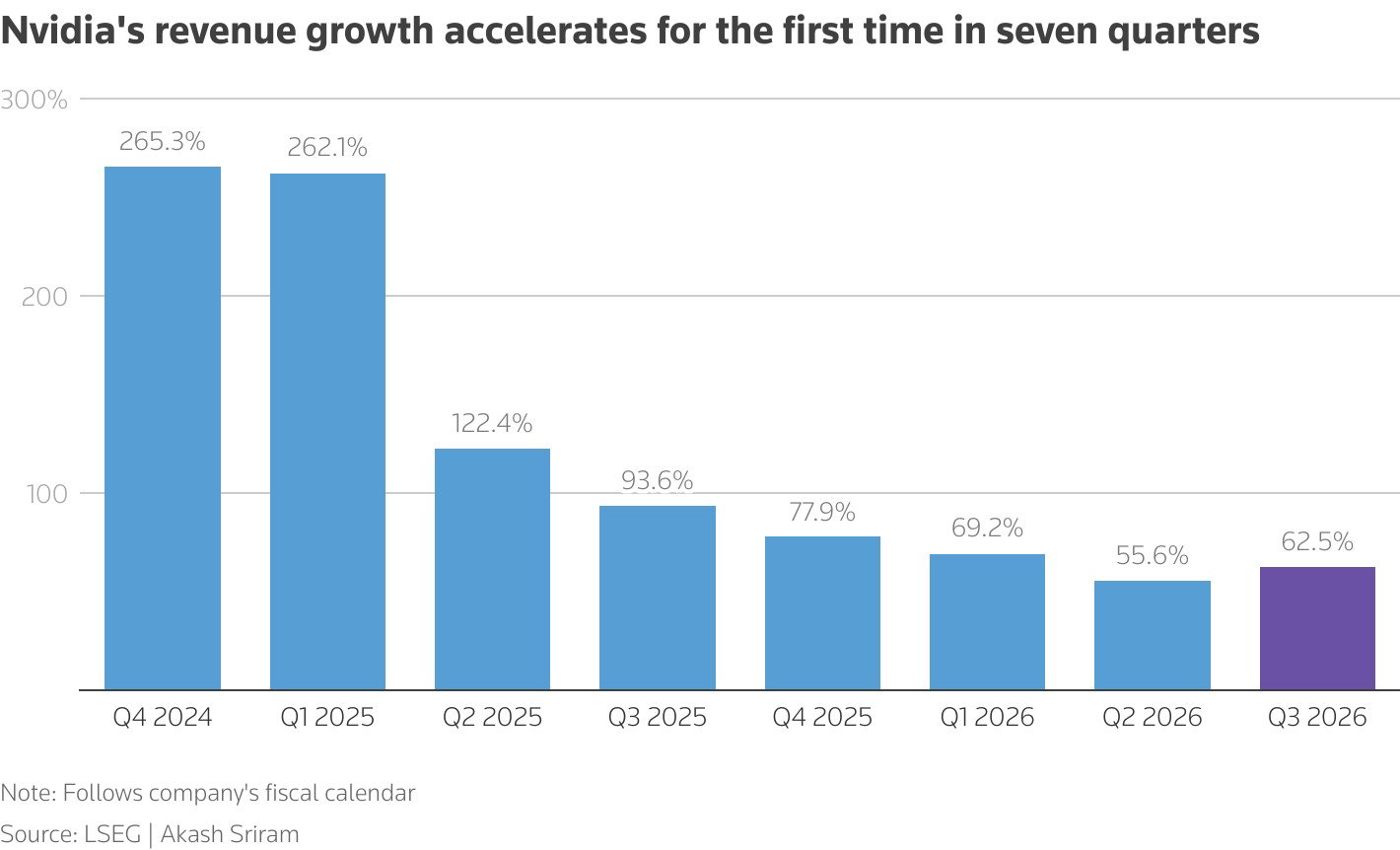
NVIDIA’s third-quarter revenue jumped 62% year-on-year, the first growth boost in seven quarters, with strong demand for its AI data-center GPUs. Revenue from that segment reached $51.2 billion, above analyst expectations of $48.6 billion.
The company also expects fourth-quarter revenue of $65 billion, well ahead of Wall Street’s average estimate of $61.6 billion. NVIDIA projected an adjusted gross margin of about 75%, and CFO Colette Kress said the company aims to maintain margins in the mid-70% range through fiscal 2027.
Shares rose 5% in extended trading following the announcement.
This renewed momentum comes as CEO Jensen Huang continues to push back against talk of an AI bubble. On the earnings call, Huang reiterated his belief that AI investment remains grounded in long-term transformation rather than short-term hype.
“There’s been a lot of talk about an AI bubble. From our vantage point, we see something very different,” he said. “Developers want NVIDIA because our architecture runs everywhere—cloud, on-premise, edge devices, robots, and PCs. Things just work.”
Huang also repeated that NVIDIA has $500 billion in bookings through 2026 for its advanced chips.
Global Tech Stocks Get A Boost From NVIDIA’s Results
NVIDIA’s strong forecast set off a wave of gains across global markets. U.S. futures rose 1%, indicating a stronger open for the S&P 500 after several choppy weeks.
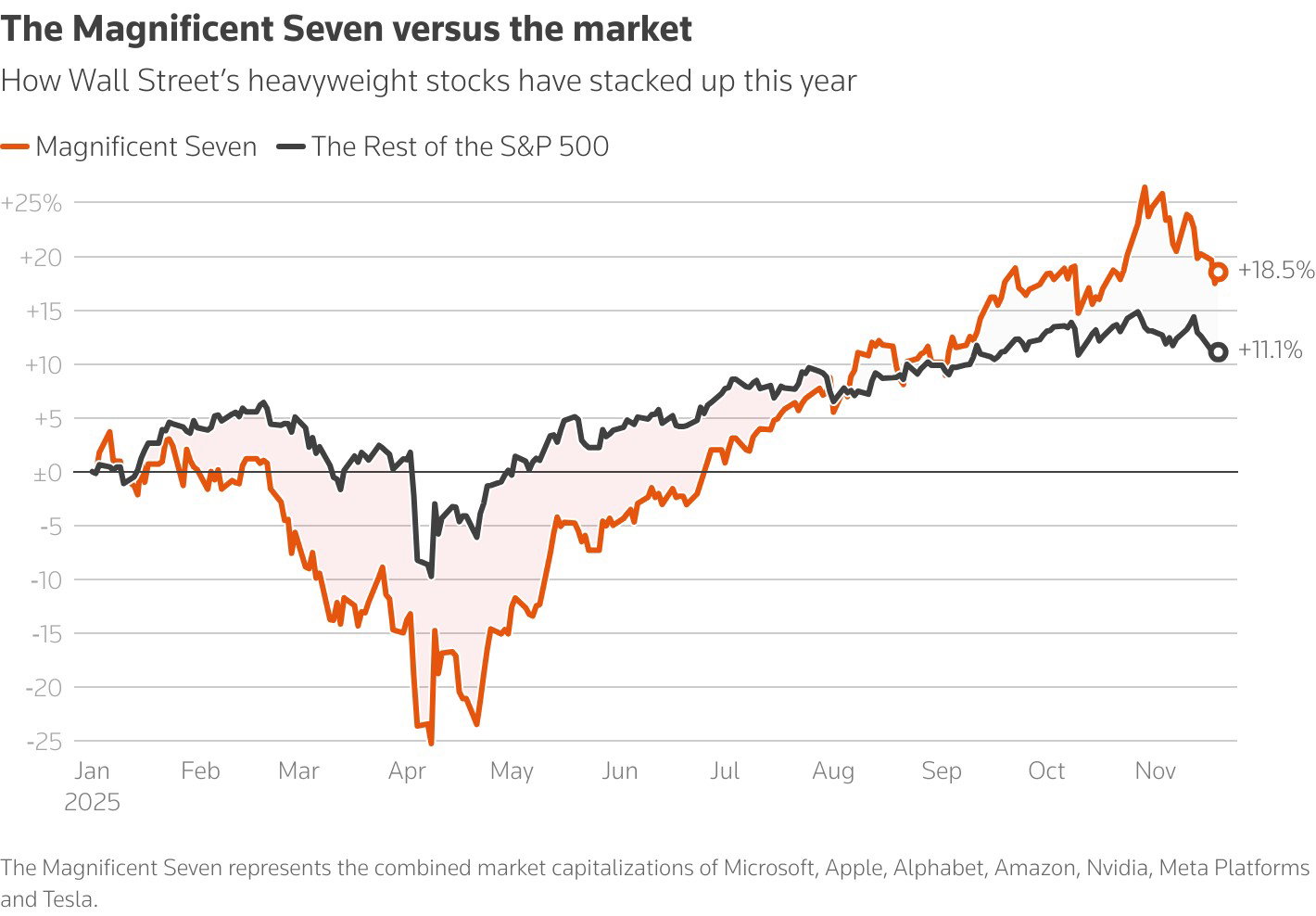
In premarket trading:
-
AMD and Intel climbed between 2% and 5%.
-
Alphabet and Microsoft moved higher.
-
Taiwan’s TSMC rallied over 4%.
-
Japan’s Nikkei returned above the 50,000 level.
-
European chipmakers, including ASML, rose more than 2%.
If gains hold, NVIDIA is on track to add roughly $243 billion in market value—more than the combined worth of several major Fortune 500 companies.
J.P. Morgan analysts described the results as: “A beat-and-raise that was stronger than most anticipated and a signal that AI demand remains resilient.”
NVIDIA stock has now gained nearly 40% year-to-date and continues to be the market’s primary gauge of AI spending behavior.
Still, some analysts say NVIDIA’s latest beat doesn’t fully address the long-term risks surrounding AI infrastructure spending.
Analysts Warn Of Concentration Risks And Circular AI Funding
Despite the enthusiastic market reaction, concerns remain about whether current AI spending levels are sustainable.
A regulatory filing showed that 61% of NVIDIA’s revenue last quarter came from just four customers, up from 56% in the previous quarter.
While the company does not disclose names, industry expectations point to Microsoft, Meta, Oracle, and possibly Amazon.
At the same time, NVIDIA has significantly expanded its investments in the very companies driving its demand.
The firm recently committed:
-
Up to $100 billion to OpenAI.
-
An additional $10 billion to Anthropic.
-
An increase to $26 billion in chip rental contracts with cloud providers—more than double the previous quarter.
These moves have fueled talk of a “circular AI economy,” where customers and vendors increasingly fund each other.
Summit Insights analyst Kinngai Chan noted: “While results and guidance were strong, investors will remain cautious about the sustainability of hyperscaler capex and the circular financing in the AI space.”
Chaim Siegel of Elazar Advisors observed: “A lot of this growth is coming from loss-making startups. Unless spending slows across the board—which is unlikely—the cycle could eventually unwind.”
NVIDIA Faces Growth Constraints Beyond Demand Alone
NVIDIA’s challenges are not limited to customer concentration. The company remains restricted from selling its most advanced chips to China due to U.S. export controls. To compensate, NVIDIA has begun expanding into the Middle East.
The U.S. Commerce Department recently authorized the export of up to 35,000 Blackwell chips to two firms in Saudi Arabia and the United Arab Emirates, reportedly worth more than $1 billion.
However, even if demand holds, physical barriers may slow growth. Land availability, power constraints, and utility connections for AI data centers are emerging as bottlenecks.
Jacob Bourne of eMarketer said: “GPU demand is enormous, but the question is whether hyperscalers can deploy this capacity fast enough. Power, land, and grid access may slow revenue growth beyond 2026.”
Huang addressed these concerns during the call: “We’ve built partnerships across land, power, financing, and data-center infrastructure. None of these challenges are simple, but they are solvable.”
As debates continue about whether AI is entering a bubble phase or reaching a new technological turning point, NVIDIA is positioning itself firmly on the side of long-term transformation.
Huang Says AI Is At A Tipping Point—Not A Bubble
Huang outlined three major shifts he believes will define the next era of computing:
-
Traditional software moving from CPUs to GPU acceleration.
-
AI-native tools, such as coding assistants, are becoming mainstream.
AI expanding from virtual applications to physical systems—including robots and autonomous machines.
His message was clear: NVIDIA expects AI adoption to grow across industries for years, not months.
Do NVIDIA’s latest results point to a durable AI boom, or are these gains temporary before broader industry risks surface?
Let us know what you think in the comments section below!
First published on Thu, Nov 20, 2025

Enjoyed what you've read so far? Great news - there's more to explore!
Stay up to date with the latest news, a vast collection of tech articles including introductory guides, product reviews, trends and more, thought-provoking interviews, hottest AI blogs and entertaining tech memes.
Plus, get access to branded insights such as informative white papers, intriguing case studies, in-depth reports, enlightening videos and exciting events and webinars from industry-leading global brands.
Dive into TechDogs' treasure trove today and Know Your World of technology!
Disclaimer - Reference to any specific product, software or entity does not constitute an endorsement or recommendation by TechDogs nor should any data or content published be relied upon. The views expressed by TechDogs' members and guests are their own and their appearance on our site does not imply an endorsement of them or any entity they represent. Views and opinions expressed by TechDogs' Authors are those of the Authors and do not necessarily reflect the view of TechDogs or any of its officials. While we aim to provide valuable and helpful information, some content on TechDogs' site may not have been thoroughly reviewed for every detail or aspect. We encourage users to verify any information independently where necessary.
Loading comments...