
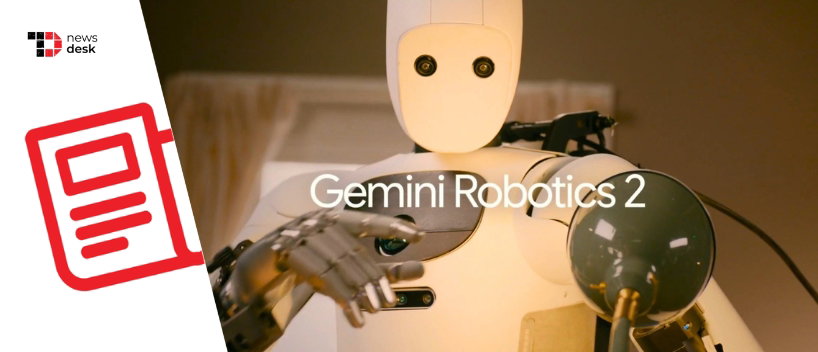
Google DeepMind is pushing robots beyond rigid, pre-programmed routines with Gemini Robotics 2, a new model family designed to help machines reason, move, adapt, and work together across real-world tasks.
TL;DR
- Gemini Robotics 2 adds whole-body control, advanced dexterity, and multi-robot collaboration.
- Gemini Robotics ER 2 acts as a high-level brain that plans tasks, tracks progress, and corrects mistakes.
- The model reaches 91.3% moment-finding accuracy and runs four times faster than larger model categories.
- Developers can access ER 2 through the Gemini API and Google AI Studio.
Google Gemini Robotics 2 Brings Whole-Body Intelligence To Robots
Most robots still rely on narrow programming or human control.
Gemini Robotics 2 is designed to close that gap by connecting vision, language, reasoning, and physical movement.
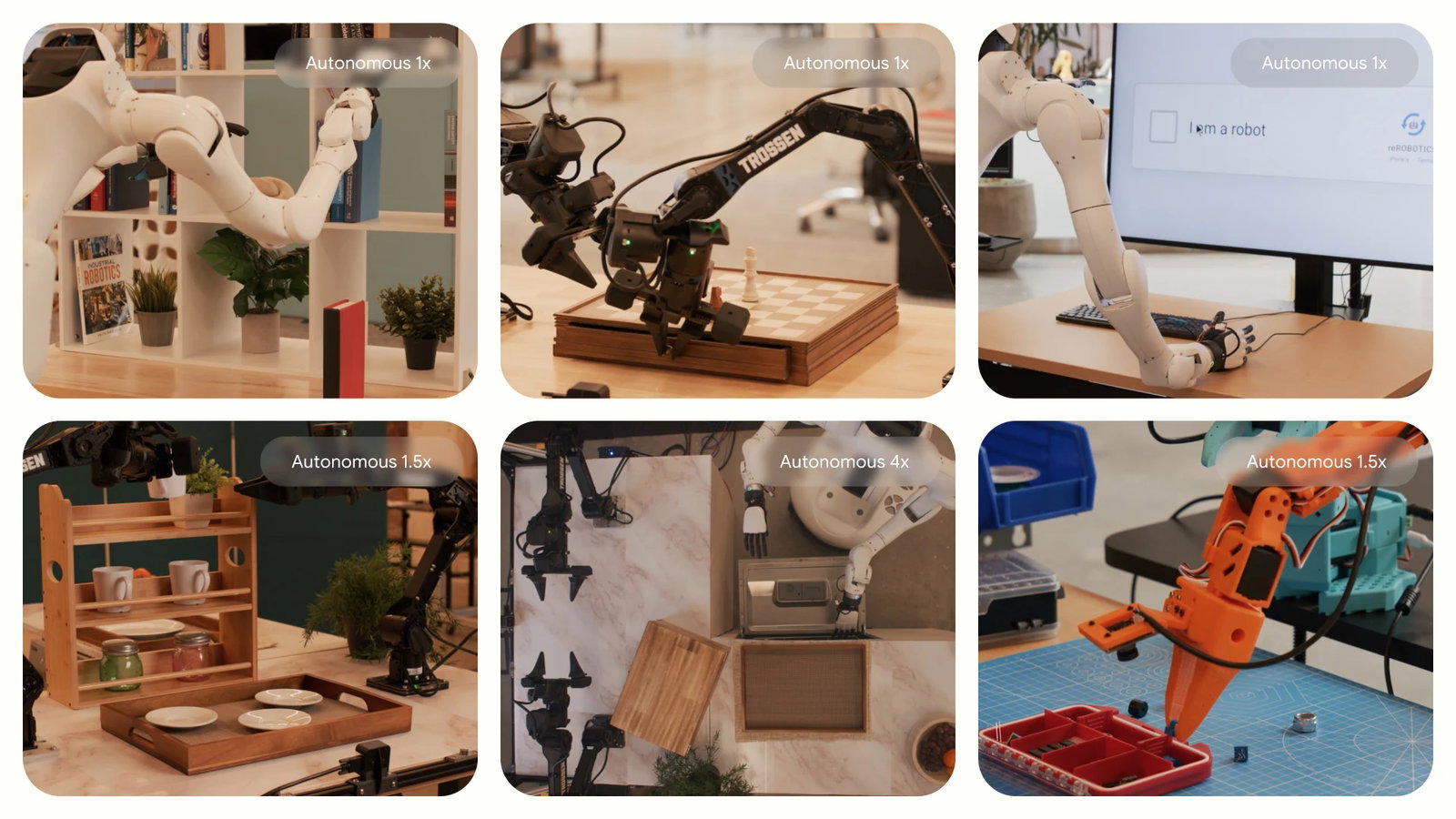
The main Gemini Robotics 2 vision-language-action model can control humanoid bodies, from feet to fingertips. It can help a robot walk, crouch, stretch, manipulate objects, and complete tasks such as cleaning a cluttered room.
Google DeepMind says the system can adapt to new robot bodies with only a few hours of data. Its Gemini Robotics On-Device 2 model brings those capabilities directly to robotic devices.
Gemini Robotics ER 2 Plans Tasks While Robots Keep Moving
The change comes from Gemini Robotics ER 2, an embodied reasoning model that serves as the robot’s decision-making layer.
“Think of Gemini Robotics ER 2 as a high-level brain for robots,” Google DeepMind said.
The model observes the environment, determines what actions are needed, coordinates with lower-level control systems, and monitors progress until the task is complete. It can also call tools such as Google Search or user-defined functions.
Unlike systems that stop moving while processing the next step, ER 2 can reason while the robot is acting. Its integration with the Gemini Live API uses bidirectional streaming to support lower-latency execution.
Google demonstrated this with Boston Dynamics’ Spot robot, which used natural-language instructions to navigate, move its manipulator, and fetch a popcorn snack.
Gemini Robotics ER 2 Tracks Progress And Fixes Failed Steps
A major robotics challenge is knowing whether a task has been completed correctly. ER 2 watches continuous video feeds to track progress, identify failures, and decide when to move forward.
Its progress classification system divides a task into five completion ranges, from 0% to 100%. This gives robots real-time awareness, allowing them to adjust their actions or retry a failed step without restarting the entire workflow.
The model also improves moment-finding, which identifies the exact point when an action should stop, such as when a cup is full. Gemini Robotics ER 2 achieved 91.3% accuracy with a mean absolute distance of 0.96 seconds, while delivering four times faster execution at a lower compute cost.
Topics For More Insights
Google Gemini Robotics 2 Enables Robots To Work As A Team
Gemini Robotics 2 also introduces multi-robot collaboration. Different machines can share a common understanding, hand off tasks, and complete workflows that one robot could not manage alone.
The system improves safety instruction following and human proximity awareness. In testing, it stopped a humanoid robot when a person entered the area and resumed work only after the space was clear.
Gemini Robotics ER 2 is publicly available through the Gemini API and Google AI Studio, with a private preview on the Gemini Enterprise Agent Platform. Google DeepMind also plans to keep expanding the models toward more complex tasks as it works to make robots more useful in everyday environments.
