
Manufacturing Technology
Atlas: Boston Dynamics' Humanoid Robot At The FIFA World Cup
Share
TL;DR
-
Atlas delivered the match ball during the Brazil versus Norway Round of 16 match at FIFA World Cup 2026.
-
The robot performed famous player celebrations before handing the ball to the referee.
-
Engineers retrained its movement for grass and used radio communication because crowded stadium networks made standard Wi-Fi unreliable.
-
The fifth-generation Atlas is fully electric, production-ready, and substantially simpler to manufacture than earlier versions.
-
Hyundai sees Atlas performing demanding, repetitive, and potentially dangerous industrial tasks.
-
Published specifications include 56 degrees of freedom, a four-hour battery, a 2.3-meter reach, and lifting capacity of up to 50 kilograms.
Introduction
Have you seen Hugh Jackman-starring Real Steel?
It was set in a world where human boxing matches had been banned.
To get their fix of adrenaline, thrills, and betting, people turned to robots to do their dirty work. This was not a WALL-E-type scenario where robots did everything while humans wasted their lives buried in smart-device screens.
* cough cough *
Here, massive robots battling it out in the ring would be controlled by rigs operated by humans placed ringside. The plot follows former boxer Charlie Kenton (Jackman) and his 11-year-old son Max, salvaging and winning with an obsolete but advanced sparring robot called Atom.
Interestingly, the movie was released in 2011 but spoke about a near-future storyline set in 2020. We’re now in 2026, and we have nothing like what the movie showed.
However, in 2026 we do have another massive sporting event: the FIFA World Cup 2026. This event, too, comes with an advanced humanoid robot: Boston Dynamics’ Atlas. It didn’t step into a boxing ring, but it was ready for its own Real Steel moment.
So, what did Atlas do at the biggest sporting event in the world, and what does it bring to the table?
What Was Atlas Doing At FIFA World Cup 2026?
Atlas did not simply make a cameo at the tournament; Hyundai placed it at the center of a historic halftime moment that combined football, robotics, and a little showmanship.
Hyundai Motor Brings Atlas Humanoid Robot To The World Cup
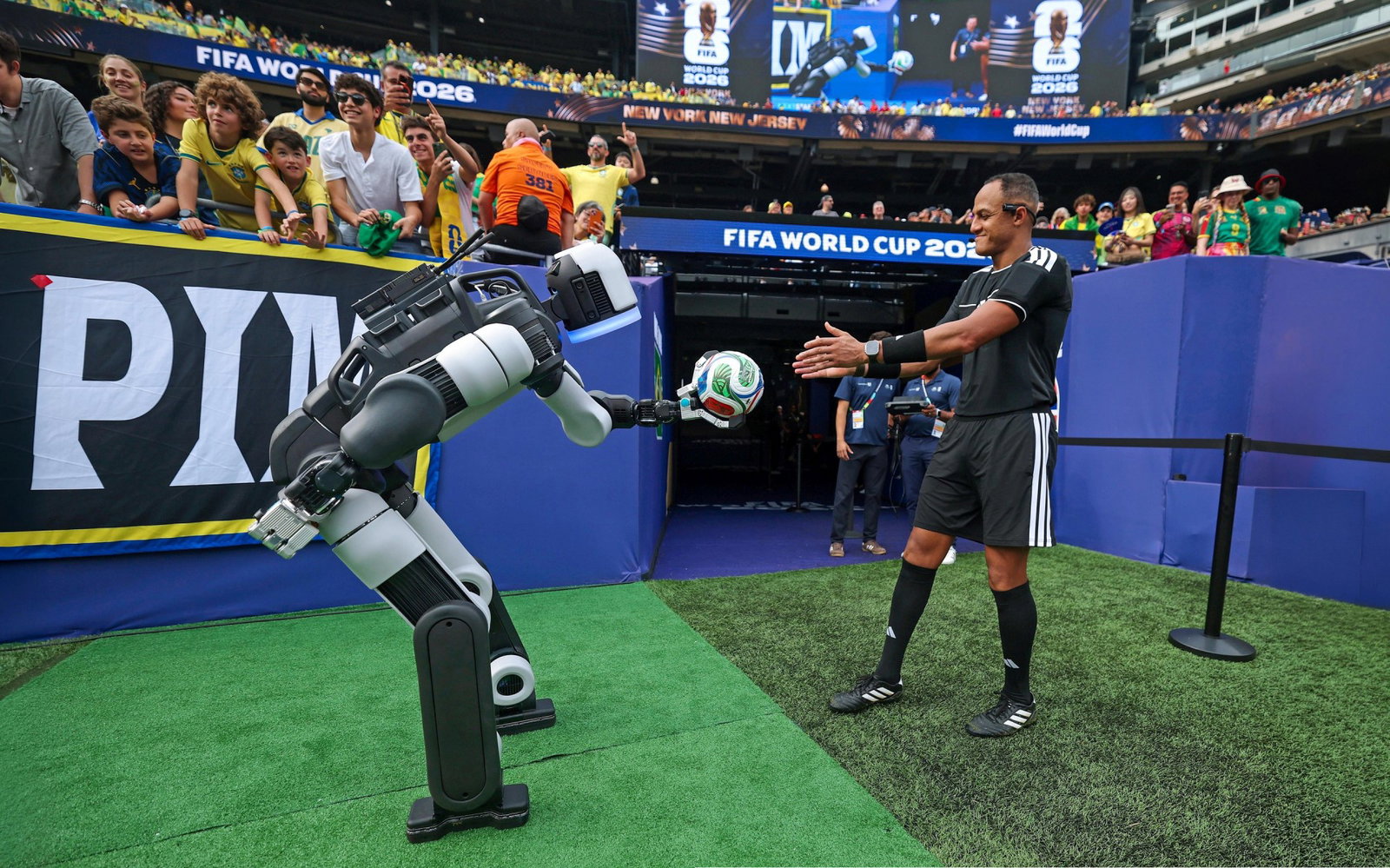
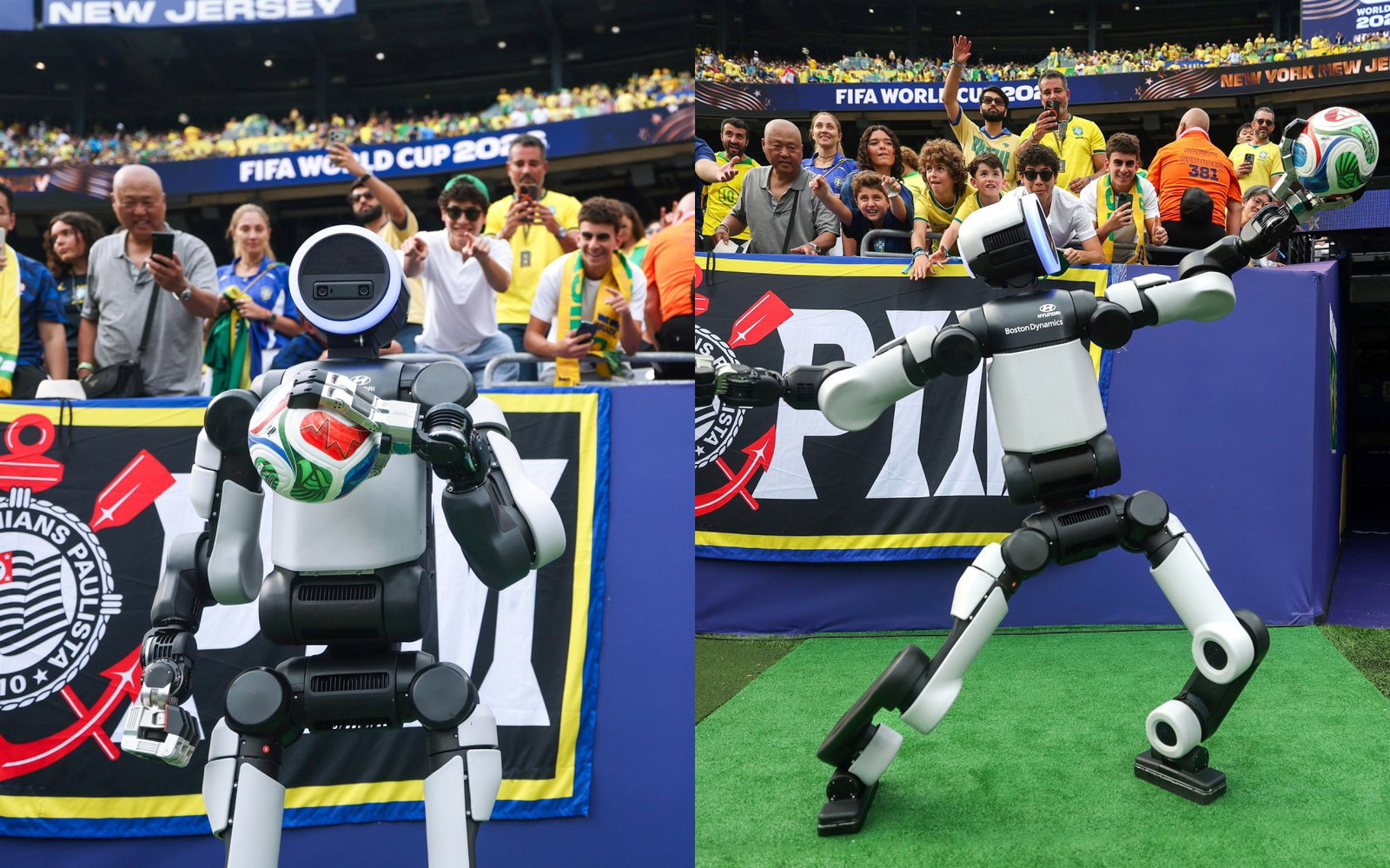
On July 5, 2026, the Boston Dynamics Atlas humanoid robot walked pitchside during halftime of the Brazil versus Norway Round of 16 match at New York New Jersey Stadium.
In front of roughly 80,000 spectators, it performed goal celebrations associated with Harry Kane, Erling Haaland, Matheus Cunha, and Son Heung-min before delivering the match ball to the referee.
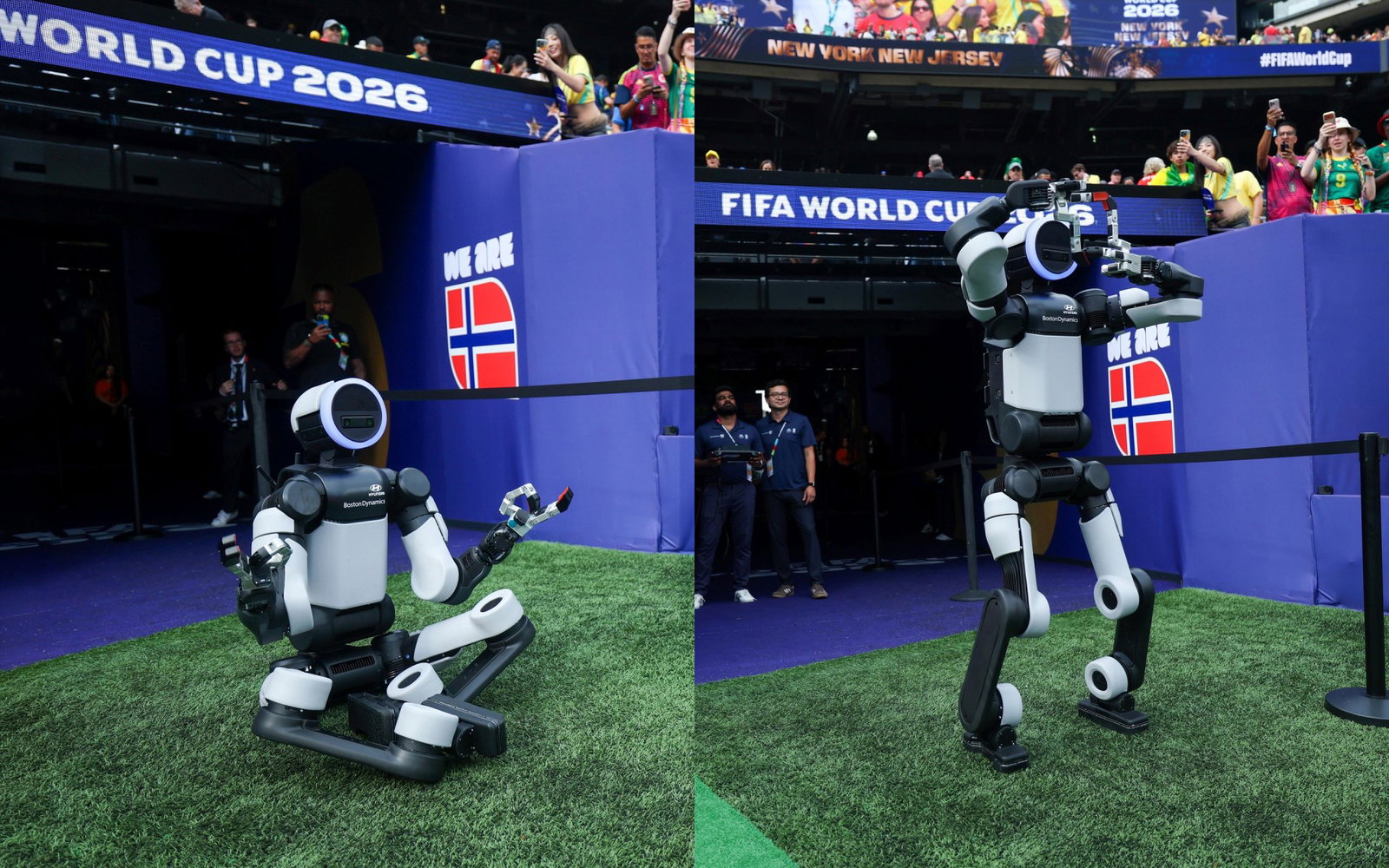
The humanoid robot also partook in Norway’s famous post-match Vikings Row celebration (before the country’s exit from the tournament).
The handoff created a tournament first, placing a humanoid robot inside one of football’s familiar rituals without CGI or a prerecorded sequence.
Presented by Hyundai Motor, a FIFA sponsor and Boston Dynamics’ parent company, Atlas reached an audience far beyond robotics circles. Hyundai's humanoid robot FIFA debut showed the machine entering a human environment, maintaining balance, and completing a complex task under intense public scrutiny.
The appearance capped Hyundai’s School of Football campaign, which took Atlas from basic footwork to the Ghost Rabona, a deceptive cross-leg kick demanding timing, balance, and full-body coordination.
However, preparing a soccer-playing humanoid robot for live football conditions introduced challenges that do not exist in a controlled laboratory.
Why Grass And Stadium Connectivity Changed The Plan
Grass can slip beneath one step and catch a foot during the next, so Boston Dynamics retrained Atlas to stay stable as surface friction changed.
Thousands of connected phones also made standard Wi-Fi unsuitable. Engineers instead used a dedicated radio link through a device attached to Atlas’ back.
The audience saw a halftime spectacle. Engineers saw a live test of movement, communication, and reliability in an unpredictable environment. Understanding its importance means looking beyond football and at the work Atlas was built to do.
What Is Boston Dynamics’ Atlas All About?
Atlas is a human-scale industrial machine designed to operate in spaces and at workstations created for people.
The latest Boston Dynamics' advanced humanoid robot is fully electric, autonomous, and intended for demanding manufacturing tasks rather than professional sport.
For over a decade, Boston Dynamics used earlier Atlas generations to study balance, whole-body control, perception, strength, and manipulation. Parkour, dancing, lifting, and backflip demonstrations helped engineers understand how a legged machine could coordinate its body and recover during complex actions.
The production model applies those lessons to industrial work. It can learn behaviors, use multiple control modes, integrate with workflows, and share trained capabilities across fleets.
Atlas has therefore shifted from a research platform into a product designed around repeatability, safety, serviceability, and business value. Turning that research icon into a scalable product also required an owner with serious manufacturing experience.
Who Owns Atlas Robots?
Hyundai Motor Group acquired an 80% controlling stake in Boston Dynamics in 2021, while SoftBank retained 20%. Following subsequent ownership changes, SoftBank’s stake fell to 9.65%, leaving Hyundai Motor Group, its affiliates, and Executive Chair Euisun Chung with the remaining 90.35%.
In June 2026, Hyundai was reported to be acquiring SoftBank’s final 9.65% for $325 million. Once completed, Hyundai-related shareholders would own 100%, SoftBank would hold 0%, and Boston Dynamics would become a wholly owned Hyundai subsidiary.
This ownership gives Atlas a direct route from robotics research to large-scale manufacturing through a company that builds millions of cars annually and already knows how to manufacture at scale. Of course, that expertise has been applied to the Hyundai Boston Dynamics Atlas robot program since it became involved.
How Did Atlas Evolve Into Its Newest Generation?
Atlas began as a hydraulic research machine built to explore mobility in human environments. Early versions ran, balanced, lifted objects, navigated obstacles, danced, and performed parkour, helping Boston Dynamics develop expertise in dynamic whole-body control.
A major reset arrived in April 2024 with the all-electric Atlas. Electric actuation reduced noise and complexity while supporting better efficiency, maintenance, and commercial deployment.
During 2025, engineers focused on automotive part sequencing. They improved 2D and 3D perception, gripper durability, fine manipulation, natural movement, reinforcement-learning policies, and real-time adaptability. Atlas was also tested at Hyundai’s Georgia metaplant.
In January 2026, Boston Dynamics and Hyundai unveiled the production-ready fifth generation. The Atlas robot had moved from demonstrating what was technically possible to addressing work that could deliver practical value.
That brings us to the key question: what makes Gen 5 different?
What’s New With Boston Dynamics’ Atlas Gen 5?
Atlas Gen 5 may look more capable than its predecessors, but one of its biggest advancements lies beneath the surface: Boston Dynamics has made the robot significantly less complex to build.
A Simpler Robot Built For Scale
The fifth-generation Boston Dynamics humanoid robot was designed with almost an order-of-magnitude reduction in complexity compared with its predecessor.
This does not necessarily mean exactly ten times fewer components, but it does mean far fewer parts and fewer unique parts.
Simplification reduces supply-chain demands, shortens assembly, limits potential failure points, improves reliability, and lowers manufacturing costs. Atlas can therefore match or exceed earlier performance while becoming easier to build, maintain, and scale.
That shift matters because humanoids cannot become viable industrial products if every unit remains an expensive, delicate, hand-built prototype. Hyundai’s manufacturing experience offers a path toward volume production, while factory deployments provide real-world data for improving the system.
Atlas is also built for greater uptime. It can autonomously replace its battery and is designed to be cleaned, serviced, and maintained in the field.
Trained Behaviors Replace Rigid Sequences
Atlas still depends on engineered software, but many complex movements are trained using human demonstrations, motion capture, reinforcement learning, and physics-based simulation.
For its football routine, engineers provided examples of human movement and allowed the system to practice under changing conditions. Simulations altered friction, ball position, body measurements, and other variables, teaching Atlas to maintain a behavior even when reality was imperfect.
Boston Dynamics separates this capability into physical and reasoning intelligence. Physical intelligence manages balance, locomotion, lifting, and manipulation. Reasoning intelligence helps the system interpret a task, divide it into steps, and adapt as conditions change.
This combination could let the Boston Dynamics robot learn new factory duties through demonstrations instead of lengthy manual reprogramming. The World Cup routine was flashy, but its training method points toward far more practical work.
The software explains how Atlas learns. Its specifications show what the hardware can handle.
Boston Dynamics’ Atlas Technical Information
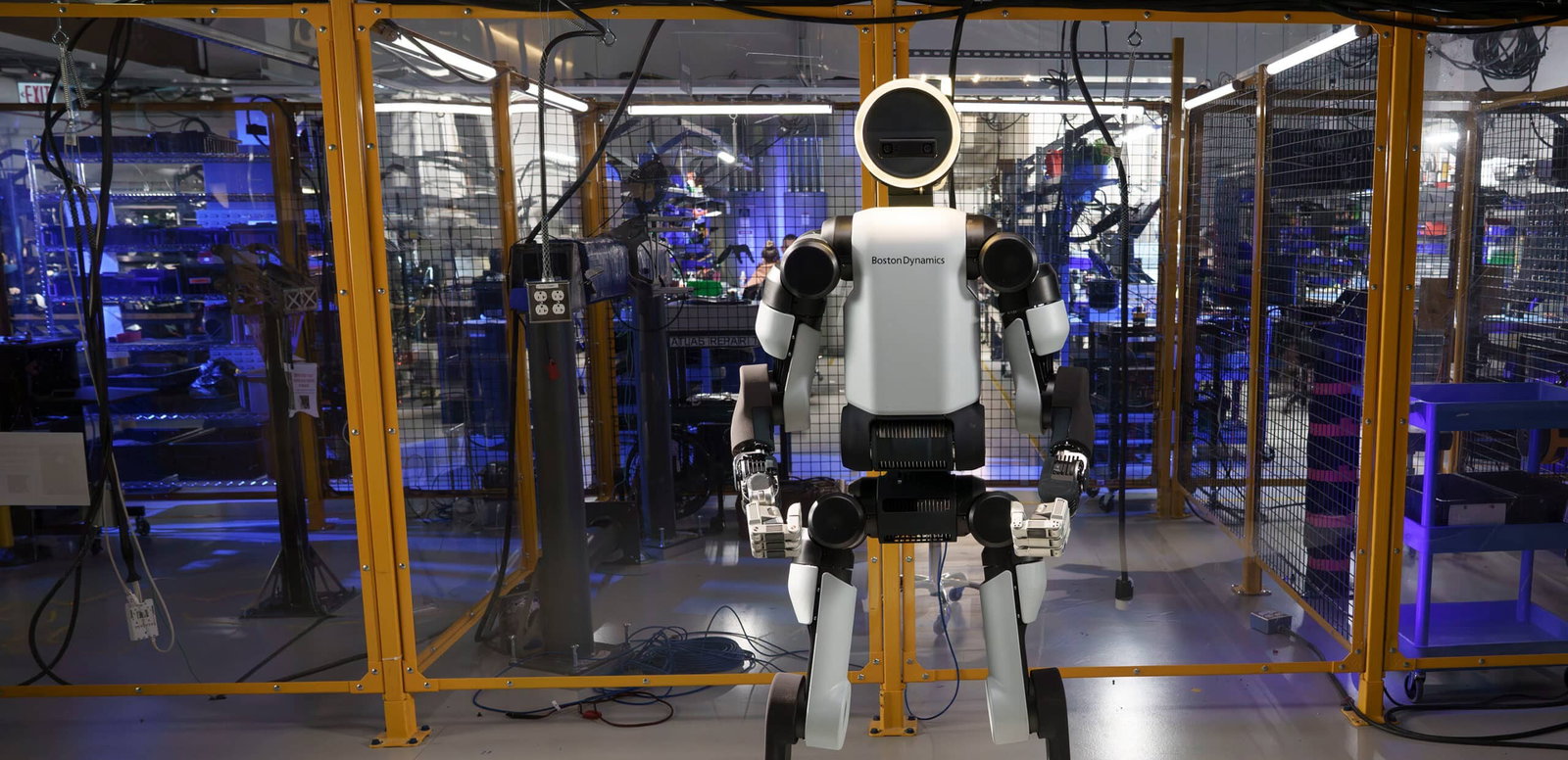
Between the choreography and match-ball delivery, it is easy to forget that Atlas is an industrial machine with a highly specific set of capabilities. Its specifications reveal a human-scale robot engineered for strength, mobility, continuous operation, and safe deployment.
Its legs let it use existing workspaces, cross gaps, climb steps, adjust its stance, and reach through confined spaces without wide wheeled bases.
| Category | Atlas Gen 5 Specifications |
| Height | 1.9 meters or 6.2 feet |
| Weight | 90 kilograms or 198 pounds |
| Degrees of freedom | 56 |
| Sensing | Tactile fingers and palms with a 360-degree camera view |
| Maximum reach | 2.3 meters or 7.5 feet |
| Instant lifting capacity | 50 kilograms or 110 pounds |
| Sustained lifting capacity | 30 kilograms or 66 pounds |
| One-handed lifting capacity | 20 kilograms or 44 pounds |
| Standard battery life | Approximately 4 hours |
| Battery life during heavy lifting | Approximately 2 hours |
| Autonomous battery swap time | Around 3 minutes |
| Battery charging time | Approximately 1.5 hours |
| Charging requirements | Standard 110V power, with 220V optional |
| Environmental protection | IP67 dust and water resistance |
| Operating temperature | -20°C to 40°C, or -4°F to 104°F |
| Safety systems | Fenceless guarding and human-detection sensors |
| Operating modes | Autonomous operation, VR teleoperation, and tablet control |
| Manufacturing | Assembled in the United States |
Atlas does not have to sit idle when its battery runs low. It can autonomously travel to a charging station, replace its depleted battery, and return to work, supporting continuous operation across industrial shifts.
Atlas can also swap its four-hour battery autonomously, supporting continuous operation without requiring a worker to stop production for charging.
Operators can leave it to work autonomously, control it through a VR headset, or steer it using a tablet interface. Its human-detection system and fenceless guarding are designed to support.
How Fast Can Atlas Run?
It’s no Kylian Mbappe, but Hyundai Motors’ Atlas is quite speedy compared to other humanoid robots.
Boston Dynamics has not published an official maximum running speed for the production model. Videos show it running, jumping, performing football movements, and recovering its balance, but estimating a figure from footage would be speculation.
Industrial value depends more on reliable movement, payload, reach, perception, safety, and repetition. The World Cup showed athletic confidence. The real test is whether that agility becomes dependable productivity.
Atlas may have entered public consciousness through football, but its next matches will be played on production lines.
Topics For More Insights
Conclusion
Atlas has come a long way from viral backflip videos. Backed by Hyundai's manufacturing scale and built on a simpler, trained-not-programmed design, it's now headed for factory floors, with its FIFA World Cup 2026 halftime appearance serving as the clearest proof yet that Boston Dynamics' humanoid robot can perform reliably outside a lab, on grass, under pressure, and in front of a global audience.
Frequently Asked Questions
Is Atlas Available For Commercial Use?
Boston Dynamics introduced its production-ready version in January 2026 and announced initial deployments with Hyundai and Google DeepMind. Broader purchasing details, pricing, and delivery timelines may vary as manufacturing expands and early workplace deployments generate operational data.
Is Atlas Designed Only For Factory Work?
Its current commercial focus is industrial automation, particularly physically demanding, repetitive, and potentially hazardous tasks. Athletic demonstrations help engineers test balance and coordination, but they do not mean the system is being developed primarily for sports or home use.
Is Atlas The Same Robot As Boston Dynamics' Spot?
No. Spot is Boston Dynamics' four-legged robot, built for inspection and patrol work, and it was actually deployed at the FIFA World Cup 2026 too, running perimeter security patrols at venues including NY/NJ Stadium and the International Broadcast Center in Dallas. Atlas is the separate, bipedal humanoid platform built for manipulation and mobility tasks like part sequencing and material handling.
Tue, Jul 14, 2026

Enjoyed what you read? Great news – there’s a lot more to explore!
Dive into our content repository of the latest tech news, a diverse range of articles spanning introductory guides, product reviews, trends and more, along with engaging interviews, up-to-date AI blogs and hilarious tech memes!
Also explore our collection of branded insights via informative white papers, enlightening case studies, in-depth reports, educational videos and exciting events and webinars from leading global brands.
Head to the TechDogs homepage to Know Your World of technology today!
Disclaimer - Reference to any specific product, software or entity does not constitute an endorsement or recommendation by TechDogs nor should any data or content published be relied upon. The views expressed by TechDogs' members and guests are their own and their appearance on our site does not imply an endorsement of them or any entity they represent. Views and opinions expressed by TechDogs' Authors are those of the Authors and do not necessarily reflect the view of TechDogs or any of its officials. While we aim to provide valuable and helpful information, some content on TechDogs' site may not have been thoroughly reviewed for every detail or aspect. We encourage users to verify any information independently where necessary.
Loading comments...