
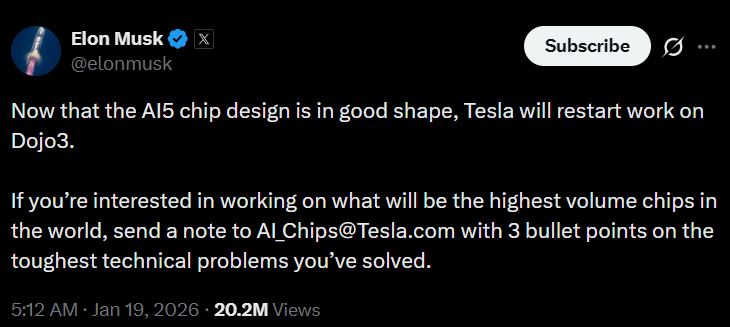
After months of silence on the fate of Tesla’s in-house AI supercomputer project, Elon Musk has revealed that the company is officially restarting Dojo3, and this time, it is headed beyond Earth.
Musk says the new system will be focused on “space-based AI compute,” marking one of the boldest technological shifts yet in Tesla’s AI and chip roadmap.
The announcement, made via Musk’s X (formerly Twitter) account, follows significant progress on Tesla’s AI5 chip and signals an expansion of the automaker’s ambitions into orbital computing, an entirely new frontier for artificial intelligence.
Here's everything you need to know.
TL;DR
- Tesla is restarting its Dojo3 project, which was previously shelved in 2025.
- Elon Musk says Dojo3 will focus on “space-based AI compute.”
- The restart follows progress on Tesla’s AI5 chip and growing AI hardware ambitions.
- Musk is rebuilding the Dojo engineering team after last year’s dissolution.
- The vision aligns with SpaceX’s satellite infrastructure for orbital deployment.
Tesla’s Dojo3 Takes Flight
Originally designed to train Tesla’s autonomous driving and robotics neural networks, the Dojo supercomputer was Tesla’s answer to Nvidia’s GPU dominance. It featured custom silicon, the D1 chip, optimized for massive AI workloads.
However, the project was paused in 2025 after internal restructuring, with many team members departing to other AI firms.
Now, Musk says Dojo3 will return, not as an Earth-based compute cluster but as an orbital AI computing system potentially powered by solar energy.
“AI7/Dojo3 will be for space-based AI compute,” Musk wrote on X, adding that Tesla is actively hiring engineers to build the highest-volume chips in the world.
What “Space-Based AI Compute” Could Mean
While details remain limited, Musk’s comments hint that Tesla plans to deploy supercomputing hardware in space, possibly via SpaceX’s Starship platform. This would enable data centers powered by continuous solar exposure while sidestepping Earth’s energy and cooling constraints.
Experts suggest that space-based compute could help overcome terrestrial data center bottlenecks, especially as AI training demands skyrocket. However, it would also introduce new challenges such as radiation shielding, cooling in a vacuum, and high launch costs.
If successful, Tesla could pioneer orbital AI infrastructure, merging its automotive AI expertise with Musk’s space operations at SpaceX, a synergy few companies can match.
The AI5–AI7 Connection
According to reports, the Dojo3 revival follows Tesla’s progress on the AI5 chip, which powers both Full Self-Driving (FSD) and the Optimus humanoid robot. Musk described the chip as “in good shape,” clearing the way for a new project phase.
Tesla is reportedly moving toward a nine-month chip design cadence, with AI6 and AI7 already on the roadmap. Industry analysts believe Dojo3 could serve as the training ground for future versions of Tesla’s AI systems, with orbital computing acting as an experimental platform.
Topics For More Insights
Rebuilding The Dojo Team
After the original Dojo team was dissolved in 2025, Tesla began rehiring engineers and chip architects this quarter. Job postings now describe “AI compute design for planetary and orbital environments,” hinting at the project’s scope.
This return comes amid renewed global focus on AI hardware independence. Major players like OpenAI, Meta, and Amazon are investing billions into AI infrastructure, but Musk’s “space compute” pivot could set Tesla apart.
“The vision is to take AI training literally off the planet,” said one Tesla insider familiar with early Dojo3 discussions. “It’s not just about more compute, it’s about energy, autonomy, and scale.”
The Bigger Picture
For now, Musk’s “space-based AI compute” remains a vision, not a launch-ready plan. But given Tesla’s parallel progress in chip design, robotics, and satellite connectivity, it could soon move from concept to prototype.
If realized, Dojo3 could make Tesla the first company to fuse AI supercomputing, chip design, and orbital technology into one vertically integrated ecosystem.
Whether this will redefine Tesla’s role beyond electric vehicles or remain another Musk moonshot remains to be seen, but the stars, quite literally, appear to be the next frontier for AI.
