
Manufacturing Technology
World’s First Metal 3D Printer Designed For Space To Be Tested Aboard The ISS!
Updated on Tue, Feb 13, 2024
Share
After all, 3D printers can be used to make anything, from simple day-to-day objects to complicated human organs and prosthetics to entire houses!
Essentially, 3D printing comes with numerous benefits including rapid prototyping, customization, personalization, reduced resource wastage, on-demand production and more. These advantages come in handy when one needs accurate, intricate and timely designing of objects.
This process includes an industrial process known as Additive Manufacturing (AM), which consists of adding layer upon layer of materials such as plastic, metal, concrete or others.
One such sector that can greatly benefit from this technology is space exploration and emerging manufacturing startups. To address this need of the hour, Airbus and the European Space Agency (ESA) announced some exciting news.
So, what did the two say and how will it benefit space programs? Let’s explore!
What Did Airbus Announce?
-
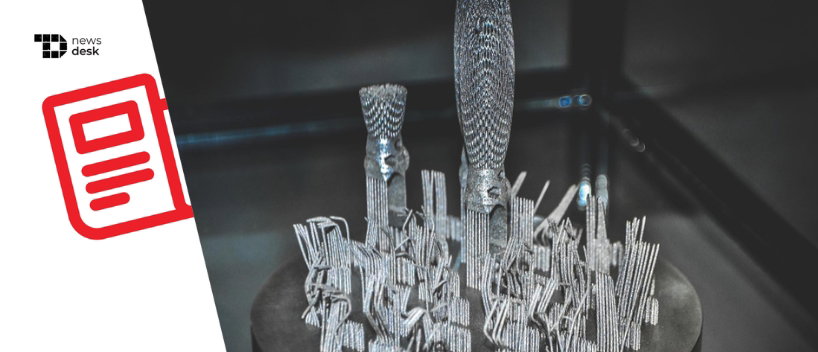
In a news release, Airbus announced that the first metal 3D printer designed for space will be tested aboard the Columbus module of the International Space Station (ISS) soon.
-
As per the release, the technology could be “a real game changer for manufacturing in space and future missions to the Moon or Mars.”
-
The metal 3D printer was developed by a consortium comprising Airbus Defence and Space, AddUp, Cranfield University and Highftech Engineering, which was funded by the European Space Agency (ESA).
-
There already are plastic 3D printers aboard the ISS, the first of which arrived in 2014, which have been used by astronauts to replace and repair plastic parts. However, since not all parts are made of plastic and supplying equipment presents logistical challenges, the metal 3D printer would make life easier for astronauts.
-
Speaking about its benefits, Gwenaëlle Aridon, the lead engineer of Airbus Space Assembly, said, “The metal 3D printer will bring new on-orbit manufacturing capabilities, including the possibility to produce load-bearing structural parts that are more resilient than a plastic equivalent.”
-
[Contd.] “Astronauts will be able to directly manufacture tools such as wrenches or mounting interfaces that could connect several parts together. The flexibility and rapid availability of 3D printing will greatly improve astronauts’ autonomy.”
-
The release further mentioned some key figures and details, which included the printer size measured at 80 x 70 x 40 cm, while the size of printed parts is 9 x 5 cm.
-
The raw material used in the machine would be stainless steel wire, which will be used to repair or manufacture tools, mounting interfaces and mechanical parts.
- The initial plan of parts to be printed in space would be 4 specimens for which the time needed to print a part would be around 40 hours.

What Are The Challenges Of 3D Printing Metal In Space?
-
While 3D printing on Earth has been mastered, 3D printing metal in space comes with numerous challenges, including technical ones.
-
According to Sébastien Girault, metal 3D printer system engineer at Airbus, “The first challenge with this technology demonstrator was size. On Earth, current metal 3D printers are installed in a minimum ten square meter laboratory.”
-
“To create the prototype for the ISS, we had to shrink the printer to the size of a washing machine ... At this size, we can print parts with a volume of nine centimeters high and five centimeters wide.” This was done to fit into the housing rack aboard the ISS Columbus Lab.
-
Girault added, “Gravity management is also key, which is why we chose wire-based printing technology. The wire is independent of gravity unlike the powder-based system, which always has to fall to the ground.”
-
Another challenge included safety concerns caused by the heat generated from the machine’s laser, which is why the printer is housed inside a sealed metal box.
-
Ahead of this, fumes emitted in the process will be captured and filtered within the machine to avoid contaminating the air inside the ISS.
One of the key questions the team is looking to answer is if metal printing is suited to a microgravity environment, which is why there will be two printers used for the test. One will be inside the ISS (flight model), while the other will be on Earth (engineering model).
Four samples will be printed in space and sent back to Earth for analysis and will be compared to similar samples printed on Earth.
Do you think the 3D metal printer will help extend the duration of future space missions? Do you think it would be massively beneficial for future space missions to the Moon and Mars?
Let us know in the comments below!
First published on Tue, Feb 13, 2024

Liked what you read? That’s only the tip of the tech iceberg!
Explore our vast collection of tech articles including introductory guides, product reviews, trends and more, stay up to date with the latest news, relish thought-provoking interviews and the hottest AI blogs, and tickle your funny bone with hilarious tech memes!
Plus, get access to branded insights from industry-leading global brands through informative white papers, engaging case studies, in-depth reports, enlightening videos and exciting events and webinars.
Dive into TechDogs' treasure trove today and Know Your World of technology like never before!
Disclaimer - Reference to any specific product, software or entity does not constitute an endorsement or recommendation by TechDogs nor should any data or content published be relied upon. The views expressed by TechDogs' members and guests are their own and their appearance on our site does not imply an endorsement of them or any entity they represent. Views and opinions expressed by TechDogs' Authors are those of the Authors and do not necessarily reflect the view of TechDogs or any of its officials. While we aim to provide valuable and helpful information, some content on TechDogs' site may not have been thoroughly reviewed for every detail or aspect. We encourage users to verify any information independently where necessary.
Loading comments...