
Artificial Intelligence
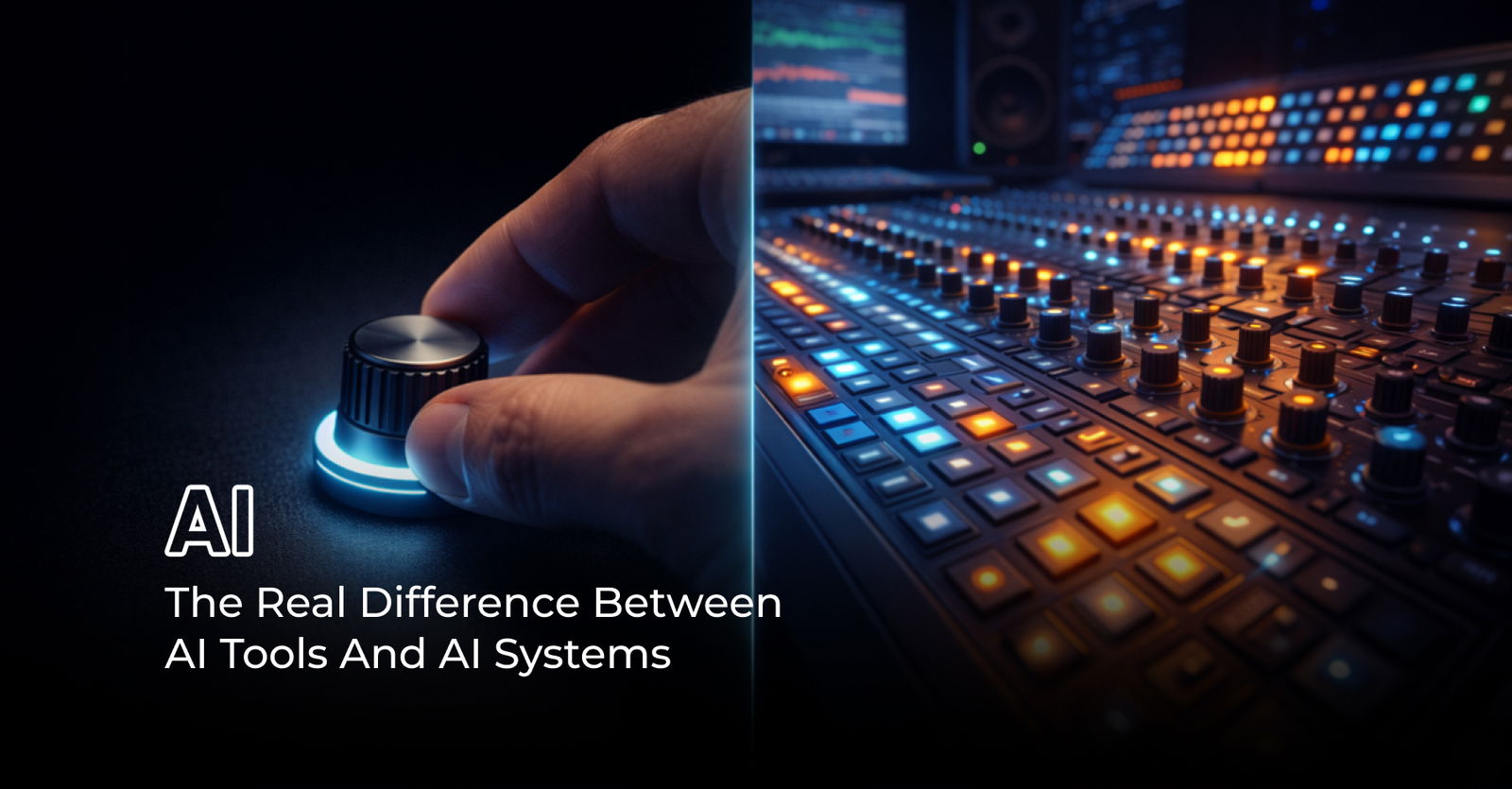
The Real Difference Between AI Tools And AI Systems
Share
Introduction
James Bond.
This is how the famous fictional British spy, code-named 007, introduced himself. An iconic style that trends even today.
A symbol of strength, adventure, and power, James Bond works for the UK’s foreign intelligence agency, the Secret Intelligence Service (SIS), AKA MI6, where he embarks on deadly missions to beat dangerous global villains.
So, how does James Bond relate to the difference between AI Tools and AI Systems?
While he stands out as a one-man army, James Bond isn’t the only agent in MI6. In fact, he was the seventh agent in the prestigious group that possessed a “license to kill.” He’s also supported by other MI6 members who equip him with high-tech gadgets, sophisticated vehicles, and stylish suits.
Essentially, James Bond is like an AI tool, an agent that completes one specific task. Meanwhile, AI systems are like MI6: an integrated framework that houses multiple agents capable of completing a wide range of tasks and working autonomously toward a specific goal.
However, before getting into the fundamental differences between them, let’s explore more about what they’re about.
TL;DR
-
AI tools focus on completing individual tasks with human guidance, while AI systems coordinate multiple tasks to deliver outcomes autonomously.
-
AI tools improve how people work today; AI systems redefine how work operates tomorrow.
-
The real difference lies in scale, consistency, and control, assistance versus end-to-end execution.
What Are AI Tools?
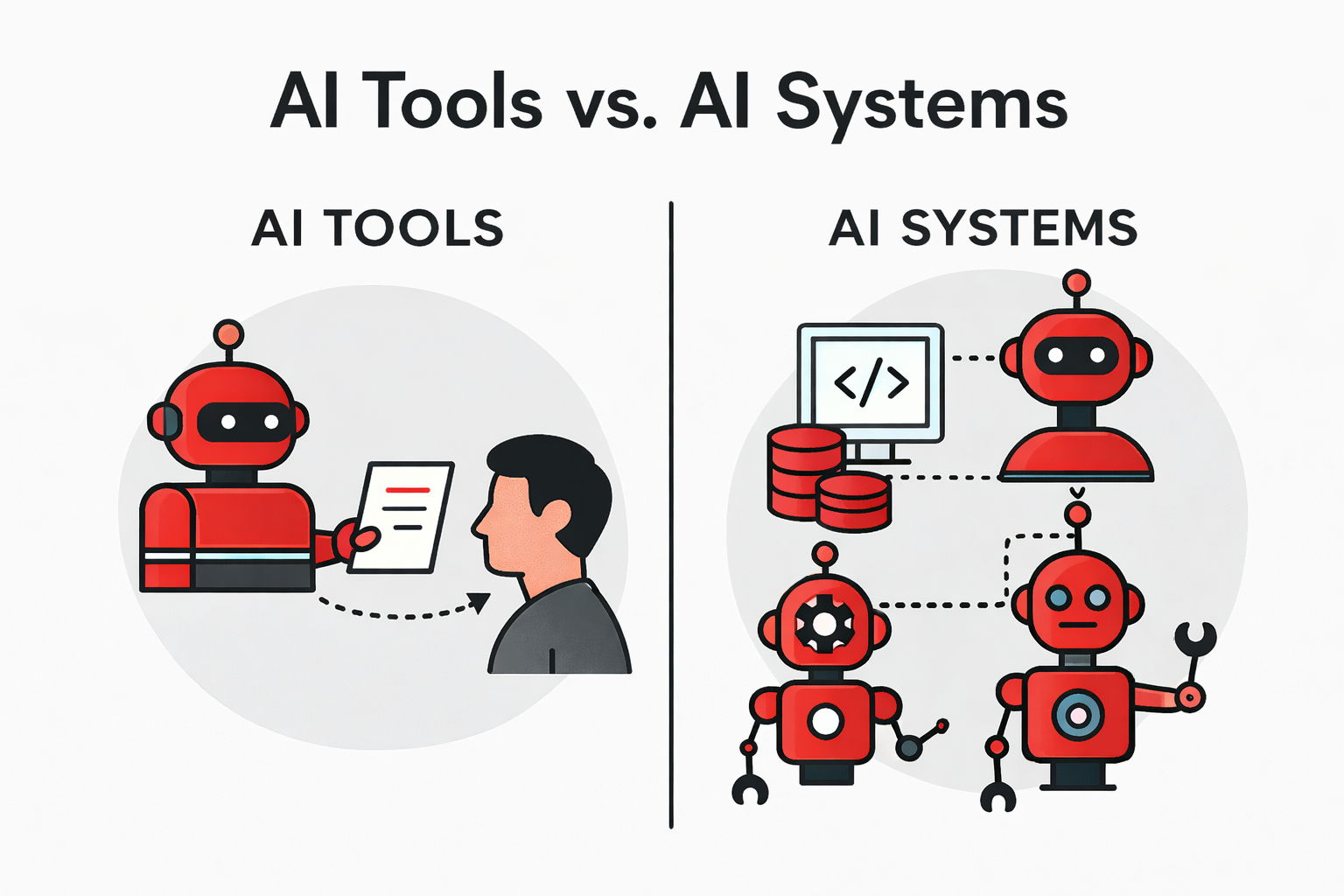
AI tools are specialized, standalone solutions designed for a single task or a small set of interrelated tasks, operating on predefined rules and trained on provided data.
They act as assistants, helping users with one task at a time.
They also require human guidance for delivery; they must be fed data and prompted to generate outputs. Ahead of this, humans play a key role in determining outputs, refining them, and deciding how to proceed.
The tool doesn’t operate beyond what the human-in-the-loop tells it to do.
AI tools include ChatGPT, Gemini, Claude, DALL-E, Midjourney, Canva, ElevenLabs, and more. All these tools perform specific tasks that require human intervention to prompt and manually validate their outputs.
They save time, money, and effort.
According to an MIT study, workers who used ChatGPT completed their tasks in less than half the time than those who didn’t, even after accounting for the additional time required to design prompts and fact-check.
Now, let’s get into the other AI. AI Systems.
What Are AI Systems?
AI systems consist of a variety of AI tools and models that can operate autonomously.
They combine multiple tools, data sources, and other components to complete tasks with minimal human intervention. They’re capable of end-to-end automation, meaning they can complete multiple, diverse steps or actions without requiring human users to review outputs or provide additional prompts during operations.
All humans need to do is set the goal or direction for the AI system to pursue and release it to execute workflows.
They can do this multiple times, repeatedly or simultaneously.
For example, fintech company Klarna found that an AI customer-service chatbot they used could handle customer queries, freeing around 700 agents to focus on other work. It now successfully resolves around 66% of all inquiries autonomously.
Essentially, AI systems are single solutions that integrate multiple AI tools or models, designed to work together or to hand off completed tasks from one tool to another multiple times, without requiring human oversight, input, or intervention.
It transcends human oversight to higher levels of supervision, rather than scrutinizing every output.
What Is The Real Difference Between AI Tools And AI Systems?
So far, we’ve figured out that the main difference between AI tools and AI systems is essentially the same between singular and plural, where the plural form can operate on its own, without needing human intervention.
However, there are more differences, which is what we’re about to explore:
-
Complexity
AI tools can generate outputs only for the specific task they’ve been designed to handle and rely on humans for data, prompts, inputs, and refinement. AI systems comprise multiple models, data flows, and decision layers, enabling them to perform multiple tasks with end-to-end automation without human intervention.
-
Scalability
AI tools offer linear scalability; output increases when more users actively operate them. AI systems offer exponential scalability; workloads can run continuously and grow without adding human operators.
-
Function
AI tools can assist in isolated tasks such as writing, summarizing, or analyzing. They can accelerate productivity for users. AI systems can perform complete business functions by linking multiple tasks together. They deliver outcomes rather than just outputs.
-
Components
AI tools comprise a single, purpose-driven AI model that delivers specific outputs. AI systems combine multiple AI models, data pipelines, infrastructure, orchestration logic, and user interfaces within a single solution.
-
Human Involvement
AI tools require human interaction to initiate tasks, interpret results, and decide the next steps. AI systems primarily require human input for setup and supervision but can operate independently.
-
Consistency
AI tools can produce variable results depending on how different users prompt or apply them. AI systems deliver consistent, repeatable outcomes by following predefined processes and rules.
-
ROI
AI tools help users save money and effort and can reduce turnaround time by around 50%, though results still require manual oversight. AI systems offer significant ROI—some studies noted up to 350%—and can save dozens of hours a week by taking on entire functions.
-
Business Impact
AI tools improve individual productivity within existing workflows. AI systems can reshape workflows entirely, altering how work is structured, delivered, and scaled.
Here’s the comparison between AI Tools and AI Systems:
| Criteria | AI Tools | AI Systems |
| Complexity | Designed for a single, well-defined task and rely on humans for inputs, prompts, and refinement | Built as multi-layered architectures that coordinate models, data, and logic to run entire workflows autonomously |
| Scalability | Scale linearly: output increases only as more users actively use the tool | Scale non-linearly, handling higher volumes continuously without proportional human involvement |
| Function | Assist with isolated tasks such as drafting, summarizing, or analyzing | Execute complete functions by chaining multiple tasks into outcome-driven workflows |
| Components | Consists of a single AI model with a basic interface | Combine multiple AI models, data pipelines, infrastructure, orchestration layers, and user interfaces |
| Human Involvement | Require constant human input to start tasks, review outputs, and make decisions | Require human oversight mainly during setup, exception handling, or strategic supervision. |
| Consistency | Results can vary based on how different users prompt or apply the tool | Deliver consistent, repeatable outcomes through predefined processes and automated execution |
| ROI | Improve individual productivity and can cut task turnaround time by around 50%, but still involves manual oversight | Give high ROI with some implementations reporting up to 350% returns by automating entire functions |
| Business Impact | Enhance efficiency within existing workflows | Transform workflows by redefining how work is structured, delivered, and scaled |
Topics For More Insights
Which One Do You Need?
If you’re new to the world of AI tools and systems, start with AI tools to understand how AI works in practice and where it can immediately support your day-to-day tasks.
Once you’re comfortable, evaluate which tasks can be automated, how much time and effort automation could save, and what additional benefits it could unlock.
If a workflow runs more than once a week, follows the same steps each time, and can be completed faster and more accurately through AI, then AI systems are your new best friend.
Conclusion
AI tools help individuals move faster, while AI systems change how entire workflows operate. One boosts productivity, the other redesigns operations. For businesses, the path is evolutionary, not binary. Start small, learn where AI adds value, then scale toward automation where repetition, volume, and consistency matter most.
The real shift isn’t about choosing smarter software; it’s about choosing how work gets done. The winners won’t be those using more AI, but those using it with intent.
However, before we conclude, one important question must be answered: Are you a fan of James Bond?
Frequently Asked Questions
What Is The Main Difference Between AI Tools And AI Systems?
The main difference lies in scope and autonomy. AI tools are designed to support a single task at a time and rely on humans for prompts, inputs, and decision-making. AI systems combine multiple AI tools, data flows, and logic to run entire workflows autonomously, delivering outcomes rather than just individual outputs.
Should Businesses Start With AI Tools Or AI Systems?
Most businesses should start with AI tools. They are easier to adopt, help teams understand how AI works in real scenarios, and quickly improve productivity. Once workflows become repetitive, time-intensive, and predictable, businesses can transition to AI systems to automate those processes end-to-end.
When Does It Make Sense To Invest In AI Systems Instead Of AI Tools?
It makes sense to invest in AI systems when a workflow runs frequently, follows the same steps, and requires consistent outcomes on a scale. If human involvement is mostly limited to checking results or moving tasks forward, an AI system can take over the entire function and deliver higher long-term ROI.
Tue, Jan 13, 2026

Enjoyed what you read? Great news – there’s a lot more to explore!
Dive into our content repository of the latest tech news, a diverse range of articles spanning introductory guides, product reviews, trends and more, along with engaging interviews, up-to-date AI blogs and hilarious tech memes!
Also explore our collection of branded insights via informative white papers, enlightening case studies, in-depth reports, educational videos and exciting events and webinars from leading global brands.
Head to the TechDogs homepage to Know Your World of technology today!
Disclaimer - Reference to any specific product, software or entity does not constitute an endorsement or recommendation by TechDogs nor should any data or content published be relied upon. The views expressed by TechDogs' members and guests are their own and their appearance on our site does not imply an endorsement of them or any entity they represent. Views and opinions expressed by TechDogs' Authors are those of the Authors and do not necessarily reflect the view of TechDogs or any of its officials. While we aim to provide valuable and helpful information, some content on TechDogs' site may not have been thoroughly reviewed for every detail or aspect. We encourage users to verify any information independently where necessary.
Loading comments...