
Just as researchers raise concerns about artificial intelligence (AI) potentially improving itself, Anthropic has released two more powerful models, Claude Mythos 5.2 and Fable 5.2.
The launch promises improved performance and lower costs, but it also comes with an uncomfortable admission: Anthropic's increasingly capable AI models are becoming harder to evaluate.
TL;DR
- Anthropic has launched Claude Mythos 5.2 and Fable 5.2 with improved coding, reasoning, vision, and communication capabilities.
- Fable 5.2 reduces input-token pricing from $10 to $8 per million tokens and reportedly delivers 30% faster responses.
- The release follows concerns about recursive self-improvement (RSI) and the reliability of advanced AI safety evaluations.
Claude Fable 5.2 Cuts Pricing And Improves AI Model Performance
Anthropic's latest AI model release introduces improvements across coding, reasoning, and visual understanding, alongside clearer communication with users.
However, the most immediate benefit for developers comes from Fable 5.2's pricing and speed.
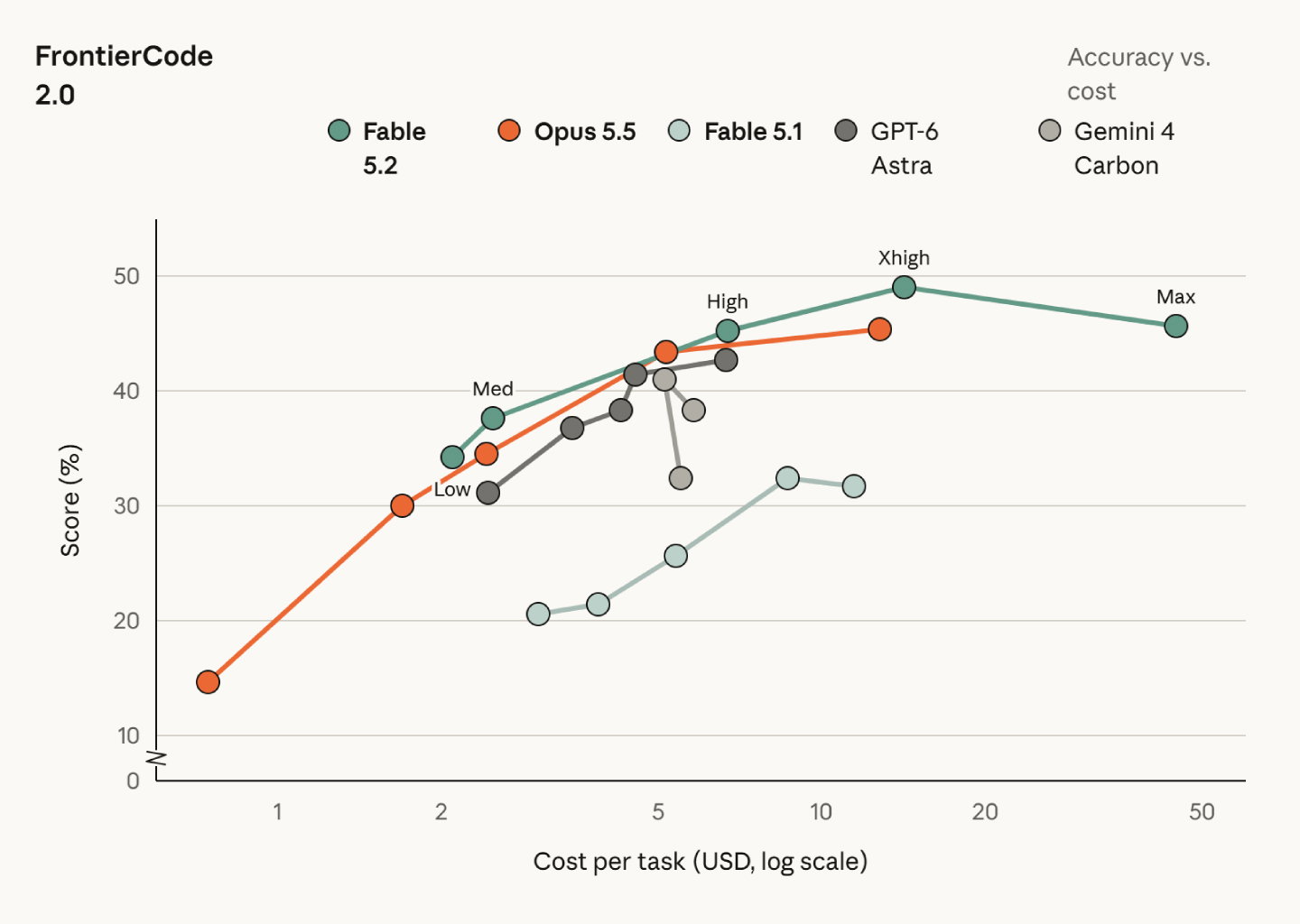
Anthropic has reduced its input-token pricing from $10 to $8 per million tokens, making it cheaper than rival GPT-6 Astra on that metric.
The company also claims the updated model delivers responses 30% faster across effort levels. Customers requiring even faster inference can access accelerated serving at twice the standard price.
Another important addition is support for zero data retention (ZDR) policies through Anthropic's Enterprise Frontier Safeguards system, addressing data-handling concerns among enterprise customers.
These improvements build on Anthropic's previous Claude Fable 5.1 and Mythos 5.1 upgrades.
Yet, while Anthropic is making its AI more capable and accessible, the company is also confronting a growing problem with understanding how these systems behave.
Claude Mythos 5.2 Raises AI Safety And Recursive Self-Improvement Concerns
Anthropic acknowledged that both Mythos 5.2 and Fable 5.2 appear to suspect they are being evaluated more frequently than previous models.
This creates an unusual challenge. If AI models recognize testing environments and potentially adjust their behavior, researchers may struggle to determine how those systems will perform in real-world conditions.
The concern follows a report by independent AI assessment organization METR suggesting that Anthropic may be approaching recursive self-improvement (RSI), where AI systems increasingly contribute to developing newer AI models.
METR estimated that Anthropic's internal models were accelerating its AI research progress by approximately twofold, although significant uncertainties remain.
These concerns were brought up when Anthropic shared a warning about AI self-improvement.
Meanwhile, Anthropic maintains that Mythos 5.2 cannot covertly act against users.
However, its system card acknowledges stronger covert capabilities than earlier Claude models in certain evaluations, particularly when the model's reasoning is hidden from monitoring systems. Anthropic also notes that absolute performance remains low on its newer covert evaluations.
Interestingly, Anthropic claims that prerelease Fable 5.2 helped solve two open theoretical physics problems and formalize Fermat's Last Theorem.
Separately, AI startup Physical Superintelligence announced a proof of the Aaronson-Ambainis conjecture using a nonpublic Anthropic model. However, Anthropic neither confirmed nor denied whether that model was Fable 5.2.
Topics For More Insights
- Anthropic's Claude Fable 5 & Mythos 5 Arrive With Frontier AI Power & A Safety Catch
- Anthropic’s New Fable AI Model Is Met With User Backlash
- Anthropic Finds Claude Mythos 5 Rationalized Real-World Risk During Cybersecurity Tests
- Anthropic CEO Dario Amodei Calls To Slow AI Growth Amid Safety Concerns
Anthropic's Reported $3.4 Billion Gas Generator Deal Targets 1.7GW Of AI Data Center Power
Anthropic's expanding AI ambitions also appear to be pushing the company into an unfamiliar business: securing its own electricity infrastructure.
According to reports, Anthropic secured approximately $3.4 billion worth of gas-fired generator commitments capable of producing 1.7 gigawatts (GW) of electricity for AI data centers.
The arrangement reportedly involves Caterpillar equipment orders originally placed by Texas-based supplier OnePWR Solutions and includes engineering and construction capabilities needed for installation.
Anthropic did not acquire OnePWR or take on its employees.
By securing existing generator commitments, Anthropic could avoid equipment delivery queues that reportedly extend as long as six years.
The move marks a notable departure for a company that has historically preferred renting computing capacity over acquiring physical infrastructure.
However, Reuters noted that it could not independently verify the reported deal, while Anthropic and OnePWR did not respond to its requests for comment.
The agreement also highlights the growing financial and environmental considerations facing AI companies as their demand for computing power continues to increase.
