

Artificial Intelligence
Anthropic Launches Claude Fable 5.1 & Mythos 5.1: Features & Pricing
Share
TL;DR
-
Claude Fable 5.1 and Claude Mythos 5.1 share the same underlying model but operate with different safeguards and access rules.
-
Claude Fable 5.1 pricing remains $10 per million input tokens and $50 per million output tokens.
-
Cache reads now cost $0.25 per million tokens, 75% less than Fable 5.
-
Anthropic estimates typical workloads could cost around 25% less and highly agentic workloads up to approximately 45% less.
-
Mythos 5.1 remains restricted to vetted cybersecurity and life sciences users.

Introduction
If Mission: Impossible had an Artificial Intelligence (AI) model lineup, Claude Fable 5.1 would be the field agent sent on difficult missions while Claude Mythos 5.1 would be the same agent carrying clearance for classified assignments.
That is surprisingly close to Anthropic's latest model strategy.
On September 1, 2026, Anthropic introduced Claude Fable 5.1 and Claude Mythos 5.1, calling them its most advanced models for coding and knowledge work. The two share the same underlying model but use different safeguards for advanced cybersecurity and life sciences work.
The launch also tackles another increasingly important AI problem: cost. While Anthropic has kept Fable's standard input and output prices unchanged, it has substantially reduced the price of repeatedly reading cached information.
So, is Claude Fable 5.1 merely Fable 5 with a decimal-point upgrade?
Not quite. The more meaningful changes appear in what the model can accomplish over long sessions and how much those sessions can cost.
Claude Fable 5.1 And Claude Mythos 5.1: Same Model, Different Clearance
Before comparing their features, there is an important distinction to make.
Claude Fable 5.1 and Claude Mythos 5.1 are the same underlying model with different levels of safeguards. Fable 5.1 is generally available while Mythos 5.1 is offered through Anthropic's trusted-access programs.
Their availability reflects that difference:
-
Claude Fable 5.1: Available to paid Claude users and developers who need Anthropic's frontier model for coding, research, and enterprise work.
-
Cloud availability: Developers can use Fable 5.1 through Amazon Web Services (AWS), Google Cloud, Microsoft Foundry, and Anthropic's own platform.
-
AWS access: AWS confirmed that Fable 5.1 is available through Amazon Bedrock and Claude Platform on AWS.
-
Claude Mythos 5.1: Limited to vetted individuals and organizations that require more permissive safeguards.
-
Specialized use: Mythos focuses particularly on advanced cybersecurity and life sciences research.
That makes the Fable-versus-Mythos question less about which model is smarter and more about what level of access the work requires.
Anthropic AI Model Updates: What Claude Fable 5.1 Does Better
Claude Fable 5.1 keeps some familiar specifications. According to Anthropic's official model documentation, it supports a 1 million-token context window, up to 128,000 output tokens, and adaptive thinking that remains always on.
The bigger Anthropic AI model updates concern how Fable 5.1 performs across longer and more complicated tasks.
-
Long-running coding: It can handle features spanning entire codebases, conduct code reviews, work on performance improvements, and continue autonomous sessions for hours.
-
Better verification: The model can write tests to verify whether the code it generated actually works.
-
Root-cause analysis: Anthropic says Fable 5.1 is less likely to take shortcuts that merely hide a problem and more likely to identify its underlying cause.
-
Agentic workflows: It can plan work, use several tools, recover when a step fails, and continue operating with limited supervision.
-
Knowledge work: Fable 5.1 can carry research from an initial question through analysis and into a finished deliverable.
-
Vision capabilities: It can understand diagrams, charts, and tables inside documents and PDFs, which expands its usefulness for finance, legal, analytics, and other document-heavy workflows.
There is early customer evidence behind those claims too. Josh Boyer, Distinguished Engineer at Red Hat, said Fable 5.1 "correctly identified the root cause of every broken build we tested."
Developers migrating from Fable 5 should also note three breaking changes: forced tool use returns an error, earlier models cannot read Fable 5.1 thinking blocks, and modifying previous turns can invalidate those thinking blocks.
Claude Fable 5.1 Pricing: What Does It Actually Cost?
This may be the most commercially significant part of the launch.
The headline Claude Fable 5.1 pricing has not changed from Fable 5. Standard input still costs $10 per million tokens while output costs $50 per million tokens.
The major change is prompt caching
According to Anthropic's current Claude pricing documentation:
| Pricing Element | Claude Fable 5.1 | Claude Fable 5 |
| Input | $10 / 1M tokens | $10 / 1M tokens |
| Output | $50 / 1M tokens | $50 / 1M tokens |
| 5-minute cache write | $12.50 / 1M tokens | $12.50 / 1M tokens |
| 1-hour cache write | $20 / 1M tokens | $20 / 1M tokens |
| Cache read | $0.25 / 1M tokens | $1 / 1M tokens |
Here is what changed financially:
-
Cache reads fell from $1 to $0.25 per million tokens.
-
That makes Claude Fable 5.1 cache reads 75% cheaper than Fable 5.
-
Anthropic estimates that typical token-billed workloads could cost around 25% less.
-
For highly agentic workloads, Anthropic estimates savings of up to approximately 45%.
-
Batch API processing receives a 50% discount on standard input and output pricing.
Claude Fable 5.1 Vs Claude Mythos 5.1: What Are The Real Differences?
The differences between Claude Fable 5.1 and Claude Mythos 5.1 primarily concern availability and safeguards rather than core intelligence.
Both models share:
-
The same underlying model
-
A 1 million-token context window
-
Up to 128,000 output tokens
-
Adaptive thinking
-
$10 per million input tokens
-
$50 per million output tokens
The divide appears when sensitive capabilities enter the picture.
Fable 5.1 can now be used to identify software vulnerabilities, making defensive cybersecurity work less likely to trigger restrictions. However, Anthropic still redirects several dual-use activities, including penetration testing, exploit generation, and binary-based vulnerability scanning.
Anthropic says the revised controls mean Claude Code users can expect around 60% fewer cybersecurity safeguard interventions per session than under Fable 5's earlier safeguards.
The biology safeguards have also become more precise. Anthropic says they now activate 85% less often on benign elementary biology and medical requests. More advanced life sciences work can instead be accessed through controlled Mythos programs.
There is our Mission: Impossible analogy completed. Fable and Mythos are not two different agents. They are effectively the same agent operating with different security clearances.
Do Claude Fable 5.1 Benchmarks Justify The Upgrade?
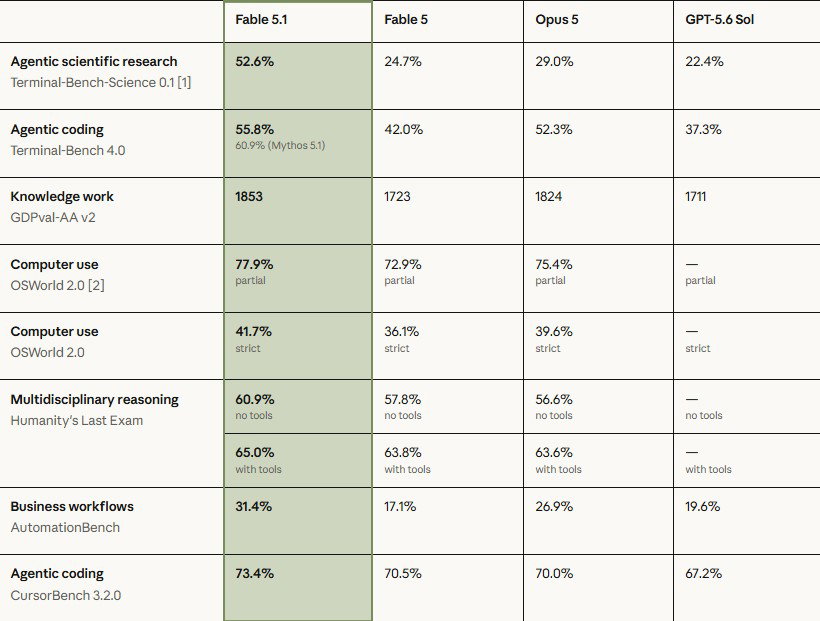
Anthropic's benchmark results indicate sizeable gains in several areas.
The company's official Fable 5.1 benchmark comparison reports:
-
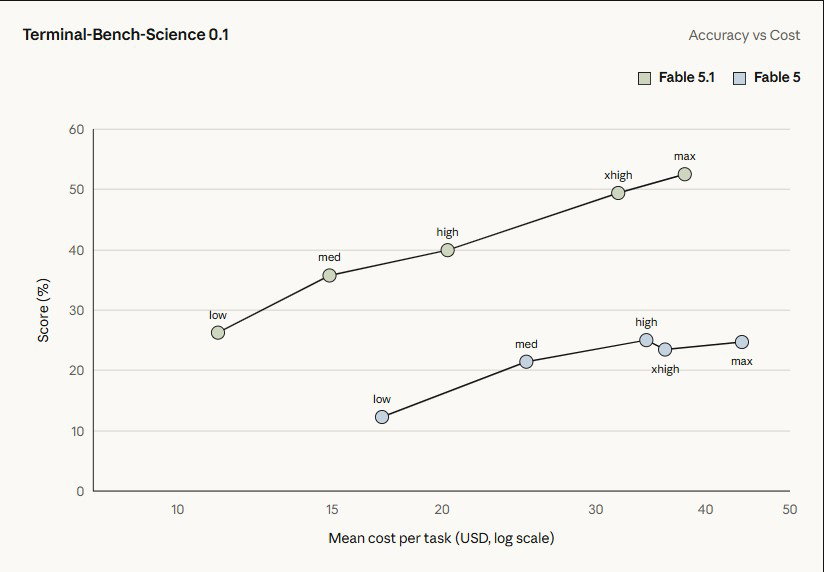
Terminal-Bench-Science 0.1: Fable 5.1 scored 52.6%, compared with 24.7% for Fable 5 and 29% for Opus 5.
-
Terminal-Bench 4.0: Fable 5.1 reached 55.8%, versus Fable 5's 42%.
-
AutomationBench: Its score increased from 17.1% on Fable 5 to 31.4%.
-
CursorBench 3.2.0: Fable 5.1 scored 73.4%, compared with 70.5% for Fable 5 and 70% for Opus 5.
The more memorable evidence comes from practical experiments.
Investment firm Millennium had experienced a software crash roughly once in every million runs that its team had reportedly been unable to explain for four to five years. Fable 5.1 reportedly disassembled an external vendor library, compared it with the core dump, and traced the crash to that library.
Anthropic also used Fable 5.1 in planetary research. The model helped train a neural network that generated a new elevation map covering around one-third of Venus. The new map reveals details at roughly two to three kilometers instead of 10 to 20 kilometers and improves elevation estimates by up to 25%.
Mythos 5.1 went deeper into biological research. Anthropic reported that its protein designs achieved binding affinities 10 times higher than the strongest relevant designs in Adaptyv Bio competitions across three targets. Its hit rate also approached 50% across 12 targets, compared with Anthropic's stated typical rate of 10% to 15%.
These figures come from Anthropic's own evaluations and early partners, so they should not be treated as guaranteed results for every workload. They do, however, make the 5.1 release look more substantial than a routine model refresh.
Safety And Enterprise Controls Come With The Upgrade
Greater capability also introduces stricter requirements.
Anthropic has designated Fable 5.1 and Mythos 5.1 as Covered Models, a category reserved for models whose capabilities warrant additional safeguards and data-handling requirements.
For enterprises, the important points include:
-
Fable 5.1 requires 30-day data retention for safety monitoring by default.
-
Anthropic is introducing Enterprise Frontier Safeguards (EFS) for eligible organizations.
-
EFS allows customers to keep monitoring data inside cloud infrastructure they control.
-
Human review can remain with the customer rather than Anthropic by default.
Anthropic says EFS was developed with more than 100 enterprise customers across industries including finance, healthcare, manufacturing, telecommunications, law, retail, and the public sector.
This matters because enterprise AI buying is no longer a benchmark competition alone.
The strongest model may look impressive on a leaderboard but businesses still need to ask what it costs to operate, where their data goes, what capabilities they can access, and which safeguards could affect their workflows.
Fable 5.1 attempts to improve several parts of that equation at once.
Conclusion
Anthropic launches Claude Fable 5.1 and Mythos 5.1 at a moment when simply claiming to have a smarter AI model is no longer enough.
Fable 5.1 keeps premium base pricing but makes long-running agentic work more economical by reducing cache-read pricing by 75%. Mythos 5.1 takes the same underlying intelligence into more sensitive scientific and cybersecurity territory while limiting access to vetted users.
The release therefore says something broader about where frontier AI is heading. Model intelligence still matters but cost per task, safeguards, privacy, and the ability to operate reliably for hours are becoming just as important.
For that Mission: Impossible agent, intelligence was never enough. The mission also needed the right clearance, tools, and budget. Claude's 5.1 generation is beginning to look much the same.
Frequently Asked Questions
What Is The Cost Of Claude Fable 5.1?
Claude Fable 5.1 costs $10 per million input tokens and $50 per million output tokens. Five-minute cache writes cost $12.50 per million tokens, one-hour cache writes cost $20, and cache reads cost $0.25. Anthropic's official pricing documentation lists the complete Fable 5.1 rates.
How Did Anthropic Reduce Cache Read Costs By 75 Percent?
Anthropic reduced the price customers pay for cache reads from $1 to $0.25 per million tokens. That is a 75% pricing reduction. Anthropic has not said that its underlying infrastructure cost of performing cache reads fell by 75%, so describing it as a cache-read pricing reduction is more accurate.
How Much Cheaper Is Claude Fable 5.1 Compared To Fable 5?
Anthropic estimates Claude Fable 5.1 costs around 25% less than Fable 5 for typical token-billed workloads. For highly agentic workloads, the company estimates savings of up to approximately 45%. Actual savings depend on how heavily the workload reuses cached context.
What Are The Differences Between Claude Fable 5.1 And Claude Mythos 5.1?
Claude Fable 5.1 and Claude Mythos 5.1 use the same underlying model and share core specifications and pricing. Fable 5.1 is generally available with tighter cybersecurity and biology safeguards while Mythos 5.1 offers more permissive capabilities to vetted organizations through Anthropic's trusted-access programs.
Thu, Sep 3, 2026

Liked what you read? That’s only the tip of the tech iceberg!
Explore our vast collection of tech articles including introductory guides, product reviews, trends and more, stay up to date with the latest news, relish thought-provoking interviews and the hottest AI blogs, and tickle your funny bone with hilarious tech memes!
Plus, get access to branded insights from industry-leading global brands through informative white papers, engaging case studies, in-depth reports, enlightening videos and exciting events and webinars.
Dive into TechDogs' treasure trove today and Know Your World of technology like never before!
Disclaimer - Reference to any specific product, software or entity does not constitute an endorsement or recommendation by TechDogs nor should any data or content published be relied upon. The views expressed by TechDogs' members and guests are their own and their appearance on our site does not imply an endorsement of them or any entity they represent. Views and opinions expressed by TechDogs' Authors are those of the Authors and do not necessarily reflect the view of TechDogs or any of its officials. While we aim to provide valuable and helpful information, some content on TechDogs' site may not have been thoroughly reviewed for every detail or aspect. We encourage users to verify any information independently where necessary.
Loading comments...