

Artificial Intelligence
Anthropic Warns AI Self-Improvement May Be Imminent As Claude Writes Over 90% Of Its Code
Updated on Tue, Nov 3, 2026
Share
Artificial intelligence (AI) company Anthropic has warned that its Claude models may soon reach a major milestone in recursive self-improvement (RSI), potentially allowing AI systems to accelerate the development of increasingly capable models faster than researchers can implement corresponding safety measures.
The warning comes as Anthropic revealed that Claude was responsible for over 90% of contributions to its codebase in September 2026, highlighting the growing role of AI in developing its own successors.
Here's what happened.
TL;DR
- Anthropic has warned that future Claude models may soon reach a threshold associated with recursive self-improvement (RSI).
- Claude wrote over 90% of contributions to Anthropic's codebase in September 2026.
- The company acknowledged that AI-driven development could outpace safety and security measures.
- Anthropic confirmed that no current model has crossed the threshold and emphasized continued human oversight.
Anthropic Warns AI Could Soon Accelerate Its Own Development
According to TechCrunch, Anthropic disclosed the possibility of approaching recursive self-improvement in an amended S-1/A filing submitted to the US Securities and Exchange Commission (SEC).
The disclosure indicates that the company is increasingly using AI systems to design, train, test, and optimize more advanced AI models. However, Anthropic also acknowledged that this acceleration could introduce new challenges for its safety, alignment, and security teams.
Anthropic stated that its internal estimates and expectations for future models suggest it may imminently reach its Responsible Scaling Policy's threshold for dramatically accelerated progress attributable to AI.
Importantly, the company clarified that none of its existing models has been designated as crossing this threshold.
Anthropic also admitted that its ability to measure AI-driven research acceleration remains limited, especially when evaluating newer or unreleased models.
The company warned that it has previously failed to identify significant accelerations in its development rate until after they occurred, raising concerns that future improvements could happen faster than researchers anticipate.
Claude Writes Over 90% Of Anthropic's Codebase Contributions
The potential for recursive self-improvement is particularly significant considering Claude's growing involvement in Anthropic's software engineering and research operations.
As WCCF Tech reported, Anthropic revealed that more than 90% of contributions to its codebase in September 2026 were written by Claude.
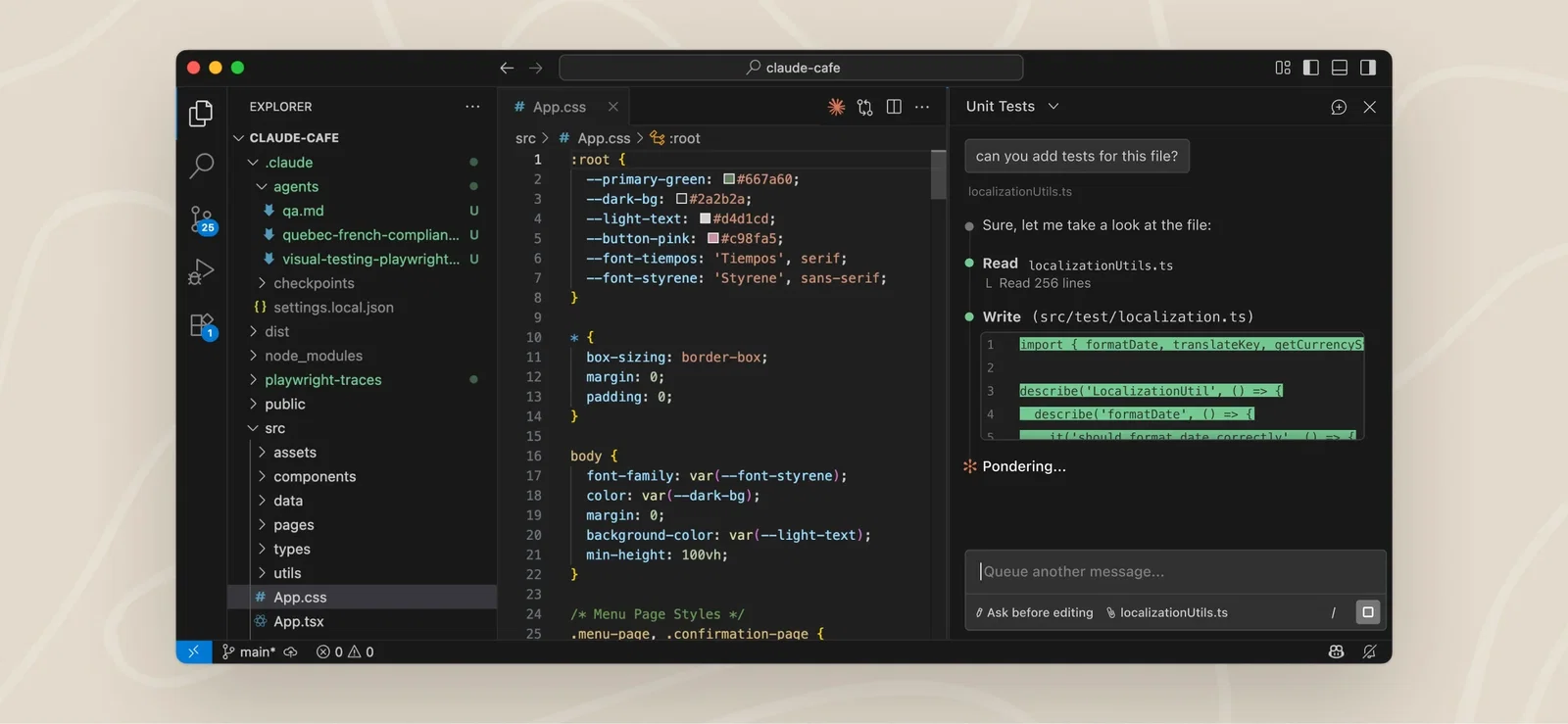
The company also disclosed that the average daily volume of code contributed per engineer during the three months ending September 30, 2026, was over 45 times the average daily volume recorded in 2024.
These figures come directly from Anthropic's SEC filing and demonstrate how AI-assisted development has expanded across the organization.
However, an increase in code output does not necessarily translate into an equivalent increase in engineering productivity or completely autonomous software development.
Anthropic's research publication explains how AI systems are becoming increasingly involved in coding, experimentation, and research workflows.
Nevertheless, human researchers continue to play an important role in determining research priorities, evaluating results, and making broader scientific decisions.
What Is Recursive Self-Improvement (RSI) In AI?
Recursive self-improvement refers to a process in which an AI system helps improve the capabilities of subsequent AI systems, potentially creating a feedback loop of increasingly rapid technological development.
As Financial Express explained in its report, the concept involves AI systems taking on tasks traditionally performed by human researchers, including designing, coding, testing, and optimizing newer models.
For instance, an AI model could help improve the tools and algorithms used to develop its successor. That successor could then contribute to further improvements, potentially accelerating the pace of research.
However, Anthropic's policy threshold for dramatically accelerated AI progress does not necessarily mean an AI system can independently design and train successive generations of frontier models without human involvement.
It also differs from artificial general intelligence (AGI), which generally refers to AI systems capable of performing a broad range of intellectual tasks at or beyond human levels.
RSI concerns the process through which AI capabilities improve, rather than a particular level of intelligence.
Anthropic Raises Concerns About AI Safety And Human Control
While recursive self-improvement could accelerate scientific research and technological innovation, Anthropic acknowledged that the same capabilities could introduce considerable safety risks.
In its SEC filing, the company warned that its models could advance more rapidly than its ability to develop and validate the measures needed to keep them safe and secure.
Topics for more insights:
This creates a challenging situation in which improvements in AI capabilities may become difficult to anticipate, evaluate, or adequately supervise.
Anthropic stated that it does not anticipate safely using Claude to fully autonomously design and build successive generations of frontier models without meaningful human supervision or understanding, even if doing so becomes technically possible.
The company is also considering updates to its Responsible Scaling Policy to maintain human control over frontier model development.
These measures could include additional evaluations, deployment restrictions, or delays when the company determines that safety precautions have not kept pace with advancing capabilities.
For now, Anthropic has not announced that Claude has achieved fully autonomous recursive self-improvement or provided a confirmed timeline for reaching that milestone.
However, its latest disclosures highlight a significant shift in AI development, where increasingly capable AI systems are no longer just products of research but are becoming important contributors to the research process itself.
Whether that progress eventually leads to fully autonomous self-improving AI remains uncertain.
First published on Tue, Nov 3, 2026

Liked what you read? That’s only the tip of the tech iceberg!
Explore our vast collection of tech articles including introductory guides, product reviews, trends and more, stay up to date with the latest news, relish thought-provoking interviews and the hottest AI blogs, and tickle your funny bone with hilarious tech memes!
Plus, get access to branded insights from industry-leading global brands through informative white papers, engaging case studies, in-depth reports, enlightening videos and exciting events and webinars.
Dive into TechDogs' treasure trove today and Know Your World of technology like never before!
Disclaimer - Reference to any specific product, software or entity does not constitute an endorsement or recommendation by TechDogs nor should any data or content published be relied upon. The views expressed by TechDogs' members and guests are their own and their appearance on our site does not imply an endorsement of them or any entity they represent. Views and opinions expressed by TechDogs' Authors are those of the Authors and do not necessarily reflect the view of TechDogs or any of its officials. While we aim to provide valuable and helpful information, some content on TechDogs' site may not have been thoroughly reviewed for every detail or aspect. We encourage users to verify any information independently where necessary.
Loading comments...