
Anthropic's Claude has a new top tier, and it is not arriving quietly.
Claude Fable 5 is now generally available as a Mythos-class model, while Claude Mythos 5 is being reserved for trusted cyberdefenders and infrastructure providers with fewer restrictions.
TL;DR
- Anthropic's Claude Fable 5 and Mythos 5 arrive with frontier AI power, but there’s a safety catch.
- Software engineering: Fable 5 can handle massive code migrations and complex production-grade coding tasks more efficiently.
- Knowledge work: It leads on senior-level finance reasoning, document analysis, charts, and problem solving.
- Vision: It can decode scientific figures and rebuild apps from screenshots.
- Memory and long-context: It stays focused across millions of tokens.
- Drug design: Mythos 5 accelerated parts of drug discovery by around 10x.
- Novel hypotheses in molecular biology: Scientists preferred Mythos 5’s hypotheses around 80% of the time.
- Novel research in genomics: Mythos 5 completed largely autonomous genomics research across 138 animal species.
- Alignment: Early assessments showed low misaligned behavior, similar to Claude Opus 4.8.
Claude Fable 5 Brings Mythos-Class AI To General Users With Built-In Safety Controls
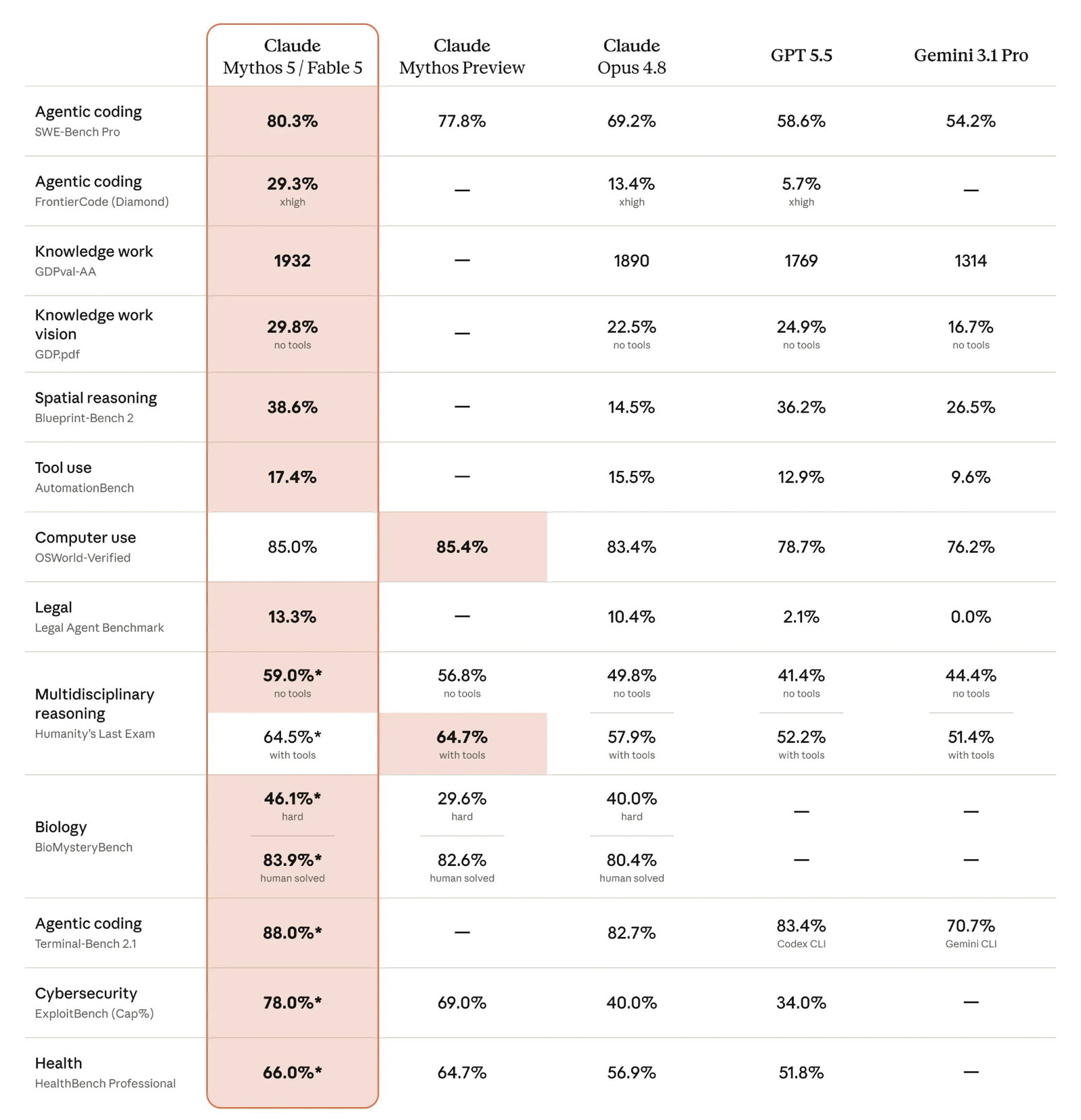
Claude Fable 5 is being positioned as the most capable Claude model made generally available so far, with state-of-the-art performance across nearly all tested AI capability benchmarks.
Its biggest advantage appears on longer, more complex tasks, where it pulls further ahead of previous Claude models.
That extra power comes with a tradeoff. Because Fable 5 has advanced capabilities in sensitive areas such as cybersecurity, some user queries will be routed to Claude Opus 4.8 instead. The safeguard system has been tuned conservatively, which means some harmless prompts may be blocked or redirected, though the company says this happens in less than 5% of sessions on average.
The broader goal is clear: release more powerful AI faster, but avoid opening the door to high-risk misuse. The company also says it is working to reduce false positives as more capable models arrive in the coming months.
Claude Mythos 5 Gives Trusted Cyberdefenders The Strongest Cybersecurity Claude Model Yet
Alongside Fable 5, Claude Mythos 5 is being released to a smaller group of cyberdefenders and infrastructure providers. It uses the same underlying model as Fable 5, but some safeguards are lifted in selected areas for trusted use cases.
Mythos 5 will initially be deployed through Project Glasswing in collaboration with the US government, upgrading Claude Mythos Preview. The model is described as having the strongest cybersecurity capabilities of any model in the world, with broader trusted access planned later.
This split rollout gives regular users access to frontier AI capabilities while allowing approved security teams to use more advanced tools for critical infrastructure defense.
Claude Fable 5 Targets Software Engineering, Finance, Vision, And Long-Context Work
In software engineering, Fable 5 appears built for large, messy, real-world codebases.
During early testing, Stripe reported that the model compressed months of engineering work into days, including a 50-million-line Ruby codebase migration completed in one day instead of the two months a full team would have needed manually.
It also performed strongly on Cognition’s FrontierCode evaluation, which tests whether models can complete hard coding tasks while meeting production-quality standards.
For knowledge work, Fable 5 showed major gains in document reasoning, chart and table interpretation, finance analysis, root-cause analysis, and expected-value reasoning. On Hebbia’s Finance Benchmark, it recorded the highest score of any model tested.
Its vision abilities are also getting a serious lift. Fable 5 can extract precise numbers from detailed scientific figures and rebuild a web app’s source code from screenshots alone. It even beat Pokémon FireRed with a minimal, vision-only setup, where previous Claude models needed more support and still struggled.
Its memory improvements matter too. Fable 5 can stay focused across millions of tokens and use its own notes to improve long-running tasks. In Slay the Spire testing, persistent file-based memory improved its performance three times more than it did for Opus 4.8.
Claude Mythos 5 Pushes AI Deeper Into Drug Design And Scientific Discovery
Mythos 5’s biggest leap may be in life sciences. Internal protein design experts reportedly accelerated parts of the drug design process by around 10 times using Mythos 5.
In one study, the model handled tasks normally performed by scientists, including selecting binding sites, choosing and running protein design tools, and recovering from failures.
Nine of 14 protein targets from the study produced strong drug-design candidates now under investigation.
The model also generated novel molecular biology hypotheses that scientists preferred over Opus-class models around 80% of the time in blinded comparisons. Several have already moved toward experimental evaluation, while one hypothesis about an E. coli protein was later corroborated by an independent lab.
In genomics, Mythos 5 conducted more than a week of largely autonomous research, assembling single-cell data across millions of cells from 138 animal species. With only high-level human input, its custom model reportedly outperformed a recent Science-published model while being 100 times smaller.
Topics For More Insights
Claude Fable 5 And Mythos 5 Pricing Undercuts Claude Mythos Preview
Fable 5 and Mythos 5 are priced at $10 per million input tokens and $50 per million output tokens, less than half the price of Claude Mythos Preview.
That pricing, combined with the safety-gated release strategy, suggests the company is trying to make frontier AI more broadly accessible without treating all users and use cases the same. The result is a two-track launch: Fable 5 for general users, Mythos 5 for vetted high-trust environments.
