

Artificial Intelligence
What Is Agentic Commerce? How AI Agents Are Buying And Selling On Your Behalf
Share
TL;DR
On the other side of the transaction, merchant agents can represent businesses by managing product discovery, offers, customer interactions, pricing decisions, and fulfillment workflows.
-
Agentic commerce uses autonomous or semi-autonomous AI agents to perform commercial activities on behalf of consumers and businesses.
-
Buyer agents can research, compare, negotiate, purchase, track, return, and reorder products within predefined permissions.
-
Seller-side agents can help merchants recommend products, respond to buyer agents, manage inventory, optimize offers, and coordinate transactions.
-
Agent-to-agent interactions could accelerate machine-to-machine commerce, where software increasingly handles both sides of a transaction.
-
Secure payments, reliable product data, identity verification, permissions, interoperability, and auditability will be essential as commerce becomes more autonomous.
Introduction
In the movie Minority Report, one of the most memorable glimpses of the future comes not from flying cars or crime prediction, but from advertising. As John Anderton walks through stores and public spaces, digital displays recognize him instantly and tailor messages to his identity, preferences, and presumed interests.
Back in 2002, that felt like an extreme version of personalized commerce. Today, personalization is already commonplace. Online stores recommend products based on browsing behavior, algorithms predict what customers might want next, and generative AI can answer increasingly specific shopping questions.
Agentic commerce pushes that idea considerably further.
Instead of technology merely recognizing what you might want, an AI agent could act on that intent. You could ask it to find a lightweight business laptop under $1,500, compare warranties and delivery dates, choose the most suitable option, and complete the purchase within permissions you have already defined.
The seller may have agents of its own, identifying suitable products, checking inventory, adjusting offers, answering transactional requests, and coordinating fulfillment.
So, the next phase of digital commerce may be less about brands predicting what customers want and more about AI systems actively representing both sides of the transaction.
That brings us to what is agentic commerce, how AI agents are buying and selling on our behalf, and what happens when commerce increasingly moves from people interacting with websites to machines interacting with machines.
What Is Agentic Commerce?
Agentic commerce is a model of buying and selling in which AI agents independently perform commercial tasks on behalf of consumers or businesses within defined permissions and objectives.
These agents can understand intent, plan actions, access external systems, evaluate alternatives, use tools, and execute permitted tasks rather than simply responding to individual prompts.
Consider the difference.
A traditional AI shopping assistant might recommend five smartphones after you ask which one has the best camera.
An agentic system could interpret your budget and preferences, compare specifications and prices across merchants, check delivery times, evaluate return policies, identify the most suitable option, and purchase it with your approval.
Now look at the seller's side.
A merchant's agent could interpret what a prospective buyer is seeking, search its catalog, identify qualifying products, generate an appropriate offer, check current inventory, answer product questions, and move the transaction toward checkout.

That is agentic commerce explained in practical terms: AI does not merely discuss a commercial activity. It can actively participate in completing it.
Significantly, autonomy does not mean unlimited authority. Agents operate within rules established by the people or organizations they represent.
A consumer might allow an agent to reorder groceries automatically but require confirmation for purchases above $100. A company could allow a procurement agent to buy from approved vendors within contracted price limits.
Agentic commerce is therefore about delegated action, not handing AI unrestricted control. It becomes more compelling when we move beyond the concept and look at the mechanics behind it, where AI agents interpret intent, coordinate decisions, and increasingly act on behalf of both buyers and sellers.
How Are AI Agents Buying And Selling On Your Behalf?
Understanding the process requires looking at both sides of a transaction.
1. The Buyer Expresses An Outcome
Agentic journeys often begin with intent rather than a search query.
For example:
"Find waterproof hiking shoes in my size under $180 that can arrive before Saturday."
The AI agent interprets the request as a collection of requirements: product category, size, features, budget, and delivery deadline.
If authorized, it may also consider previous purchases, preferred brands, loyalty programs, payment preferences, or other relevant information.
The shopper provides the destination. The agent works out the route.
2. The Buyer Agent Builds A Plan
The agent then decides which steps are necessary.
It might search multiple catalogs, compare specifications, eliminate products that violate the budget, confirm availability, examine delivery estimates, evaluate return policies, and identify the strongest matches.
Unlike a basic recommendation engine, it can coordinate several actions in pursuit of the same objective.
If an item sells out midway through the process, the agent can potentially reassess its choices instead of simply returning an error.
This planning capability is one of the characteristics that differentiates autonomous online shopping agents from conventional shopping tools.
3. Seller-Side Agents Respond
The merchant does not have to remain passive while buyer agents become more sophisticated.
Seller-side agents can work across merchandising, product recommendations, promotions, customer service, inventory, order management, and fulfillment.
Suppose a buyer agent requests an office chair under $500 with adjustable lumbar support and delivery within three days.
A merchant agent could identify compatible products, verify real-time stock, expose relevant specifications, surface an applicable promotion, calculate delivery availability, and return those details in a format the buyer's agent can process.
The seller's AI is effectively representing the commercial interests of the business while still operating within pricing, inventory, brand, and customer-experience rules set by the merchant.
4. Agents Evaluate Each Other's Offers
This creates the possibility of agent-to-agent commerce.
Instead of a human navigating a storefront, a buyer agent could communicate directly with merchant systems or merchant-side agents.
The buyer's agent might ask:
Does this product meet my user's requirements?
The merchant's systems respond with specifications, availability, price, delivery terms, warranties, and policies.
The buyer agent evaluates that information against its instructions and either proceeds, asks for alternatives, or queries another seller.
In more advanced scenarios, agents could also negotiate acceptable terms within predefined limits.
Commerce starts becoming less about one person navigating one website and more about software systems coordinating around intent.
5. The Transaction Is Authorized
Product discovery is only part of the problem.
Allowing an AI agent to spend money creates much greater requirements around trust.
Systems need to establish who authorized the agent, which actions it can perform, what it can purchase, how much it may spend, and when human confirmation is required.
An agent might have permission to automatically spend up to $50 on routine supplies but require approval before completing a $2,000 electronics purchase.
Secure credentials, transaction limits, fraud detection, identity verification, consent mechanisms, and detailed audit trails become essential.
The objective is not simply autonomous payment. It is controlled autonomous payment.
6. Agents Continue After The Sale
Agentic commerce does not necessarily end when the payment succeeds.
A buyer agent could track shipping, react to delivery delays, initiate an exchange, request a refund, manage a warranty claim, or reorder a frequently purchased item.
A seller-side agent could provide order updates, coordinate returns, recommend replacements, resolve basic service requests, or route more complicated problems to a person.
That means agents can participate across the customer lifecycle, not just at checkout.
With the buying and selling process clear, the next step is understanding what actually sets agentic commerce apart from the traditional way digital transactions happen.
Traditional E-Commerce Vs. Agentic Commerce
The difference between traditional e-commerce and agentic commerce becomes easier to see when we examine where the work takes place.
| Traditional E-Commerce | Agentic Commerce |
| Human enters a search query | Agent interprets an intended outcome |
| Human filters products | Agent evaluates requirements and constraints |
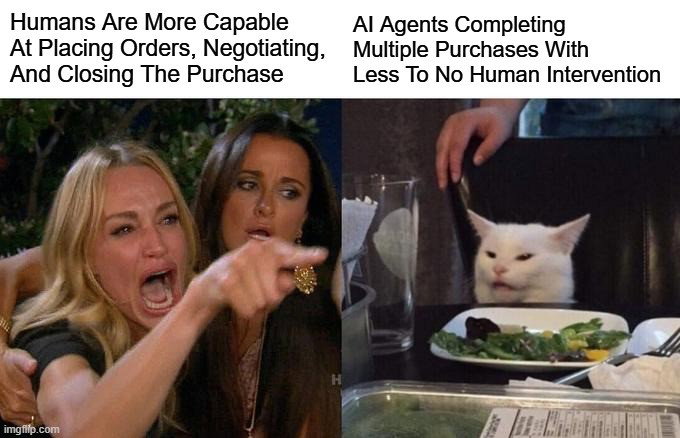
| Human compares several choices | Agent can evaluate many offers automatically |
| Human visits merchant websites | Agent can interact directly with merchant systems |
| Recommendations assist decisions | Agents may make permitted decisions |
| Human initiates checkout | Agent may initiate or complete payment |
| Merchant markets primarily to humans | Merchants may also need to communicate with buyer agents |
| Human handles tracking and returns | Agents can manage post-purchase tasks |
Traditional e-commerce is primarily designed around human interaction with digital storefronts. Agentic commerce introduces a second audience for commerce infrastructure: machines acting for those humans.
That seemingly small difference could reshape everything from product discovery to payments.
The shift from manual, step-by-step shopping to goal-driven automation changes more than how transactions happen. It also reshapes the value agentic commerce can create for both sides of the market.
Why Agentic Commerce Matters To Buyers?
The immediate attraction is convenience.
Instead of spending 45 minutes comparing nearly identical products, users can delegate the research.
Yet convenience is only the beginning.
AI agents buying on your behalf can potentially account for multiple constraints simultaneously, including budget, compatibility, preferred brands, shipping deadlines, previous purchases, and loyalty benefits.
They can also evaluate options at a scale that would be tedious for a human shopper.
This could be particularly useful for repetitive purchases, complex travel bookings, subscription management, procurement, replenishment, and products with extensive technical specifications.
The interface changes from "show me everything available" to "achieve this outcome for me."
Why Agentic Commerce Matters To Sellers?
The shift is equally significant for merchants.
Businesses have traditionally optimized digital commerce around attracting human attention. Search rankings, ads, imagery, landing pages, navigation, reviews, and promotional messaging all help convince a person to continue toward checkout.
Agents evaluate offers differently.
A purchasing agent may care more about whether a merchant can provide accurate product specifications, current inventory, transparent pricing, reliable delivery information, clear policies, and machine-readable trust signals.
Topics For More Insights
That means sellers increasingly need to make their businesses understandable not only to people but also to software.
Merchant-side agents can also increase operational efficiency by supporting product discovery, customer service, merchandising, inventory decisions, promotions, and order management.
Selling may therefore become more autonomous at the same time that buying does.
The potential of agentic commerce is significant for both sides of the transaction, but greater autonomy also introduces new points of failure. As AI agents take on more decisions and actions, it becomes equally important to understand where things can go wrong.
What Could Go Wrong With Agentic Commerce?
Giving AI greater commercial authority inevitably creates risks.
Incorrect Decisions:
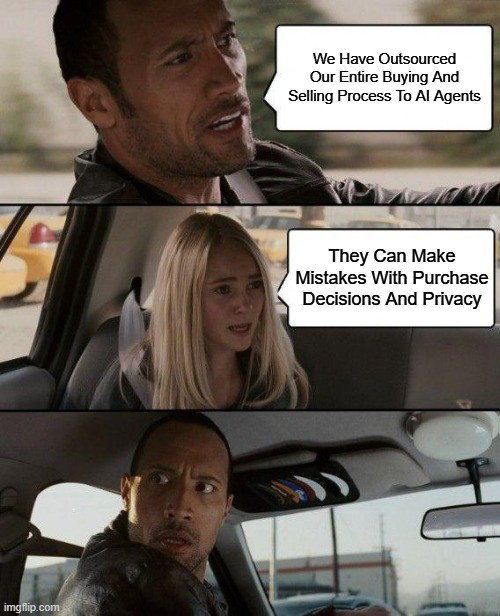
An agent might misunderstand a requirement, receive inaccurate product data, or prioritize the wrong criterion. An autonomous purchase is only as useful as the information, reasoning, and constraints behind it.
Privacy Concerns:
Highly personalized agents may have access to purchase histories, preferences, payment information, loyalty accounts, or business procurement data. Users and organizations need clear control over what agents can access and why.
Fraud And Agent Identity:
Traditional anti-bot systems often treat automated traffic suspiciously. Agentic commerce creates a more complicated question: is this bot malicious, or is it an authorized agent representing a legitimate customer?
Merchants will increasingly need mechanisms for identifying trustworthy agents and verifying their authority.
Conflicting Objectives:
A buyer agent wants the best result for its user. A seller agent represents the merchant.
Those goals are not always identical. Transparent rules and safeguards become especially important if agents begin negotiating prices, promotions, placement, or purchasing terms.
Accountability:
If an agent purchases the wrong item or exceeds its authority, businesses need to determine what happened. That requires traceable actions, transaction records, approval histories, and clear escalation processes. Autonomy without accountability creates risk rather than convenience.
Even with these potential errors, the bigger question is whether agentic commerce can become reliable enough to change how people shop online altogether.
Are AI Agents About To Replace Online Shopping?
Not entirely. Some purchasing decisions lend themselves naturally to delegation. Reordering household essentials, renewing software, booking routine travel, replenishing business inventory, or purchasing standardized products can benefit from automation.
Other purchases are emotional, exploratory, or experiential. People may still want to browse clothes, discover unfamiliar brands, compare luxury products, visit stores, test vehicles, or simply enjoy shopping.
Agentic commerce therefore does not necessarily replace traditional e-commerce. It adds another commercial mode. Sometimes people will browse. Sometimes they will ask an AI for recommendations. Sometimes they will instruct an agent to take care of the transaction. Increasingly, sellers will need to support all three.
The Final Word
Agentic commerce represents more than a faster checkout experience. It changes who performs the work involved in a transaction. On the buying side, AI agents can transform an intention into research, comparison, selection, payment, and post-purchase actions.
On the selling side, agents can interpret demand, surface products, manage offers, support customers, coordinate orders, and interact directly with purchasing agents.
As those capabilities converge, digital commerce starts moving toward an environment where humans define objectives and machines increasingly negotiate the steps required to accomplish them.
The transition will require better product data, stronger identity standards, secure payments, transparent permissions, reliable interoperability, and clear accountability.
Yet the central idea is surprisingly simple. The next online purchase may not start with a person visiting a store. It could start with someone saying, "Get this done for me." On the other side, another agent may already be ready to sell it.
Frequently Asked Questions
How Will Agentic Commerce Change Product Discovery And Search Visibility For Brands?
Agentic commerce could shift product discovery from human-facing search results toward machine-readable recommendations. Brands may need to optimize structured product data, availability, pricing, delivery information, compatibility, policies, and trust signals so AI agents can accurately evaluate their offerings. This could make “agent visibility” increasingly important alongside traditional SEO, marketplace optimization, and paid discovery.
Can AI Agents Negotiate Prices Or Commercial Terms With Other AI Agents?
Potentially, yes. In advanced agent-to-agent commerce, buyer agents could evaluate multiple sellers and negotiate within predefined limits, while seller agents respond according to pricing rules, inventory levels, margins, contract terms, or promotional policies. However, such interactions would require strict authorization, transparent constraints, identity verification, and auditability to prevent unintended commitments or manipulative automated behavior.
Who Is Responsible When An Autonomous AI Agent Makes The Wrong Purchase?
Responsibility will depend on how authority is delegated across the user, agent provider, merchant, payment system, and underlying platform. Clear permission boundaries, transaction logs, human-approval thresholds, and dispute mechanisms will therefore become essential. As agentic commerce matures, businesses will need governance frameworks that make it possible to determine what an agent was authorized to do and why a transaction occurred.
Mon, Sep 28, 2026

Enjoyed what you read? Great news – there’s a lot more to explore!
Dive into our content repository of the latest tech news, a diverse range of articles spanning introductory guides, product reviews, trends and more, along with engaging interviews, up-to-date AI blogs and hilarious tech memes!
Also explore our collection of branded insights via informative white papers, enlightening case studies, in-depth reports, educational videos and exciting events and webinars from leading global brands.
Head to the TechDogs homepage to Know Your World of technology today!
Disclaimer - Reference to any specific product, software or entity does not constitute an endorsement or recommendation by TechDogs nor should any data or content published be relied upon. The views expressed by TechDogs' members and guests are their own and their appearance on our site does not imply an endorsement of them or any entity they represent. Views and opinions expressed by TechDogs' Authors are those of the Authors and do not necessarily reflect the view of TechDogs or any of its officials. While we aim to provide valuable and helpful information, some content on TechDogs' site may not have been thoroughly reviewed for every detail or aspect. We encourage users to verify any information independently where necessary.
Loading comments...