
Artificial Intelligence
AI Agent Memory And Its Types: How Smart Systems Remember, Learn, And Adapt
Share
TL;DR
-
AI agent memory helps AI systems store, retrieve, and use past context to make smarter decisions.
-
Short-term memory supports current conversations and tasks, while long-term memory preserves useful information across sessions.
-
Semantic, episodic, and procedural memory help AI agents understand facts, recall experiences, and follow workflows.
-
Strong LLM memory management allows agents to personalize responses without overloading the context window.
-
Agentic AI cognitive storage is becoming essential for building advanced AI agents that can reason, remember, and act over time.
Introduction
In the movie Groundhog Day, Phil Connors is trapped living the same day over and over again. What changes everything is not the loop itself, but his ability to remember each version of the day. Every failed conversation, every wrong move, and every small discovery help him make better choices the next time. Without that memory, he would simply wake up and repeat the same mistakes forever.
AI agents face a similar challenge. They are no longer being built just to answer one question and disappear. They are being designed to plan tasks, use tools, interact with users across sessions, adapt to preferences, and complete multi-step workflows. As these agents take on more responsibility, one question becomes central to their intelligence: how does an AI agent remember?
That is where AI agent memory comes in. At its simplest, AI agent memory is the ability of an artificial intelligence system to store, retrieve, and use past information to improve current and future decisions. Unlike traditional AI models that treat each task independently, agents with memory can retain context, recognize patterns over time, and adjust based on earlier interactions.
In today’s article, we will discuss what AI agent memory is, its types, and everything else you need to know.
Shall we?
What Is AI Agent Memory?
AI agent memory is the architecture that decides what information should be captured, where it should be stored, how it should be updated, and when it should be retrieved. It encodes information from interactions, stores it durably, retrieves it when relevant, and updates it as conditions change.
This is why agentic AI cognitive storage is becoming such a crucial concept. AI memory is not just saving chat history. It is cognitive storage that helps agents preserve useful facts, events, instructions, workflows, and user preferences in a way that can support future reasoning.
AI agents require memory because real-world tasks rarely end in a single interaction; they need context, past decisions, user preferences, and previous outcomes to respond intelligently, act consistently, and improve over time.
Why Do AI Agents Need Memory?
AI agents need memory because real work rarely happens in a single prompt. A customer support agent may need to remember previous complaints, refund history, and preferred communication channels. A coding copilot may need to remember a team’s framework, naming conventions, and earlier deployment issues. A personal AI assistant may need to remember routines, meeting preferences, and long-running goals.
Memory helps agents keep track of conversations, track progress in multi-step workflows, learn from feedback, and preserve personalization by remembering user preferences.
The need becomes even clearer in multi-session and multi-step applications. Besides, personal AI assistants, stateful workflows, and collaborative agent systems all depend on memory architectures that persist beyond a single interaction. This is especially critical for enterprise AI, where users expect continuity, governance, and task completion, not just clever responses.
Memory also helps solve the limits of large context windows. Even if context windows grow, keeping everything in context increases cost, latency, and the risk of irrelevant information interfering with the answer.
Context windows are temporary and reset every session, while memory is persistent, structured, relevance-based, and better suited for personalization across time. This is why AI agent memory is not one single capability. It is made up of different memory types, each helping agents manage context, recall information, and act more intelligently.
What Are The Different Types Of AI Agent Memory?
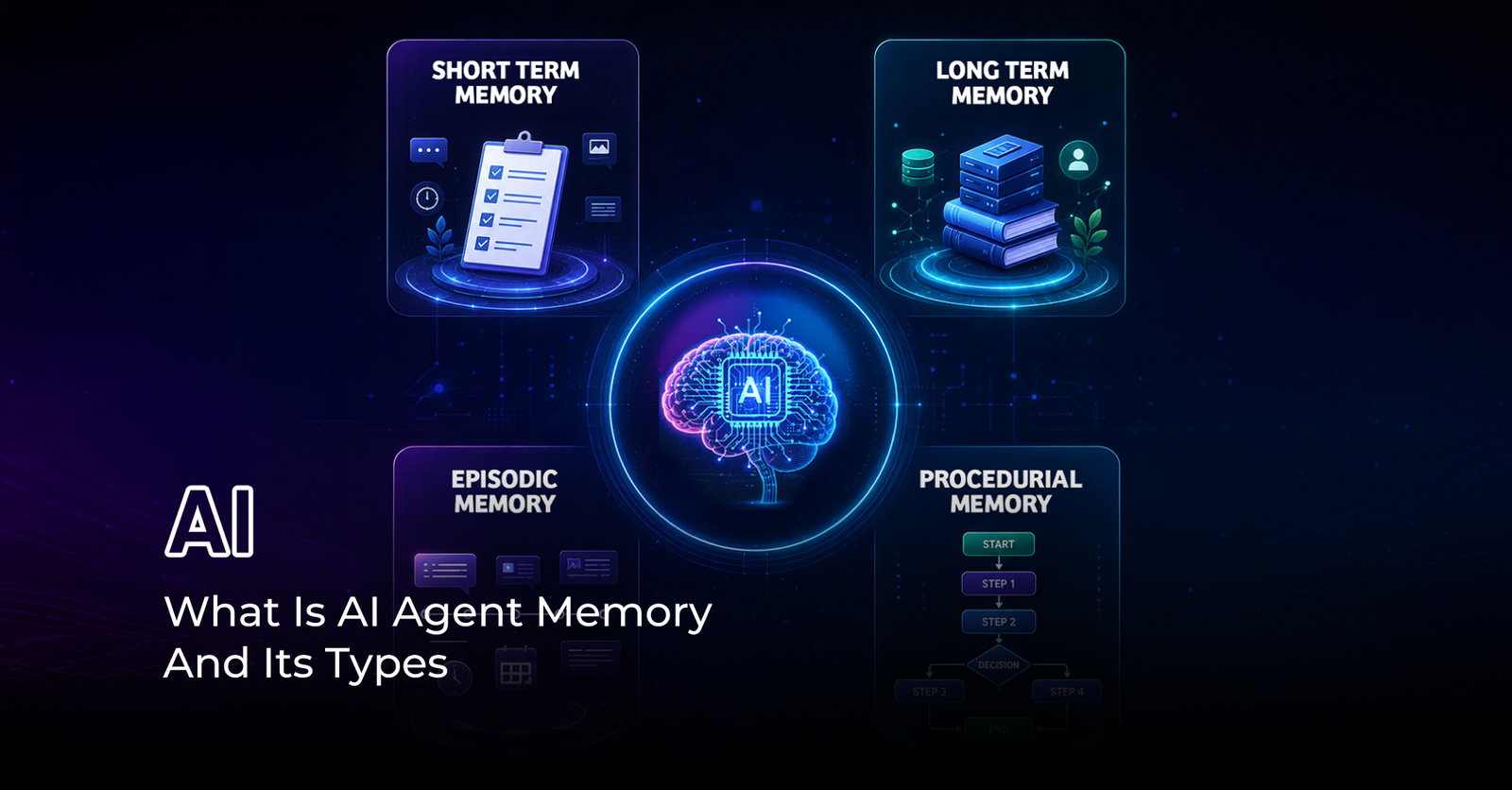
Different sources categorize AI agent memory in slightly different ways, but most frameworks agree on a core set: working or short-term memory, long-term memory, semantic memory, episodic memory, and procedural memory.
1. Short-Term Memory Or Working Memory
Short-term memory, often called working memory, acts like the agent’s scratchpad. It holds recent context, current instructions, intermediate task results, and conversation state.
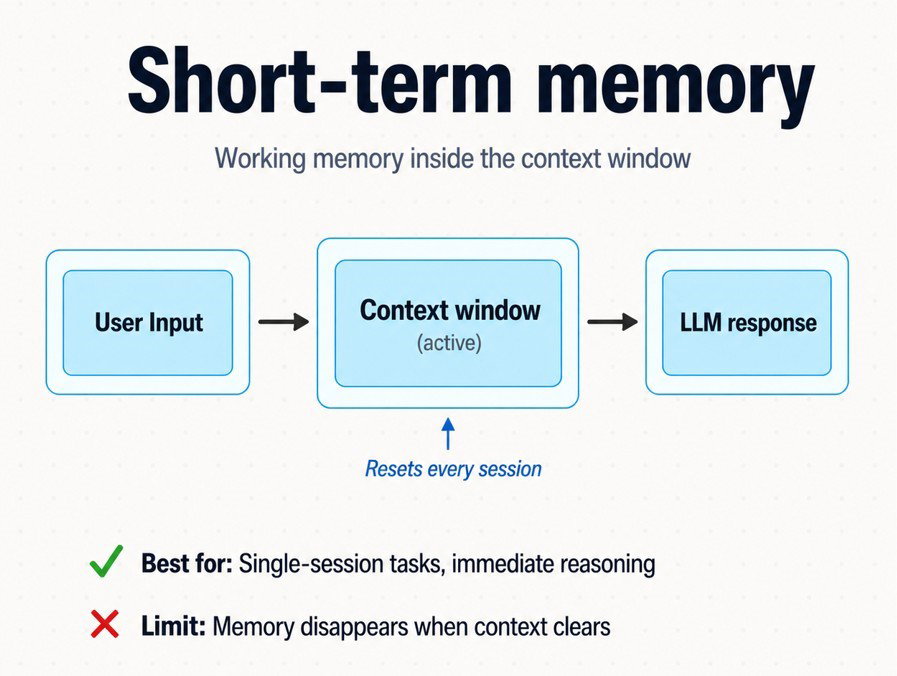
In a chatbot, this allows the agent to understand follow-up messages such as “make it shorter” or “use the second option.” In a workflow agent, it helps track what has already been done and what step comes next. Working memory is a specialized subset of short-term memory used for active information manipulation during task execution.
Short-term memory is fast and useful, but it is usually temporary. When the session ends, the memory may be cleared unless the system promotes selected details into long-term memory.
2. Long-Term Memory
Long-term memory allows agents to remember information beyond the current session. It can store user preferences, previous decisions, project context, organizational rules, customer history, or other durable information.
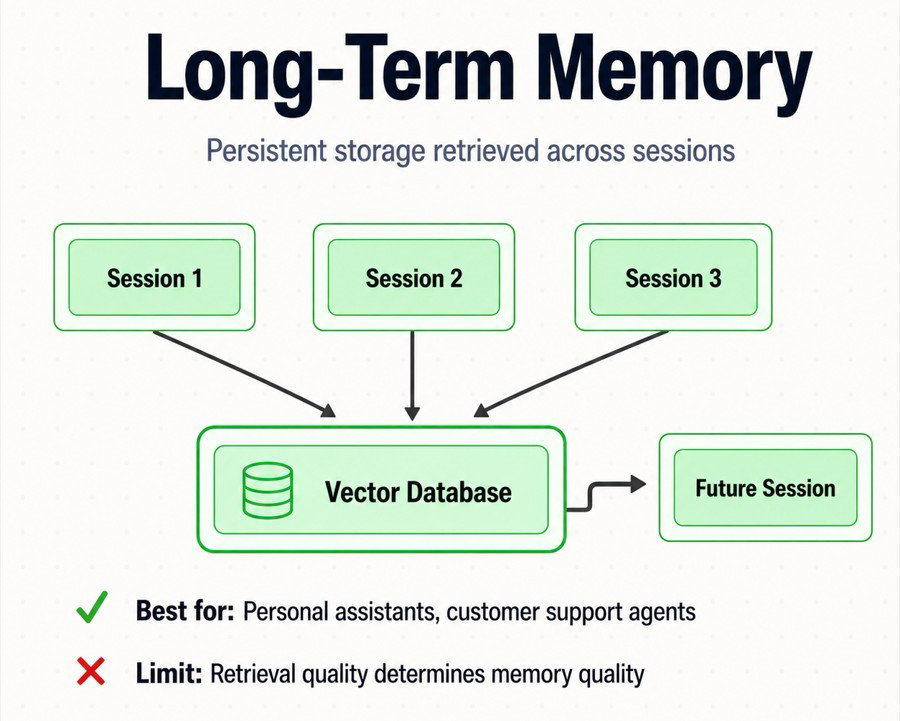
How do AI agents store long-term information? In most production architectures, long-term memory is stored outside the LLM in databases, vector stores, knowledge graphs, event logs, or other persistent systems. Long-term memory is often implemented using databases, knowledge graphs, or vector embeddings, while RAG can be used to fetch relevant information from stored knowledge bases.
The significant point is that long-term memory is selective. Saving everything creates noise. Storing every detail can reduce retrieval quality. Moreover, mature memory systems need metadata such as user ID, memory type, timestamps, and expiry rules.
3. Semantic Memory
Semantic memory stores facts, concepts, relationships, and general knowledge. It tells the agent what is true, what a term means, how entities relate to each other, and what domain knowledge should guide the answer.
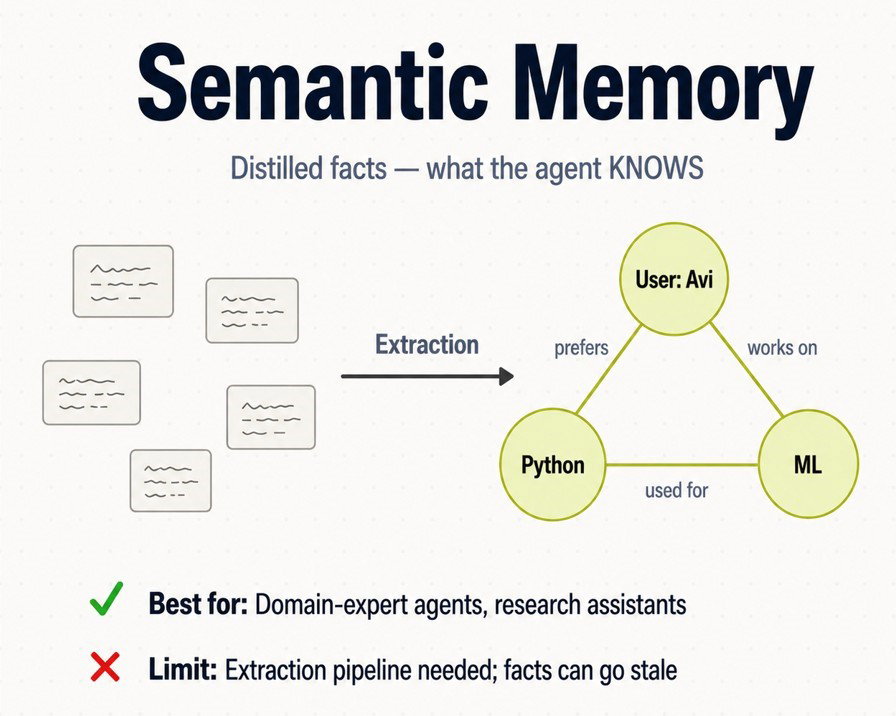
For example, a support agent’s semantic memory may include product specifications, policy rules, customer tiers, and known issue resolutions. A legal AI assistant may use semantic memory for statutes, precedents, and internal legal templates. Semantic memory is structured factual knowledge that can be retrieved and used for reasoning, often through knowledge bases, symbolic AI, or vector embeddings. It helps agents ground answers in facts rather than relying only on model weights or guesses.
4. Episodic Memory
How does episodic memory work in agentic systems? Episodic memory stores specific past events, including what happened, when it happened, what action was taken, and what outcome followed. It is the agent’s record of experience.
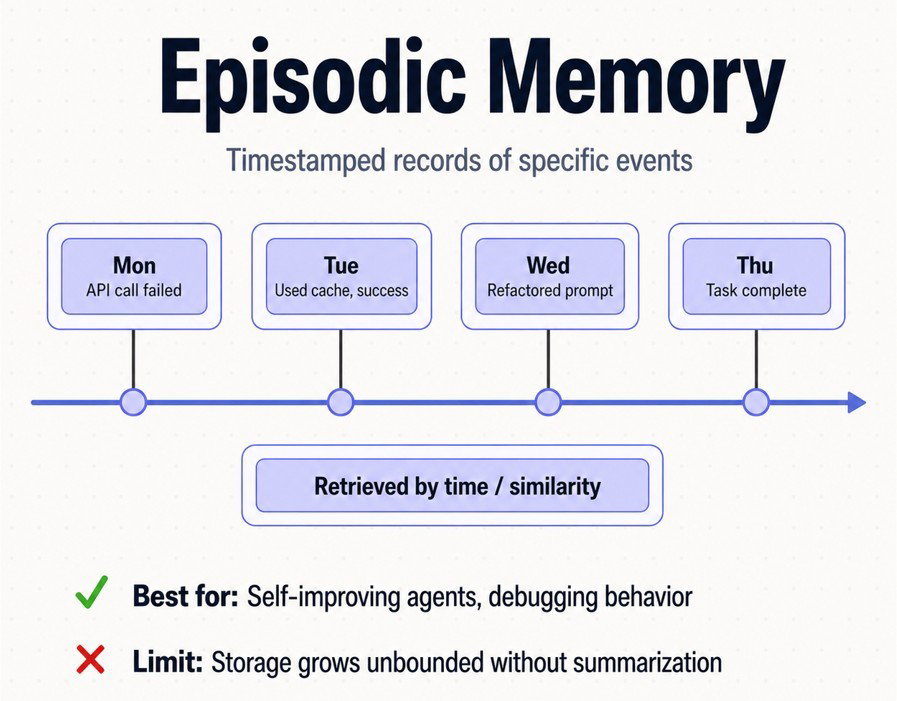
For instance, an AI coding assistant may remember that a previous deployment failed because of a version mismatch. A sales assistant may remember that a client rejected a proposal because of budget concerns. A customer support agent may remember that a user already tried a troubleshooting step.
Episodic memory is the ability to recall specific past experiences, often implemented by logging key events, actions, and outcomes in a structured format. It may be stored using vector databases for semantic search and event logs for ground truth. This makes episodic memory especially useful for case-based reasoning. The agent can compare current issues with similar past events and avoid repeating failed approaches.
5. Procedural Memory
Procedural memory stores how to do things. It includes task steps, workflows, tool-use rules, decision patterns, and repeated procedures.
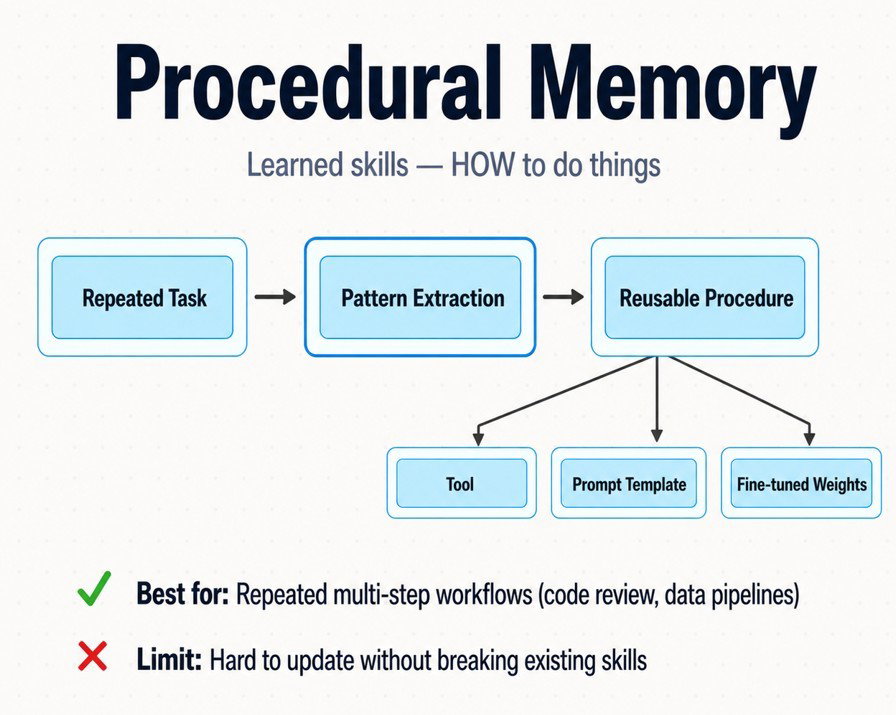
For example, an agent that drafts a campaign report may remember the required format, approval sequence, and data sources. A DevOps agent may remember the process for rolling back a failed deployment. Procedural memory is the ability to store and recall skills, rules, and learned behaviors, so agents can perform tasks efficiently without reasoning through every step from scratch.
Procedural memory is key for automation as it helps agents move from answering questions to executing repeatable work.
Together, these memory types make AI agents more contextual and continuous. However, they also raise a bigger challenge: deciding what to store, retrieve, update, or forget.
The Challenges Of AI Agent Memory
While memory makes agents more useful, it also creates new challenges.
First, there is the noise problem. If an agent stores everything, retrieval becomes messy and irrelevant memories may pollute the context. Memory stores that grow without consolidation become noisier, making it harder to surface the right context.
Second, there is the staleness problem. User preferences, policies, projects, and facts change over time. A memory that was useful three months ago may not serve any purpose today. Memory systems need timestamps, confidence scores, versioning, expiry rules, and mechanisms to update or delete outdated records. Then comes the governance problem. Memory can contain user-specific or sensitive information, so teams need access controls, audit trails, retention policies, and deletion mechanisms.
Once an agent stores anything traceable to a person, teams must consider what is being stored, how long it is kept, and how deletion requests are handled.
Conclusion
AI agent memory is the foundation that allows agents to move from stateless response engines to adaptive, context-aware collaborators. It gives agents continuity, personalization, learning ability, and operational awareness.
The most important AI agent memory types include short-term or working memory, long-term memory, semantic memory, episodic memory, procedural memory, retrieval memory, parametric memory, and prospective memory. Together, these forms of agentic AI cognitive storage help agents understand what is happening now, remember what happened before, know what is true, repeat useful procedures, and act on future goals.
As AI agents become more deeply embedded in enterprise workflows, LLM memory management will become as critical as model selection. The best agents will not simply be the ones with the largest models. They will be the ones with the smartest memory architecture.
Frequently Asked Questions
How Does AI Agent Memory Improve Reasoning In Multi-Step Workflows?
AI agent memory helps systems retain task progress, previous decisions, tool outputs, and user intent across different steps.
This allows agents to avoid repetition, maintain continuity, and make more informed decisions as workflows become more complex.
Why Is Long-term Memory Different From Simply Increasing LLMs Context Window?
A larger context window only holds more information temporarily during a session, while long-term memory stores useful information for future retrieval.
This makes long-term memory better for personalization, recurring tasks, user preferences, and cross-session continuity.
How Does Episodic Memory Help AI Agents Learn From Past Interactions?
Episodic memory stores specific events, actions, outcomes, and mistakes from previous interactions.
By recalling similar past situations, an AI agent can avoid failed approaches and apply successful patterns more effectively.
Mon, Aug 10, 2026

Liked what you read? That’s only the tip of the tech iceberg!
Explore our vast collection of tech articles including introductory guides, product reviews, trends and more, stay up to date with the latest news, relish thought-provoking interviews and the hottest AI blogs, and tickle your funny bone with hilarious tech memes!
Plus, get access to branded insights from industry-leading global brands through informative white papers, engaging case studies, in-depth reports, enlightening videos and exciting events and webinars.
Dive into TechDogs' treasure trove today and Know Your World of technology like never before!
Disclaimer - Reference to any specific product, software or entity does not constitute an endorsement or recommendation by TechDogs nor should any data or content published be relied upon. The views expressed by TechDogs' members and guests are their own and their appearance on our site does not imply an endorsement of them or any entity they represent. Views and opinions expressed by TechDogs' Authors are those of the Authors and do not necessarily reflect the view of TechDogs or any of its officials. While we aim to provide valuable and helpful information, some content on TechDogs' site may not have been thoroughly reviewed for every detail or aspect. We encourage users to verify any information independently where necessary.
Loading comments...