
Artificial Intelligence
What Are Decision Models? Why AWS And OpenAI Are Copying Jev?
Share
TL;DR
That is the idea behind decision models, a fast-rising AI category that has already pulled Jev, AWS, and OpenAI into the same conversation.
-
Decision models are AI systems designed to choose among predefined options rather than generate unrestricted responses.
-
They can help with classification, routing, risk assessment, moderation, and other structured decisions.
-
Their appeal is growing as AI agents need faster, cheaper, and more predictable ways to choose their next actions.
-
Jev helped bring renewed attention to this model category by positioning bounded decision-making as a dedicated AI capability.
-
OpenAI followed with its Decisions API, while AWS introduced Strands Decider 2B.
Introduction
In the movie Moneyball, Billy Beane challenges baseball’s traditional scouting system by relying on data to make clearer, more structured decisions about which players to recruit. Instead of depending only on instinct, the process narrows complex information into choices that can directly influence what happens next.
That same principle is becoming increasingly relevant in artificial intelligence.
For the past few years, AI development has largely focused on generation. Models can write emails, create code, summarize documents, answer questions, analyze images, and reason through complex problems. Yet many real-world software systems do not always need another open-ended response.
Sometimes, they simply need to make the right choice.
Should a customer request go to sales or support? Is a transaction suspicious? Which tool should an AI agent use next? Does a piece of content violate a policy? Should a workflow continue automatically or be escalated to a human?
These are bounded problems where the possible outcomes are already known.
That is where decision models are gaining attention. Instead of generating unrestricted responses, they evaluate context and select from predefined options, often while indicating how confident they are in the result.
The concept itself is not new. Decision-making models have long existed across statistics, machine learning, operations research, and business management. What is changing is how they are being adapted for modern AI systems.
As companies build more autonomous agents and automated workflows, structured AI decision making is starting to look less like a niche capability and more like an important layer of the AI stack.
That shift also helps explain why Jev, a relatively small decision model, quickly drew the attention of companies such as AWS and OpenAI.
What Are Decision Models In AI?
At their simplest, AI decision models are systems that evaluate information and select an outcome from a limited set of possibilities.
Instead of asking a model to freely generate an answer, developers define the choices available to it.
For example, imagine an insurance company receiving thousands of customer messages. A generative model could read each message and write a summary explaining what the customer wants.

A decision model could instead answer a narrower question:
Which department should handle this message?
The available options could be:
Claims, billing, policy changes, fraud investigation, or general support.
The model evaluates the message and selects one of those options, potentially returning probabilities or confidence scores alongside its answer.
This illustrates the core difference in decision models vs generative AI.
Generative models are designed for open-ended creation. They work well when the output could take many possible forms, such as writing an explanation, generating code, or drafting a report.
Decision models work better when the acceptable outcomes are already defined.
That distinction makes them useful for tasks such as fraud detection, content moderation, customer-support routing, lead qualification, compliance checks, risk scoring, and selecting actions inside automated workflows.
There are also several types of decision models depending on the underlying technology. Traditional systems may rely on rules, decision trees, statistical models, or machine-learning classifiers. Newer AI decision models attempt to combine some of the flexibility of language models with the predictable outputs of traditional classifiers.
That combination is becoming particularly relevant as AI systems move from answering users to taking actions.
How Do Decision Models Work And Why Are They Becoming Crucial?
To understand how decision models work, it helps to think of them as a controlled decision layer. A system provides the model with context, asks a specific question, and defines the answers the model is allowed to choose from.
For instance, an AI shopping agent could receive information about a product and be asked: What should happen next?
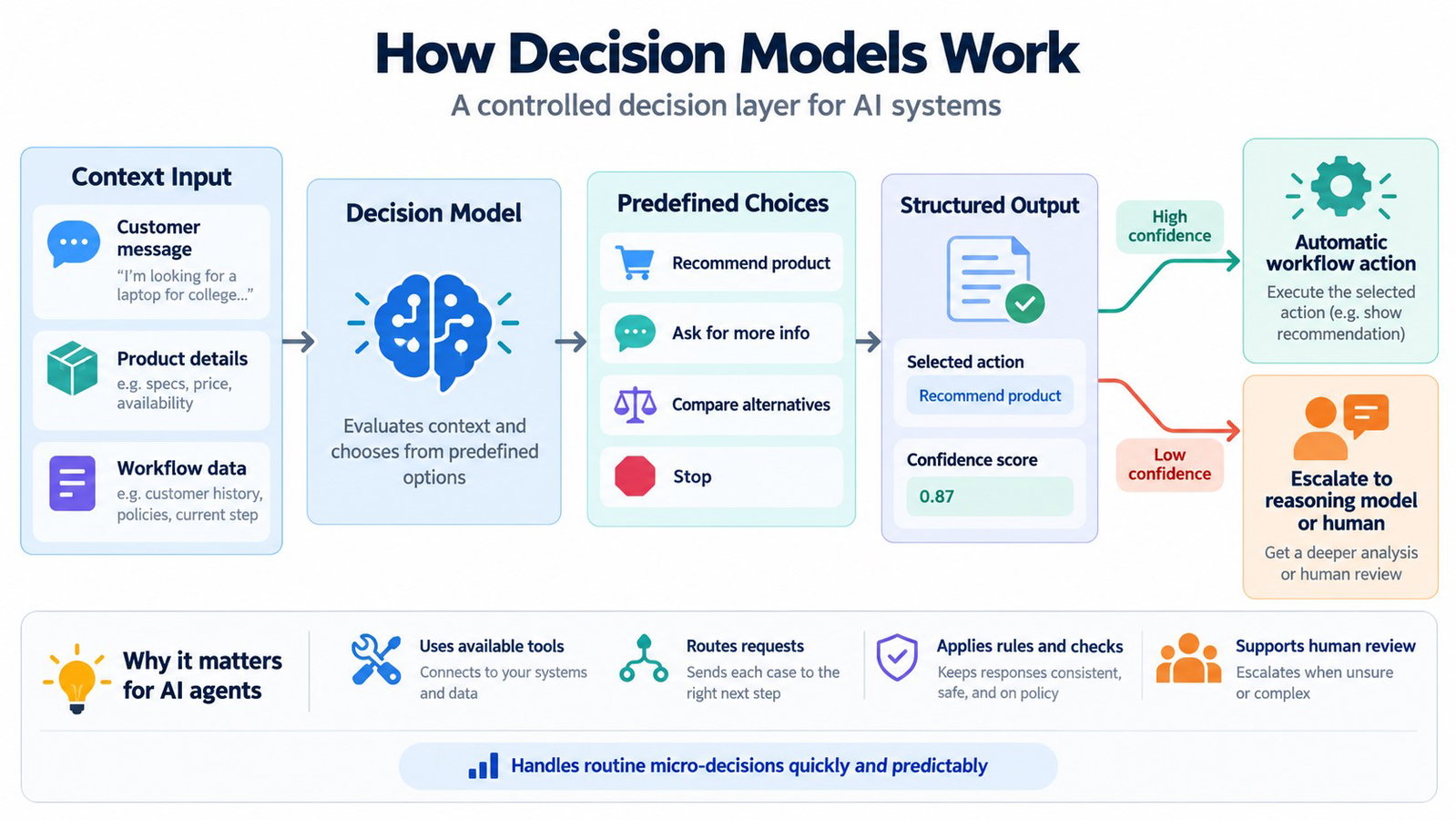
Recommend product, ask user for more information, compare alternatives, or stop.
The decision model evaluates the available context and selects the option it considers most appropriate. This can make decision models easier for software systems to work with because their outputs are predictable. Instead of parsing a paragraph generated by an LLM and trying to determine what action it recommends, an application receives a structured response it can use directly.
Confidence information can add another layer of control.
If a decision model is highly confident that a support request belongs in the billing queue, the workflow may proceed automatically. If confidence is low, the request could instead be sent to a larger reasoning model or a human employee.
That makes decision models for AI agents particularly interesting.
Agentic systems often make dozens of small choices while completing a task. They may need to select tools, interpret results, verify whether conditions have been met, determine whether to continue, and decide when human involvement is required.
Using a large generative model for every micro-decision can increase latency and cost.
A specialized decision model in AI could handle routine choices quickly while reserving expensive reasoning models for situations that genuinely require deeper analysis.
This creates a more modular approach to artificial intelligence.
One model may generate content. Another may reason through complex problems. A third may specialize in making structured decisions.
That architectural idea was not invented in 2026. However, one company packaged it in a way that made the AI industry pay much closer attention.
Jev Turned Decision Models Into A New AI Product Category
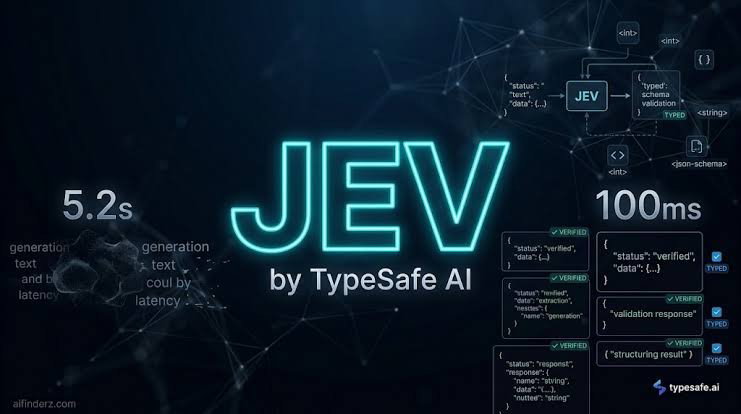
Jev, developed by TypeSafe AI, helped turn the abstract idea of decision modelling into a much clearer product proposition. Instead of competing directly with large language models on writing, coding, or broad reasoning, Jev focuses on answering constrained questions.
Developers can provide context, define a question, specify possible outcomes, and receive a structured decision. The philosophy is essentially: decide instead of generate.
That may sound like a small distinction, but it addresses an important weakness in many AI workflows. Large language models are extremely flexible because they can generate almost anything. That flexibility can also make them unnecessary for simple decisions where an application already knows the possible outcomes.
Jev positioned itself between two familiar approaches. Traditional classifiers are fast and efficient but often need to be trained for specific tasks. Large language models can adapt to new instructions without specialized training but may be slower, more expensive, and more verbose than necessary.
Jev attempts to combine flexibility with constrained outputs. That makes it relevant for decision model's use cases such as classification, moderation, workflow routing, policy checking, scoring, and agent control.
Yet the biggest sign that Jev had identified something important came not from its own marketing, but from what happened next. Major AI companies quickly started launching similar capabilities.
Why OpenAI Followed Jev With Its Decisions API?
OpenAI announced its Decisions API shortly after Jev entered the market, immediately inviting comparisons between the two approaches. The underlying product idea is familiar.
Developers provide context, define a question, and specify a finite set of possible answers. The AI then evaluates the situation and chooses among those answers instead of generating unrestricted text. That allows OpenAI to address tasks such as classification, routing, evaluation, and deciding which action an AI agent should take next.

The significance lies in how naturally this fits into OpenAI's broader ecosystem. OpenAI already provides models for generation, reasoning, coding, tool use, and agentic workflows. Adding a dedicated decision interface allows developers to use different types of intelligence at different stages of an application.
A reasoning model can investigate a complicated problem. A generative model can produce an explanation. A decision layer can choose what happens next.
This is why decision models vs generative AI does not necessarily have to be an either-or competition. In many applications, both could work together. OpenAI's move also validates one of Jev's central assumptions: developers may want decision-making exposed as a distinct AI capability rather than forcing every problem through a traditional chat-completion interface.
However, OpenAI was not the only large player moving in that direction.
Why AWS Built Strands Decider 2B?
AWS approached the emerging decision-model category from a more infrastructure-focused direction with Strands Decider 2B. The roughly 1.9-billion-parameter model is designed specifically to evaluate predefined choices and return a decision with confidence information.
Unlike conventional language models, which are optimized to predict and generate sequences of tokens, Strands Decider modifies that architecture around choosing among available options. That makes its intended purpose clear.

It is not trying to write an essay or hold a conversation. It is designed to decide. AWS also acknowledged that Jev helped generate attention around this new class of models, while conversations with customers pointed toward the same underlying need.
Enterprises building AI agents increasingly need lightweight systems capable of making repeatable decisions throughout a workflow. That could involve determining which API to call, deciding whether a process has succeeded, selecting a route through an application, or escalating a problem when uncertainty rises.
For AWS, this trend also fits naturally with its broader cloud strategy. If companies deploy millions of AI agents across enterprise infrastructure, those agents will need supporting components. Not every component needs to be a massive frontier model.
Smaller decision models running cheaply and close to enterprise workloads could become one of those components.
AWS’s move showed that decision models were no longer just an experimental idea. Once both AWS and OpenAI had introduced their own approaches, the obvious question was whether they were independently responding to the same market need or following the path Jev had already laid out.
Are AWS And OpenAI Really Copying Jev?
Calling the new products “Jev clones” makes for a compelling headline, but the reality requires some distinction. Neither structured decision-making nor classification originated with Jev.
Businesses have used rule engines, decision trees, recommendation systems, classifiers, and business decision models for years. Machine learning has always involved models designed to choose between classes or predict outcomes. What Jev appears to have done successfully is reframe the concept for the generative AI era.
Instead of presenting decision-making as a conventional machine-learning task, Jev presented it as a flexible AI primitive developers could use in much the same way they use modern foundation models.
That product framing matters.
The rapid appearance of alternatives from OpenAI, AWS, Cloudflare, and others suggests that the underlying idea resonated.
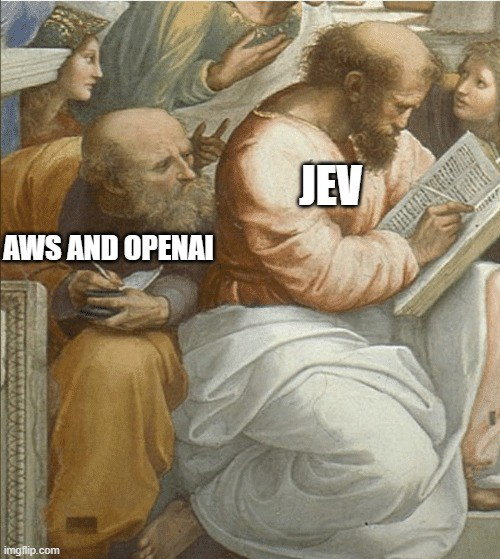
So, AWS and OpenAI may not be copying Jev's technology in the literal sense.
They are responding to the same product insight Jev made visible: modern AI applications need a layer dedicated to choosing between known outcomes.
The emerging competition is therefore about who can build the fastest, cheapest, most accurate, and easiest-to-integrate decision layer.
Why Decision Models Could Become Essential For AI Agents?
The timing of this competition is critical because AI systems are becoming increasingly autonomous.
An AI chatbot mainly needs to return an answer.
An AI agent needs to repeatedly determine what to do next.
Those decisions can accumulate throughout even a simple task.
An agent booking business travel may need to decide which search tool to use, which flights meet company policy, whether prices are acceptable, whether approval is required, and whether the task can continue without human involvement.
Topics For More Insights:
Using a frontier model for every one of those decisions may work technically, but it may not be the most efficient architecture.
This is where decision models in machine learning could evolve into a more specialized layer of agentic AI.
Routine decisions could be handled by small, inexpensive models. Complicated situations could be escalated to more capable reasoning systems.
The result could be an AI stack where different models handle different levels of cognition.
That is also why decision intelligence models are becoming relevant beyond pure AI research. Businesses increasingly need systems that can convert data and context into concrete actions rather than simply generate more information.
Conclusion: What Happens Next For Jev, AWS, And OpenAI?
Jev may have arrived at the right moment.
As enterprises move beyond AI experimentation and begin deploying autonomous workflows, the industry is discovering that intelligence does not always need to produce language. Sometimes, the most valuable output is simply the correct choice.
Jev helped bring that idea into focus. OpenAI's Decisions API and AWS Strands Decider 2B suggest major platforms now see similar potential. The next battle will likely revolve around accuracy, latency, cost, confidence calibration, deployment flexibility, and integration with agent frameworks.
Jev has the advantage of helping define the emerging category. AWS has enterprise infrastructure and open-source distribution. OpenAI has an enormous developer ecosystem and a growing agent platform. Regardless of which approach wins, the broader direction is becoming clearer.
The future of AI may not revolve around one giant model doing everything.
Instead, applications could combine powerful reasoning systems with smaller specialized models designed for generation, classification, verification, and decision-making. If that architecture becomes standard, Jev's biggest contribution may not be becoming the largest AI model company. It may be convincing the industry that decision-making deserves a model of its own.
Frequently Asked Questions
How Are Decision Models Different From Traditional Machine Learning Classifiers?
Traditional classifiers are usually trained for a specific task, such as detecting spam or categorizing customer requests. Modern AI decision models aim to be more flexible by accepting natural-language context, predefined options, and changing instructions without requiring a new model to be trained for every use case. This makes them potentially more adaptable for dynamic AI workflows and agentic systems.
Why Could Decision Models Be More Cost-Effective For AI Agents Than Large Language Models?
AI agents often make many small decisions, such as choosing a tool, routing a request, or determining whether a task should continue. Using a large generative model for each step can increase latency and compute costs. Smaller decision models can handle these bounded choices more efficiently, while complex cases can still be escalated to larger reasoning models.
Could Decision Models Eventually Replace Generative AI Models?
Decision models are unlikely to replace generative AI because they solve a different problem. Generative models are better suited to creating content, explaining complex topics, and handling open-ended reasoning, while decision models specialize in choosing among defined outcomes. The more likely future is a hybrid AI architecture where generative, reasoning, and decision models work together within the same system.
Tue, Oct 13, 2026

Enjoyed what you've read so far? Great news - there's more to explore!
Stay up to date with the latest news, a vast collection of tech articles including introductory guides, product reviews, trends and more, thought-provoking interviews, hottest AI blogs and entertaining tech memes.
Plus, get access to branded insights such as informative white papers, intriguing case studies, in-depth reports, enlightening videos and exciting events and webinars from industry-leading global brands.
Dive into TechDogs' treasure trove today and Know Your World of technology!
Disclaimer - Reference to any specific product, software or entity does not constitute an endorsement or recommendation by TechDogs nor should any data or content published be relied upon. The views expressed by TechDogs' members and guests are their own and their appearance on our site does not imply an endorsement of them or any entity they represent. Views and opinions expressed by TechDogs' Authors are those of the Authors and do not necessarily reflect the view of TechDogs or any of its officials. While we aim to provide valuable and helpful information, some content on TechDogs' site may not have been thoroughly reviewed for every detail or aspect. We encourage users to verify any information independently where necessary.
Loading comments...