

Artificial Intelligence
Could Netflix’s VOID AI Be The Future Of AI Video Editing And Filmmaking?
Share
Overview
TL;DR
-
Netflix’s VOID fully removes objects and reconstructs scenes so they look natural, going beyond basic editing tools.
-
Combines multiple AI systems like Meta’s SAM2, Google’s Gemini, and Alibaba’s CogVideoX.
-
Key abilities include rewriting dialogue, adjusting backgrounds, enhancing actor performances, and reducing reshoots.
-
In a human preference study, VOID was picked 64.8% of the time, beating six other tools, including Runway.
-
Helps speed up production while giving filmmakers more creative freedom to tell their stories.

Introduction
Filmmaking has always lived with a “what if.” What if a scene felt slightly off? What if a performance could be better? What if a small mistake could simply disappear?
Until now, those questions came with expensive answers through reshoots, complex edits, or simply accepting what was captured. Once a scene was filmed, its possibilities were mostly locked in, with only minor fixes along the way.
With the rise of AI video editing and smarter video editing AI tools, solutions like Netflix VOID AI are beginning to redefine how creators approach post-production.
Netflix VOID AI, the company’s new research project, is exploring a different approach, not just editing scenes after the fact, but rethinking them in a way that still feels natural and real. By releasing it openly through Hugging Face, where the model is hosted for testing and experimentation, Netflix is making it accessible to a wider creative community. It is also supporting this with code on GitHub, allowing developers to build on it and explore what storytelling could look like next.
It might feel like a small change, but it could mean a lot more for how films are made. Let’s understand what VOID AI really is and why it matters. Read on!
What Is VOID AI?
VOID (Video Object and Interaction Deletion) is an AI research system that can remove objects from a video and rebuild the scene as if they were never there.
This makes it a breakthrough in AI video object removal, going beyond traditional editing tools.
When any element is removed, VOID AI doesn’t just leave a space or blur it out. It adjusts the movement, the interactions, and the flow of the scene, so everything still looks natural, like that object was never part of it in the first place.
This makes it a powerful innovation in AI video object removal, going far beyond traditional editing techniques.
How VOID AI Is Different From Traditional Video Editing
Most video editing AI tools focus on visual cleanup. They remove objects, fix lighting, or smooth transitions, but they don’t really understand what’s actually happening in the scene.
Well, VOID AI does. It brings in a sense of cause and effect to video editing. If a person holding a guitar is removed, the guitar doesn’t just hang in the air; it falls. If a car in a crash disappears, the scene shifts to a version where the accident never happened.
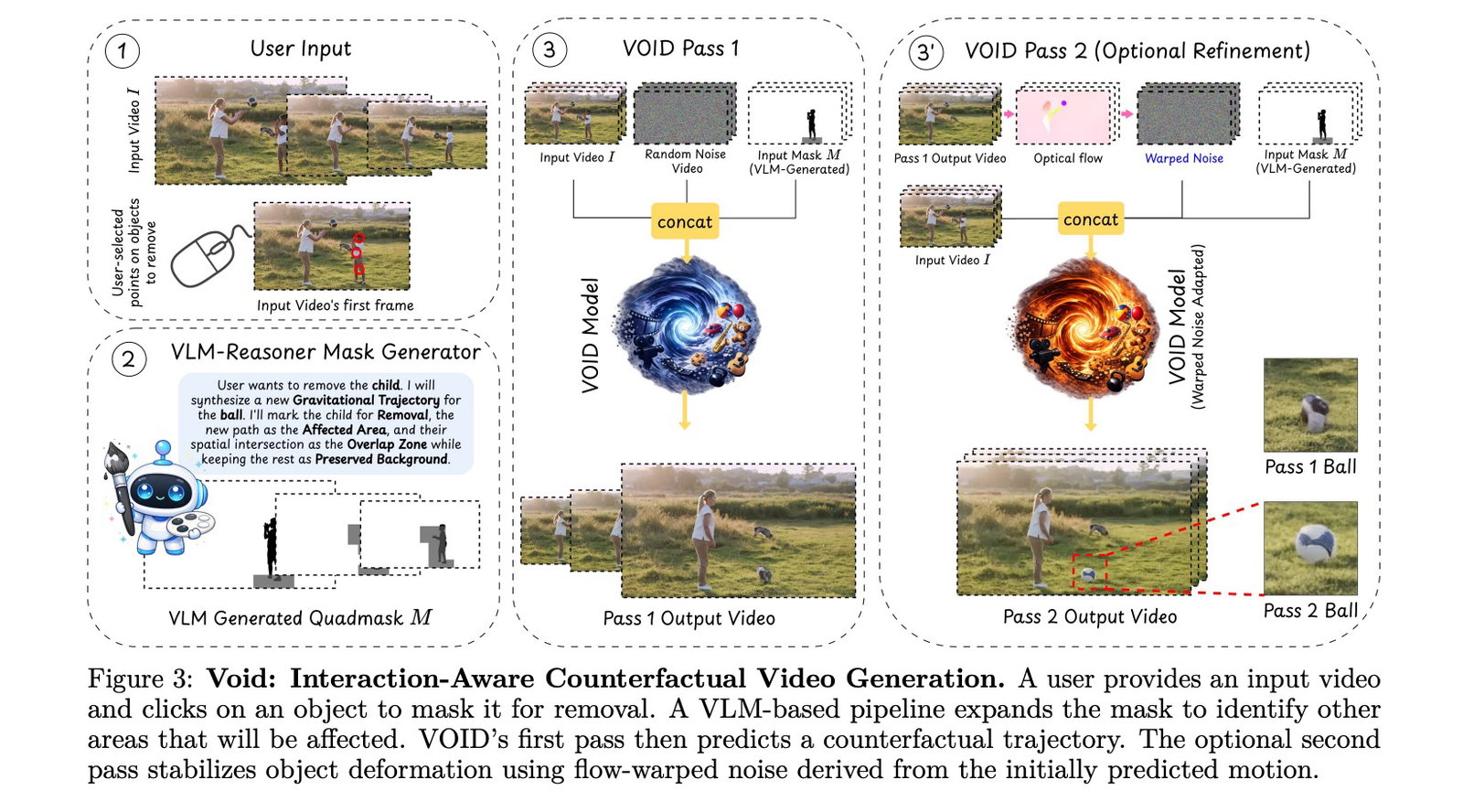
This approach is called counterfactual video generation. It shows how a scene could have played out differently. That’s why VOID AI feels less like editing and more like recreating the moment itself.
This is why it stands out among modern AI filmmaking tools, offering deeper scene understanding rather than simple edits.
How Netflix’s VOID AI Works
To make VOID AI work, Netflix had to start with training. Since real-world footage rarely offers clean “before and after” versions of the same scene, Netflix created synthetic datasets using tools like Kubric and HUMOTO.
This highlights how next-generation AI video editing systems rely on structured learning rather than simple visual correction.
This allowed them to build controlled scenarios, like a scene with an object, the same scene without it, and how physics plays out in both. These clear comparisons helped the AI learn how interactions should change, not just what to remove. To bring this learning into action, VOID AI relies on multiple AI systems working together, each handling a different part of the process.
-
The Multi-AI Pipeline Behind VOID AI
VOID AI isn’t just one model; it works more like a team of AI systems. Behind this, tools like Meta’s SAM2, Google’s Gemini, and Alibaba’s CogVideoX work together to make it happen. The powerful video model can generate full scenes while keeping everything smooth and consistent. Netflix has fine-tuned it to go beyond visuals so it can follow how things move and interact over time.
-
The Quadmask System
VOID AI uses something called a quadmask. It splits a scene into four parts, which include the object being removed, the areas touching it, the parts affected by it, and the background that stays the same. This gives the AI a clearer view of the entire scene. It can see how everything connects and adjusts the right parts when something is taken out. That’s why the final result feels smooth and natural, like the scene was always meant to be that way.
-
Two-Pass Processing For Stability
VOID AI follows a two-step generation approach. The first pass creates a reconstructed version of the scene. The optional second pass refines it using optical flow techniques and ensures that objects remain stable across frames and don’t warp or distort. This matters because one of the biggest challenges in AI-generated video is maintaining consistency over time, and VOID AI directly addresses that.
All of this is what helps VOID AI move past simple edits and actually change a scene in a way that still feels real. Here are the features that make that happen.
Topics For More Insights:
Features Of VOID AI
Behind every natural-looking change is a system that thinks about the scene the way a filmmaker would. It’s this thinking that makes the features of VOID AI truly effective.
-
Rewriting Dialogue And Facial Expressions
One of VOID AI’s most impressive tricks is changing dialogue without needing a full re-shoot. The AI can match new lines to an actor’s lips and expressions, so it feels like they actually said it on set.
-
Modifying Backgrounds And Environments
VOID AI can digitally transform a scene’s background, adjusting lighting, weather, or even entire environments to match the story’s needs. It can fix continuity errors, enhance visual consistency, or completely change the location.
-
Digitally Enhancing Actor Performances
When a performance is already strong, VOID AI can take it a step further. It fine-tunes small details, like facial expressions, gestures, or timing, and helps a scene feel even more polished while keeping the actor’s original emotion intact.
-
Reducing Reshoots And Production Costs
Reshoots can be costly and time-consuming. VOID AI helps reduce the need for them by making changes digitally, saving both time and money while keeping the production on schedule.
With capabilities like these, VOID AI stands in a class of its own to offer precision and flexibility that set it apart from other AI video generation tools.
VOID AI Vs. Runway
According to Forbes, a human preference study found that VOID AI was chosen 64.8% of the time, beating six other tools, including Runway, the leading commercial alternative, which only managed 18.4%.
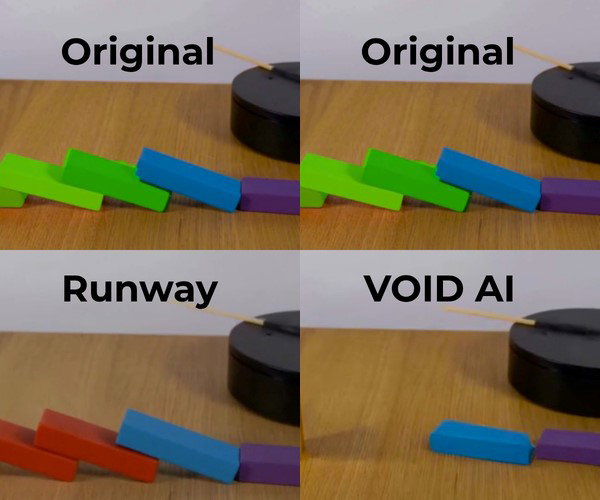
Unlike Runway, which just marks objects and often leaves them visible, VOID AI can fully remove objects and rebuild the scene, so it looks like the object was never in the scene to begin with.
What Makes Netflix’s Approach Unique
Netflix has a unique advantage. It’s not just the technology, but the experience and resources behind it. With huge content libraries, a keen sense of what audiences love, and a production pipeline that connects every step, VOID AI becomes part of the storytelling itself. It lets creators experiment, refine, and bring their vision to life in ways that were much harder or even impossible before.
With its advanced features and unique approach, VOID AI is opening up entirely new possibilities for how films can be made.
Why VOID AI Is A Game-Changer For Filmmaking
By reworking scenes, improving performances, and speeding up production, VOID AI is changing the way filmmakers create. Here’s why it’s such a game-changer.
-
Faster Production Timelines
With fewer reshoots and more efficient editing, projects can move from production to release much faster. This is especially important in today’s binge-driven streaming culture.
-
Greater Creative Flexibility For Directors
Directors no longer have to settle for “good enough.” They can experiment with different versions of a scene even after filming is complete.
-
Minimizing Human And Technical Errors
Continuity issues, missed cues, or technical glitches can now be corrected without major disruptions as VOID AI acts like a safety net for filmmakers.
On that note, let’s wrap up this article.
Conclusion
Telling stories isn’t just about what you capture on camera anymore. Now this is all about what you can imagine and bring to life afterward. VOID AI lets filmmakers tweak performances, adjust dialogue, and transform scenes without the hassle of endless reshoots, and gives them room to get really creative.
At the same time, it makes us think about ethics, consent, and what’s real in a story. The line between what was actually filmed and what’s digitally created is starting to blur.
Honestly, that’s exciting. Filmmaking is stepping into a whole new chapter, where “what if” moments finally have no limits, and audiences get stories that feel sharper, richer, and more alive than ever!
Frequently Asked Questions
What Is The AI Video Object Removal Technique?
AI video object removal is a technique where AI identifies and removes unwanted elements from a video and fills in the background, so the scene still looks seamless. Instead of manually editing frame by frame, the AI predicts how the scene should look without the object and generates that updated version automatically.
Is VOID AI Better Than Runway?
In head-to-head comparisons, many users prefer VOID AI as Runway AI alternative because VOID AI fully removes the objects and reconstructs what’s behind them in a way that looks natural. Runway can handle basic removal tasks, but VOID’s deeper understanding of scene context often produces smoother, more realistic outcomes.
Can AI Replace Video Editing?
AI can automate and speed up many parts of video editing, especially repetitive or technical tasks, but it’s not a full replacement for human editors. Creative decisions, narrative pacing, emotional tone, and artistic choices still rely on human judgment. AI tools like VOID AI are more powerful assistants that enhance what editors can do, rather than taking over the entire craft.
Thu, Apr 9, 2026

Enjoyed what you've read so far? Great news - there's more to explore!
Stay up to date with the latest news, a vast collection of tech articles including introductory guides, product reviews, trends and more, thought-provoking interviews, hottest AI blogs and entertaining tech memes.
Plus, get access to branded insights such as informative white papers, intriguing case studies, in-depth reports, enlightening videos and exciting events and webinars from industry-leading global brands.
Dive into TechDogs' treasure trove today and Know Your World of technology!
Disclaimer - Reference to any specific product, software or entity does not constitute an endorsement or recommendation by TechDogs nor should any data or content published be relied upon. The views expressed by TechDogs' members and guests are their own and their appearance on our site does not imply an endorsement of them or any entity they represent. Views and opinions expressed by TechDogs' Authors are those of the Authors and do not necessarily reflect the view of TechDogs or any of its officials. While we aim to provide valuable and helpful information, some content on TechDogs' site may not have been thoroughly reviewed for every detail or aspect. We encourage users to verify any information independently where necessary.
Loading comments...