
Artificial Intelligence
AI Slop Vs. Human Writing: How To Spot Low-Quality AI Text
Share
TL;DR
-
Merriam-Webster made “slop” its 2025 Word of the Year as low-quality AI content became mainstream.
-
An Ahrefs analysis found AI content in 74.2% of 900,000 newly discovered webpages.
-
Common red flags include repetition, generic structure, vague sourcing, inflated language, and thin original insight.
-
Hallucinated studies, quotes, dates, and links are stronger warning signs than stylistic quirks.
-
AI detectors should support human review, not decide authorship, because false positives and evasion remain serious problems.
Introduction
Ever watched MasterChef and seen a plate that looks restaurant-ready, only for the judges to take one bite and find there is not much going on underneath?
Online writing has developed a similar problem.
An article can arrive beautifully plated with clean grammar, neat subheads, confident explanations, and just the right amount of professional vocabulary. Yet start checking the claims, sources, and actual insights, and the dish can fall apart quickly.
That problem has become visible enough for Merriam-Webster to name “slop” its 2025 Word of the Year, defining it as low-quality digital content usually produced at scale with artificial intelligence (AI).

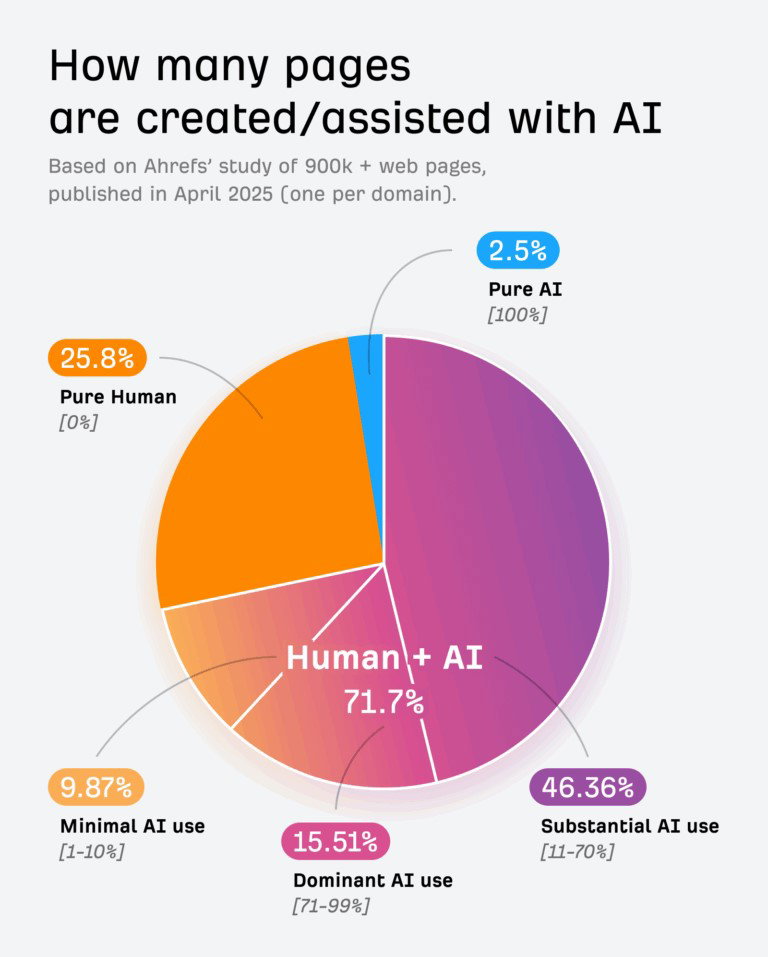
An Ahrefs detector-based study of 900,000 newly discovered English webpages in April 2025 found AI content in 74.2% of them, although most were classified as mixed human-AI work rather than pure AI.
The useful question, then, is not “Was AI involved?” It is “Is there anything valuable beneath the presentation?”
What Is AI Slop?
AI slop is not simply text written with artificial intelligence. It is low-effort, low-value output that looks competent on the surface while offering little substance underneath.
A 2026 ACM AI Letters paper titled Why Slop Matters describes three recurring traits: superficial competence, asymmetric effort, and mass producibility. In plain English, slop can look polished, take seconds to produce, and be reproduced at huge scale.
That distinction matters. Google's own Search guidance says generative AI can help with research and structure. The problem begins when publishers generate many pages without adding user value, which can fall under scaled content abuse. So, AI assistance is not the villain here. Unoriginality, weak verification, and empty writing are.
AI Slop Vs. Human Writing: What Actually Feels Different?
The obvious tells are getting weaker. Perfect grammar is not proof of AI, while a typo is hardly a certificate of human authorship.
Still, research suggests experienced readers notice clusters of patterns. In a 2025 University of Maryland-led study, five annotators who regularly used large language models (LLMs) for writing achieved a 92.7% true-positive rate when identifying AI-generated articles in a controlled test. Less experienced readers performed close to chance.
What were experts noticing? Repetitive formatting, overly tidy conclusions, excessive formality, generic introductions, over-explaining, limited tonal variation, and factual inconsistencies. Separate research has tracked unusually frequent words such as “delve,” “intricate,” and “underscore” in LLM-influenced scientific writing.
One suspicious word proves nothing. A whole page that sounds polished, generic, symmetrical, and strangely frictionless deserves a closer read.If you want an additional signal when reviewing questionable writing, you can also run the text through an AI detector and use the result alongside the other clues rather than treating it as a final verdict.
How To Spot AI Slop: Primary Indicators Of Low-Quality AI Text
The primary indicators of AI slop are better treated as a checklist of quality failures than a machine-authorship test.
-
Low information density: Several paragraphs repeat one idea without adding evidence, examples, or consequences.
-
Template-shaped writing: Every section follows the same rhythm, paragraph length, and “problem, benefits, challenges, future” structure.
-
Inflated importance: Ordinary facts are repeatedly framed as “pivotal,” “transformative,” or part of a “broader landscape” without showing why.
-
Vague authority: Claims lean on “experts say,” “studies show,” or “research suggests” without naming the source.
-
No lived or reported detail: There are no interviews, observations, first-hand tests, original data, or specific insight that could only come from doing the work.
Wikipedia's volunteer AI Cleanup project documents similar AI-generated content red flags, including repetitive formatting and inflated significance. Crucially, its guide warns that these are observations, not proof. Humans can write formulaically too.
Identifying LLM Hallucinations In Text
Style is annoying. Hallucination is dangerous.
IBM defines AI hallucinations as outputs that sound plausible but are factually wrong, irrelevant, or fabricated. In text, the red flags often show up as nonexistent studies, invented quotations, broken URLs, fake statistics, wrong dates, or real sources that do not support the claim attached to them.
A practical verification habit is simple. Inspect the claim before admiring the prose. Open the cited source, search the quoted wording, check whether the named report exists, confirm the publication date, and verify whether the source actually supports the article’s claim.
If a paragraph becomes less credible each time you click its links, you are not dealing with a style problem anymore. You are dealing with unreliable content.
Low-Quality AI Text Detection: Why Detector Scores Are Not Proof
It is tempting to paste suspicious copy into an AI detector and treat the percentage as a verdict. Research says that is risky.
Stanford researchers tested seven detectors on essays by non-native English writers and found that 61.22% of TOEFL essays were classified as AI-generated. At least one detector flagged 89 of 91 essays. Senior author James Zou warned that “current detectors are clearly unreliable and easily gamed.”
Newer detectors may perform better on particular benchmarks, but the core problem remains because detection changes across models, domains, editing styles, and languages. Even the 2025 Measuring AI “Slop” in Text study found that strong LLMs struggled to match human judgments about which passages counted as slop.
Use detector scores as a signal for review, not an accusation.
How Can You Tell If An Article Was Written By AI Or A Human?
Sometimes, you cannot tell with confidence, especially when a human has heavily edited AI-assisted copy. A better editorial test asks whether the article earns trust.
Check four things: specificity, sourcing, reasoning, and voice. Specificity means using concrete names, dates, examples, and details. Sourcing means claims can be verified. Reasoning explains why the evidence matters, while voice reflects deliberate and distinctive writing choices.
Human writing can be bad, while AI writing can be excellent. The strongest dividing line is the editorial work involved, including research, judgment, verification, and revision.
That is also why Google advises creators to focus on accuracy, quality, and relevance rather than obsessing over whether automation touched the page.
Topics For More Insights
Conclusion
AI slop succeeds because it can plate mediocre information beautifully. Clean grammar, polished formatting, and authoritative language can make weak content look far more useful than it really is.
The defense is not hunting for one suspicious phrase or rejecting every article touched by AI. It is demanding substance: reliable sources, specific examples, logical reasoning, original insight, and claims that survive verification.
Much like that impressive-looking MasterChef dish, good presentation can get the first glance. It cannot save what lacks substance once somebody actually digs in.
So, when evaluating AI slop vs. human writing, do not judge the plating alone. Check what the article actually serves.
Frequently Asked Questions
Is AI Slop The Same As Spam Content?
No. Spam content is usually created to manipulate rankings, attract clicks, or promote something. AI slop refers more broadly to low-quality, low-effort AI-generated material. The two overlap when AI is used to mass-produce shallow pages mainly for traffic.Why Do AI Models Produce Repetitive Or Generic Writing?
Large language models predict likely word patterns, so vague prompts can produce familiar structures, phrases, and explanations. Without strong source material or editing, the output may feel repetitive. Detailed prompting and human revision can improve specificity, context, and overall writing quality.Can AI Slop Contain Completely Accurate Information?
Yes. AI slop can be factually correct and still be poor content. It may repeat obvious information, lack original insight, or stretch simple ideas unnecessarily. Quality depends not only on accuracy but also on context, usefulness, reasoning, and added value.Mon, Aug 17, 2026

Enjoyed what you read? Great news – there’s a lot more to explore!
Dive into our content repository of the latest tech news, a diverse range of articles spanning introductory guides, product reviews, trends and more, along with engaging interviews, up-to-date AI blogs and hilarious tech memes!
Also explore our collection of branded insights via informative white papers, enlightening case studies, in-depth reports, educational videos and exciting events and webinars from leading global brands.
Head to the TechDogs homepage to Know Your World of technology today!
Disclaimer - Reference to any specific product, software or entity does not constitute an endorsement or recommendation by TechDogs nor should any data or content published be relied upon. The views expressed by TechDogs' members and guests are their own and their appearance on our site does not imply an endorsement of them or any entity they represent. Views and opinions expressed by TechDogs' Authors are those of the Authors and do not necessarily reflect the view of TechDogs or any of its officials. While we aim to provide valuable and helpful information, some content on TechDogs' site may not have been thoroughly reviewed for every detail or aspect. We encourage users to verify any information independently where necessary.
Loading comments...