

LinkedIn is introducing a “Seems like AI slop” reporting option that lets members flag posts or comments that appear inauthentic or heavily AI-generated, while the professional network strengthens automated detection, creator feedback and anti-bot defenses.
TL;DR
- LinkedIn members can report posts and comments that appear to be low-quality AI-generated content.
- User reports will help LinkedIn refine its classifiers and improve feed recommendations.
- LinkedIn is replacing its AI rewriting feature with a tool that proofreads without changing the author’s voice.
LinkedIn is giving its members a more direct way to push back against low-quality artificial intelligence (AI) content appearing across its platform.
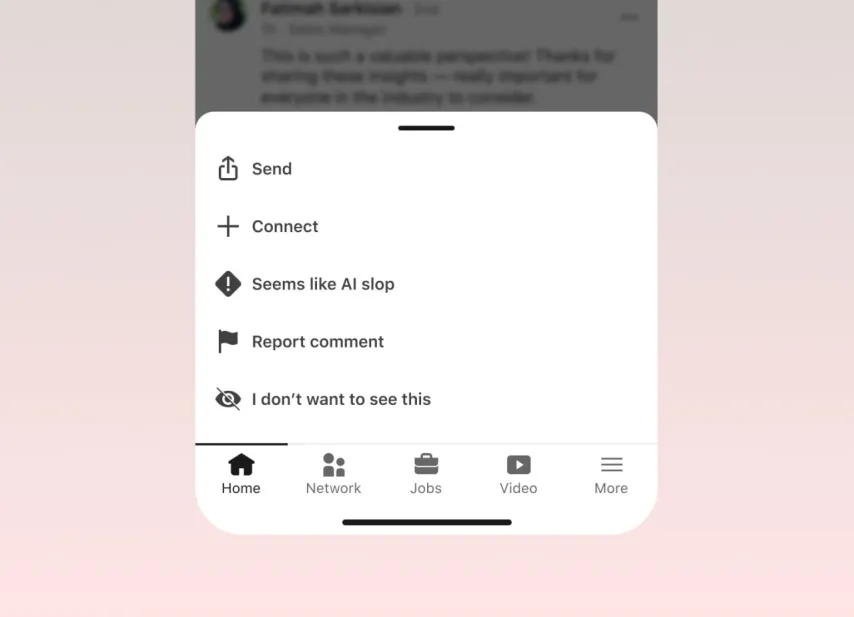
The Microsoft-owned professional network is rolling out a “Seems like AI slop” option that allows users to flag posts or comments that appear heavily AI-generated, inauthentic or lacking original professional insight.
According to a first-party post from LinkedIn Chief Product Officer Hari Srinivasan, “AI slop is a top priority for all of us. We really care about this.” He explained that people use LinkedIn to interact with real professionals and access their genuine ideas, perspectives and expertise.
How Will LinkedIn’s AI Slop Button Work?
The Verge reported that the option is appearing inside the three-dot menu attached to LinkedIn posts. Selecting it can hide the reported post and display a message thanking the member for providing feedback.
The reports will also provide LinkedIn with additional signals that can be used to train and refine its content-ranking models. Srinivasan acknowledged that defining slop is difficult and can change over time, making human feedback useful alongside automated detection systems.
The Verge also cited research from AI detection company Pangram, which reportedly found that 41% of long-form LinkedIn posts it analyzed were completely generated using AI. However, LinkedIn is not treating all AI-assisted writing as low-quality content.
As Srinivasan clarified, “AI and slop are not the same thing.” Some professionals may use AI to refine their thoughts or improve their writing, rather than automatically generating entire posts.
LinkedIn Strengthens AI Detection And Anti-Bot Defenses
TechCrunch reported that LinkedIn is introducing new and improved classifiers designed to identify AI slop and other low-quality posts. Content detected by these systems may appear less frequently in suggested posts and recommendations from people outside a member’s network.
The company is also strengthening its defenses against bots and large-scale automated activity. Srinivasan said LinkedIn catches hundreds of thousands of automated comment attempts every day and has blocked billions of other automation attempts during the past couple of months.
Techlusive’s coverage described the initiative as part of LinkedIn’s broader effort to improve the authenticity of conversations and reduce spam. It also highlighted the platform’s expanding profile and company-page verification features, which could help members better understand who created the content they are reading.
LinkedIn Will Warn Creators About Inauthentic Posts
LinkedIn is also testing private notifications for creators whose content has been repeatedly perceived by other members as inauthentic or overly dependent on AI.
According to TechCrunch, this feedback could appear inside the creator’s analytics dashboard, giving them an opportunity to adjust their writing without publicly labelling the post as AI-generated.
The approach could help LinkedIn distinguish between users who rely on AI to generate generic posts and those who use it only to proofread or refine their original ideas.
LinkedIn Replaces Its AI Post Enhancement Tool
Interestingly, LinkedIn is also removing its own “Enhance your post” feature, which previously used AI to rewrite or expand content.
Topics for more insights:
The platform will replace it with a proofreading feature focused on grammar, spelling and clarity. LinkedIn says the new tool will improve a member’s writing without changing their individual voice or personal style.
LinkedIn did not provide a specific worldwide rollout schedule for all the newly announced features. However, The Verge confirmed that its reporter could already access the AI slop reporting option, suggesting that deployment has begun for at least some members.
