

Artificial Intelligence
7 Ways To Maximize AI Subscriptions And Stop Wasting Money
Share
TL;DR
-
Audit every subscription, API, seat, owner, renewal date, and business use case.
-
Explore existing licenses before purchasing another platform with overlapping features.
-
Route each task to the least expensive model that meets its quality and security needs.
-
Standardize team workflows to reduce guessing, revisions, and duplicated effort.
-
Control token usage, context, automated retries, and other consumption-based expenses.
-
Select plans, seats, limits, and billing terms using actual usage patterns.
-
Measure business outcomes before renewing, replacing, downgrading, or canceling each tool.

Introduction
Do you remember Roman Pearce from The Fast and The Furious franchise? Played by actor-singer Tyrese Gibson, the outspoken loudmouth often got in trouble for this quirk. However, along with the bold vocals, Pearce became popular for one iconic dialogue.
In Fast & Furious 6, during a briefing from Agent Luke Hobbs (Dwayne Johnson), Pearce asks his team member Tej Parker (Ludacris) for spare change to use the vending machine. Shocked at why Pearce would ask for money when he’s already a millionaire, Parker calls him out.
“That's how you stay a millionaire,” replies Pearce. Yes, Roman Pearce gave us a free lesson in money-saving tactics by refusing to spend his own money and instead just “borrow” it.
Businesses would also love to imbibe this trait, especially since they are always looking to save every cent they can. However, they cannot simply bum money off other businesses without a legal obligation to return it or pay tax on it.
Instead, they must operate smartly and cut costs wherever possible. That now includes one of the latest money-spending fads: artificial intelligence (AI).
As AI adoption has grown at an unprecedented rate, business subscription costs have ballooned. The sheer availability of platforms, models, and specialized tools has only fueled the spending spree.
So, how can you take a page from Roman Pearce’s book, maximize your AI subscriptions, and stop wasting money? Here are 7 ways!
Why Business AI Spending Gets Out Of Control
Before finding the savings, you must first see where the money is going. A single AI plan may look affordable, but business spending rarely stops there.
Marketing buys writing tools, developers add coding assistants, designers test creative generators, and operations connect paid APIs. Workplace suites may already include similar features, yet easy access encourages teams to add tools faster than companies can review them.
The bill also includes seats, tokens, storage, integrations, agents, training, and human review. Since generative artificial intelligence (GenAI) products often overlap, companies may fund several tools for one task while leaving premium features unused. This is called subscription creep, where individually reasonable charges combine into a much larger bill.
That makes a complete spending audit the first stop on the road to savings.
7 Ways To Maximize Your AI Subscriptions And Stop Wasting Money
Knowing where the money goes is only the beginning. The next step is to make every tool, seat, and model earn its place in your AI stack. Here are 7 ways you can improve your AI strategy, enhance your outputs, and maximize your subscriptions.
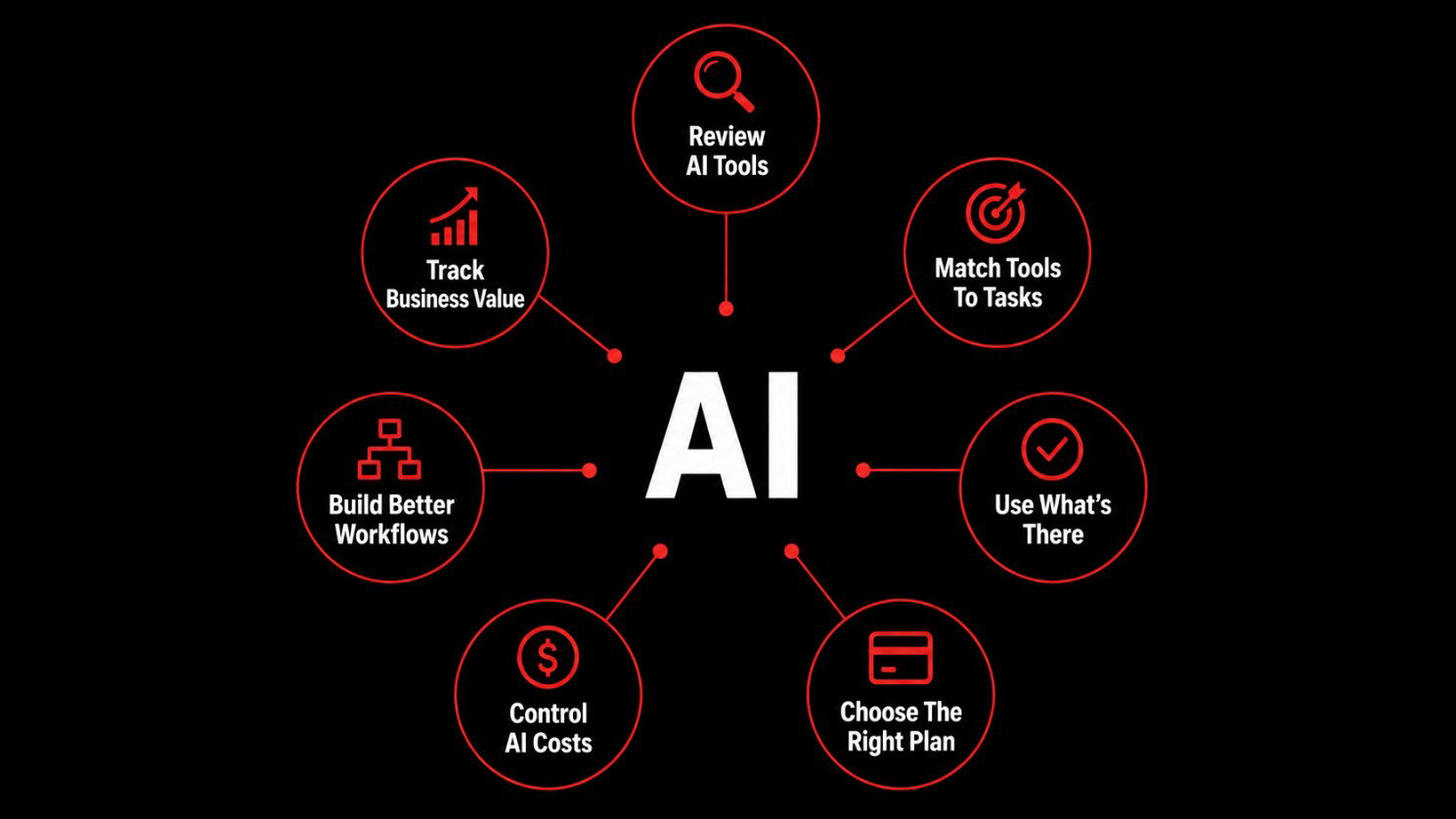
1.Review Your AI Tools: Audit Your Stack And Assign Clear Ownership
Effective AI subscription management starts with one central record of every paid tool, API, license, and seat. Include its price, users, purpose, owner, renewal date, billing cycle, and recent activity. Then group your tools by job, such as writing, research, coding, design, or automation.
The answer to how to avoid overpaying for multiple generative AI subscriptions is not automatically choosing one platform. Every additional tool should provide a distinct capability, stronger security, better output, or measurable advantage.
Remove inactive seats, pause experiments that never became workflows, and assign one person or function to approve new spending. Categorizing subscriptions by use case will also make unnecessary overlap easier to spot.
Once you stop wasting money on unused AI subscriptions, you can seek more value from what remains.
2. Use What You Have: Maximize Existing Licenses Before Buying More Tools
Before approving another purchase, check what your current plans already include.
General assistants may support writing, file analysis, research, images, coding, projects, or automation. Your workplace software may also bundle AI features that teams have never tested.
For each new request, ask whether an approved platform can perform the task, whether an existing integration can remove manual work, and whether employees need training rather than another license.
This does not mean forcing one tool into every workflow. Purpose-built software may be cheaper and more reliable for a narrow job than a premium general model. Using your paid capabilities fully is among the most proven ways to save money on AI tools.
Next, each task needs the right destination.
3.Match Tools To Tasks: Choose The Right Platform And Model For Every Job
If you are exploring how to optimize AI tool costs, stop treating every request as a frontier-model problem. Dynamic usage sends each task to the least expensive option that meets your quality, speed, privacy, and reliability requirements.
Model routers can automate this selection in larger systems, while smaller teams can document their own routing rules. A stronger model can handle planning and review before a smaller model takes over routine execution.
| Type Of Task | Best AI Choice |
| Formatting, extraction, classification, and basic summaries | Small, fast model |
| Routine writing, rewriting, and basic analysis | Mid-tier general model |
| Strategy, complex reasoning, and difficult research | Advanced reasoning or frontier model |
| Planning a complex project | Strong model for planning |
| Executing an approved plan | Smaller or cheaper model |
| Final quality or risk review | Strong model with human oversight |
| Images, video, audio, or presentations | Specialized creative platform |
| Repetitive sensitive work | Approved local or private model where practical |
| Structured software development | Coding-focused model or assistant |
| Calculations and rule-based actions | Traditional software when AI adds no value |
The goal is to use the lowest-cost option that still meets your required quality standard. Once each task has the right destination, your team needs a consistent way to complete it.
4.Build Better Workflows: Standardize How Teams Plan, Prompt, And Review
Poorly defined work creates long chats, repeated generations, and uneven results.
Begin with the outcome by defining the audience, source material, format, limits, approval process, and success criteria before prompting. Turn recurring tasks into shared workflows with templates, input checklists, approved instructions, and review stages.
Separate planning, execution, and quality assurance instead of asking one model to improvise everything. For complex projects, approve an outline, specification, or diagram before an agent begins production.
Preparation reduces corrections and prevents employees from rebuilding the same process. Clear plans and reusable requirements also reduce unnecessary iterations and token use. With your workflow settled, you can trim the hidden waste inside each run.
5.Control AI Costs: Cut Token Waste, Rework, And Unchecked Automation
When researching how to reduce AI costs, examine what each workflow repeatedly loads, generates, and retries.
Remove stale instructions, unnecessary files, unused connectors, and old chat history when they are irrelevant. Request the required format and length instead of paying for verbose responses.
For APIs and agents, reuse stable instructions through prompt caching, batch non-urgent work, set team budgets, and stop automated loops after a defined number of attempts. Keep brief project notes so restarted sessions do not repeat completed work.
Unnecessary connectors increase the amount of context processed, while caching prevents the same material from being processed repeatedly.
Your usage may now be under control, but the commercial plan must still fit your team.

6.Choose The Right Plan: Review Seats, Usage Limits, And Billing Terms
The question of how to avoid overspending on AI tools cannot be answered by choosing the lowest advertised price.
Compare free, individual, team, business, and enterprise options using your seat counts, activity, usage caps, overage rates, administrative controls, data terms, and security needs. Keep experimental tools monthly until they prove useful. Consider annual billing only after sustained use justifies the commitment.
Remove inactive seats before renewal and negotiate when many employees need the same platform. A higher business tier may offer better value if it includes centralized billing, access controls, shared workspaces, or stronger data protection.
Staying monthly during the evaluation stage also gives you greater flexibility as tools, capabilities, and business requirements change. Your final decision should depend on what the tool delivers, not what its plan promises.
7.Track Business Value: Measure Results Before Renewing Any Subscription
High usage does not prove that a subscription is useful.
Your teams can consume more tokens and generate more content while creating additional review work. Instead of treating token volume or prompt activity as proof of adoption, measure whether the work becomes faster, better, or cheaper.
To maximize AI subscription ROI, assign every tool a measurable purpose.
Track hours saved, turnaround time, cost per completed task, outsourcing avoided, errors reduced, revenue supported, quality improvements, and employee adoption. Compare those gains with your licenses, usage, integration, training, and human review costs.
This turns return on investment into a renewal decision. Every review should end with one action: renew, downgrade, replace, or cancel.
That is how Roman Pearce’s small lesson becomes a practical business habit.
Topics For More Insights
Conclusion
Businesses do not have to abandon AI to control what they spend on it. They need a clear view of their tools, smarter task routing, repeatable workflows, tighter usage controls, suitable plans, and proof of value. The companies that stop wasting money on AI subscriptions will not necessarily use less AI. Like Roman Pearce, they will simply become much more careful about whose money gets spent and why.
Frequently Asked Questions
How Can Companies Calculate The ROI Of An AI Subscription?
Begin by adding the subscription price, usage charges, integration expenses, employee training, and human review time. Then carefully estimate measurable benefits, including labor hours saved, outsourcing avoided, faster sales cycles, reduced errors, or additional revenue. Subtract total costs from total benefits, divide the result by total costs, and multiply by 100. Companies should also record nonfinancial gains, such as better consistency or faster decisions, while keeping them separate from the percentage calculation for clarity during renewal reviews.
When Should A Business Use Multiple AI Platforms?
Multiple platforms make sense when each serves a distinct requirement. One may offer stronger coding support, another may integrate with workplace data, while a specialist tool handles design, research, or regulated information more safely. Companies may also keep a second platform for output comparison, continuity during outages, or negotiating leverage. The overlap becomes wasteful when teams cannot explain why both are needed, rarely use one of them, or receive no measurable advantage from the additional subscription cost.
How Often Should Companies Review Their AI Subscriptions?
Monitor usage and charges monthly, especially for APIs, agents, and tools with variable billing. Conduct a stack review every quarter to check active seats, duplicated capabilities, workflow adoption, security needs, and measurable results. Before an annual renewal, run a deeper assessment that includes employees, finance, procurement, IT, and business owners. Fast-moving teams may need more frequent reviews after pilots or major model releases, but every subscription should have a named review date and responsible decision-maker in advance.
Tue, Jul 28, 2026

Liked what you read? That’s only the tip of the tech iceberg!
Explore our vast collection of tech articles including introductory guides, product reviews, trends and more, stay up to date with the latest news, relish thought-provoking interviews and the hottest AI blogs, and tickle your funny bone with hilarious tech memes!
Plus, get access to branded insights from industry-leading global brands through informative white papers, engaging case studies, in-depth reports, enlightening videos and exciting events and webinars.
Dive into TechDogs' treasure trove today and Know Your World of technology like never before!
Disclaimer - Reference to any specific product, software or entity does not constitute an endorsement or recommendation by TechDogs nor should any data or content published be relied upon. The views expressed by TechDogs' members and guests are their own and their appearance on our site does not imply an endorsement of them or any entity they represent. Views and opinions expressed by TechDogs' Authors are those of the Authors and do not necessarily reflect the view of TechDogs or any of its officials. While we aim to provide valuable and helpful information, some content on TechDogs' site may not have been thoroughly reviewed for every detail or aspect. We encourage users to verify any information independently where necessary.
Loading comments...