
Artificial Intelligence
Top 5 LLMs You Can Run Locally on Your Machine
Share
TL;DR
-
Meta's Llama 4 Scout has 109 billion total parameters and 17 billion active parameters, but its single-GPU claim refers to an Int4-quantized model on an Nvidia H100.
-
Alibaba's Qwen3 family spans models from 0.6 billion to 235 billion parameters under Apache 2.0, while Qwen3.6 adds a more capable 27-billion-parameter coding model.
-
Google's Gemma 4 now comes in five core sizes after the June 2026 addition of a 12-billion-parameter model, covering edge devices, laptops, and workstations.
-
DeepSeek V4 Flash uses a Mixture-of-Experts design with 284 billion total parameters, 13 billion active parameters, and a one-million-token context window.
-
Tools such as Ollama and LM Studio simplify many local deployments, but model compatibility, memory needs, and setup time still vary by architecture.
Introduction
Streaming a movie is convenient until the service pulls it, raises the price, or goes down right when you want to watch. Owning the disc means none of that happens. That is roughly the trade-off businesses and hobbyists are weighing with artificial intelligence (AI) right now.
Cloud APIs became the default way many people accessed powerful large language models (LLMs), but they were never the only option. Open-weight models and local inference tools have improved quickly, making on-device and self-hosted deployments practical for a wider range of workloads in 2026.
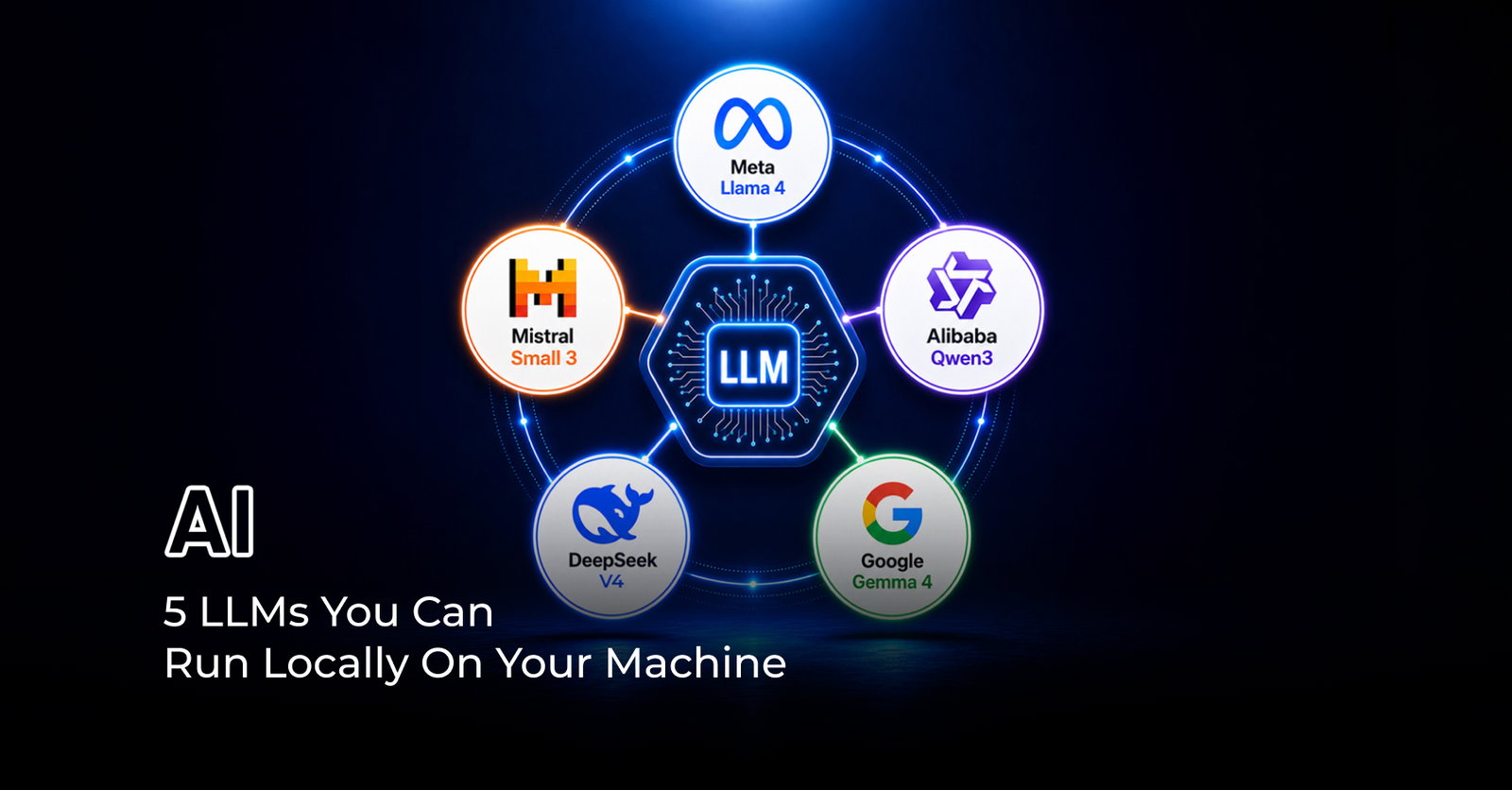
So, which models are worth the download? We picked five strong options across different hardware tiers, from laptops to multi-GPU workstations, along with tools that make local deployment easier.
What Is A Local LLM, And Why Does It Matter Now?
A local LLM is a model whose weights run on hardware you control, such as a laptop, desktop, workstation, on-premises server, or private cloud AI deployment. Inference can stay on that hardware, but prompts may still leave the device if you enable cloud fallbacks, web tools, connectors, or telemetry.
This is different from open source in the strict sense. Most of the models below release their trained weights publicly under permissive licenses, which is why the industry calls them open weight models rather than fully open source, since the training data and code are not always included alongside the weights.
Why Run An LLM Locally?
Running an LLM locally can address privacy, cost, availability, and control requirements that a public cloud API may not fully meet.
-
Privacy: Prompts and files can remain on systems you control, provided the runtime is configured for local inference and optional cloud features, plugins, and external tools are disabled or governed.
-
Cost: Local inference avoids per-token API charges, but hardware, storage, electricity, maintenance, and engineering time still contribute to the total cost.
-
Reliability: Once the model and runtime are installed, an offline deployment can keep working during an internet outage, on a flight, or at a disconnected client site.
-
Control: Enterprises using on-premises infrastructure or a private cloud AI deployment can choose the model, quantization, fine-tuning process, access controls, and data location. That control can support governance requirements, but it does not remove the need for security, monitoring, and legal review.
The benefits are real, but model size and hardware requirements still determine what is practical.
The Top 5 LLMs You Can Run Locally In 2026
The list spans compact models that suit personal devices and much larger open-weight systems intended for workstation or server-class local deployment.
-
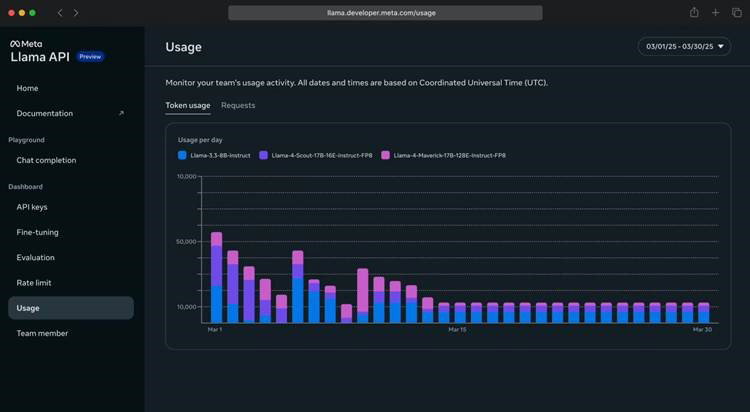
Meta Llama 4 (Scout)
Meta released Llama 4 Scout in April 2025. It remains a widely supported open-weight option for long-context and multimodal workloads.
-
Architecture: Mixture-of-Experts with 17 billion active parameters and 109 billion total. Meta says the Int4-quantized model fits on a single Nvidia H100 GPU; all weights still have to be stored, so this is not a typical consumer-GPU setup.
-
Context window: Supports up to 10 million tokens. Actual usable context depends on the runtime, quantization, memory, and task, so the maximum is not a guarantee that every large codebase will fit or reason well in one pass.
-
License: Llama 4 Community License, not Apache 2.0 or MIT. Most users can use it under the published terms, while organizations with more than 700 million monthly active users must request a separate license.
-
Best for: Long-context and multimodal applications where mature support across Hugging Face, vLLM, Ollama, and other Llama-compatible tooling matters.
-
-
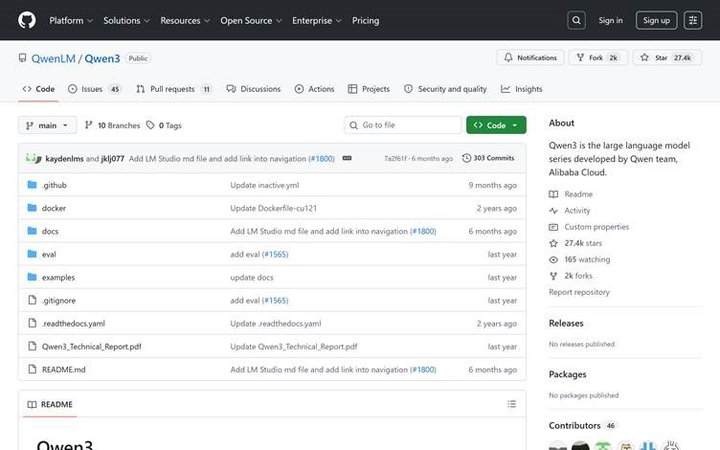
Alibaba Qwen3
Alibaba's Qwen family offers one of the broadest ranges of open-weight model sizes, making it easier to match capability to available hardware.
-
Sizes: The original Qwen3 family includes eight dense and Mixture-of-Experts variants ranging from 0.6 billion to 235 billion total parameters.
-
License: Apache 2.0 for the Qwen3 checkpoints discussed here, subject to the license terms and applicable law.
-
Latest release: Qwen3.6-27B is a dense multimodal model with a native 262,144-token context window, extensible to about one million tokens. Its official results exceed Qwen3.5-397B-A17B on several coding-agent benchmarks, though not every benchmark.
-
Best for: Coding assistants and multilingual work. Quantized 8B or 14B Qwen3 variants are more practical for home systems, while Qwen3.6-27B needs substantially more memory at long context lengths.
-
-
Google Gemma 4
Google launched Gemma 4 on April 2, 2026, and added a 12-billion-parameter model in June, bringing the current core family to five sizes. The models are built from Gemini research and technology.
-
Sizes: E2B and E4B effective-parameter models, a 12-billion-parameter unified multimodal model, a 26-billion-parameter Mixture-of-Experts model with 4 billion active parameters, and a 31-billion-parameter dense model.
-
Multimodal: All sizes support text, image, and video inputs. Native audio input is available on E2B, E4B, and 12B.
-
License: Google's Gemma license permits responsible commercial use, subject to its terms and restricted-use conditions.
-
Best for: E2B and E4B on edge, browser, and mobile-class deployments; 12B for laptops; and 26B or 31B for consumer-GPU or workstation setups. A discrete GPU is not required for every variant, but it improves speed.
-
-
DeepSeek V4 (Flash)
DeepSeek released the open weight V4 preview on April 24, 2026. For local deployment, V4 Flash is the more realistic of the two checkpoints, although it is still far larger than a typical laptop model.
-
Architecture: Mixture-of-Experts with 284 billion total parameters and 13 billion active per token; the larger V4 Pro has 1.6 trillion total parameters and 49 billion active.
-
Context and reasoning: Supports a one-million-token context window plus thinking and non-thinking modes. Returned reasoning content can help with debugging, but it should not be treated as a complete or faithful audit trail of how the model reached an answer.
-
License: The official DeepSeek V4 repositories and model weights are released under the MIT License.
-
Hardware: V4 Flash is a workstation or server-class local model. At a theoretical 4-bit minimum, 284 billion parameters represent roughly 142GB of weight data before runtime overhead and KV cache, so multi-GPU or high-memory systems are the realistic target.
-
Best for: Teams with substantial local infrastructure that need very long context, coding, agentic workflows, and strong reasoning without sending prompts to a third-party API.
-
-
Mistral Small 3
Mistral AI released Small 3 in January 2025. It is no longer the company's newest Small model, but its 24-billion-parameter size, Apache 2.0 license, and local deployment profile still make it a practical option.
-
License: Apache 2.0.
-
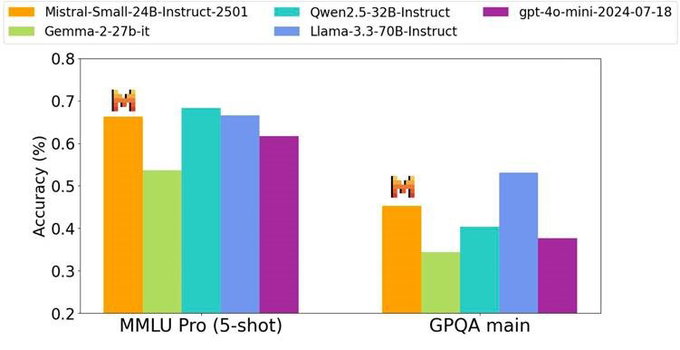
Performance: Competitive with much larger models like Llama 3.3 70B and Qwen 32B while running more than three times faster on the same hardware, according to Mistral's own technical announcement.
-
Why it's fast: A deliberately shallow architecture with fewer layers than competing models shortens every forward pass.
-
Best for: Low-latency local chat, function calling, and teams that want control over where inference data is processed. Mistral says quantized builds can run on a single RTX 4090 or a Mac with 32GB RAM.
-
Quick Comparison: The Ultimate Local AI Tier List
For readers who want the short version before committing to a download, here is how the five models stack up on paper.
| Model | Developer | License | Sizes | Best For |
| Llama 4 Scout | Meta | Community License | 17B active / 109B total | Long-context, multimodal workloads |
| Qwen3 / Qwen3.6 | Alibaba | Apache 2.0 | 0.6B-235B; 27B in Qwen3.6 | Coding and multilingual work |
| Gemma 4 | Gemma License | E2B, E4B, 12B, 26B A4B, 31B | Edge, laptop, and multimodal use | |
| DeepSeek V4 Flash | DeepSeek | MIT | 13B active / 284B total | Server-class long-context reasoning |
| Mistral Small 3 | Mistral AI | Apache 2.0 | 24B | Low-latency local chat |
The Best Local LLM Tools To Run These Models
A model file is only half the setup. You also need a compatible runtime, enough memory, and a front end or API.
-
Ollama: A popular command-line and local API tool for pulling and serving supported models. It raised $65 million in July 2026 and grew to nearly 9 million users, but newly released model architectures may require time before full support arrives.
-
LM Studio: A desktop app for browsing, downloading, and chatting with supported local models without using a terminal, making it approachable for non-technical users.
-
llama.cpp: A widely used open-source inference engine and backend option for many local apps, suited to developers who want low-level control and GGUF support.
-
GPT4All: Adds local document-chat features and a desktop interface for supported models on modest hardware.
-
vLLM: Designed for high-throughput serving when teams need to handle many concurrent requests on GPU servers.
-
Open WebUI: Adds a shared browser-based chat interface for Ollama or OpenAI-compatible backends; it does not itself make an unsupported model architecture compatible.
Conclusion
The gap between cloud APIs and self-hosted AI has narrowed, but these five models do not belong to the same hardware tier. Llama 4 Scout, Qwen3, Gemma 4, DeepSeek V4 Flash, and Mistral Small 3 suit different needs, from compact edge inference to long-context, multi-GPU deployments.
The right choice begins with memory, context length, runtime compatibility, and licensing, not benchmark rank alone. Start with a quantized model that fits the machine comfortably, then scale to a workstation or private server only when the workload justifies it.
Frequently Asked Questions
What Are The Top Tools To Run LLMs Locally?
Ollama and LM Studio are approachable choices for many users, but no single runner supports every new architecture immediately. Use llama.cpp for GGUF-focused control, or vLLM and SGLang for larger server deployments. For DeepSeek V4, check the official compatibility guidance before assuming a one-command install.
Can I Run These Models Without A Dedicated GPU?
Yes, for smaller quantized models. Gemma 4 E2B or E4B and small Qwen3 variants can run on CPU-only systems, although responses may be slow. DeepSeek V4 is not realistic on a 16GB CPU-only machine. Memory needs depend on parameter count, quantization, context length, and runtime overhead, so a fixed cutoff such as '14B requires 12GB of VRAM' is unreliable.
Are Open Weight Models Safe To Use For Commercial Products?
Qwen3, DeepSeek V4, and Mistral Small 3 use Apache 2.0 or MIT checkpoints that generally permit commercial use, subject to license notices, terms, and applicable laws. Llama 4 and Gemma 4 use custom licenses, so businesses should review the exact model license and any acceptable-use conditions before deployment.
Tue, Jul 21, 2026

Liked what you read? That’s only the tip of the tech iceberg!
Explore our vast collection of tech articles including introductory guides, product reviews, trends and more, stay up to date with the latest news, relish thought-provoking interviews and the hottest AI blogs, and tickle your funny bone with hilarious tech memes!
Plus, get access to branded insights from industry-leading global brands through informative white papers, engaging case studies, in-depth reports, enlightening videos and exciting events and webinars.
Dive into TechDogs' treasure trove today and Know Your World of technology like never before!
Disclaimer - Reference to any specific product, software or entity does not constitute an endorsement or recommendation by TechDogs nor should any data or content published be relied upon. The views expressed by TechDogs' members and guests are their own and their appearance on our site does not imply an endorsement of them or any entity they represent. Views and opinions expressed by TechDogs' Authors are those of the Authors and do not necessarily reflect the view of TechDogs or any of its officials. While we aim to provide valuable and helpful information, some content on TechDogs' site may not have been thoroughly reviewed for every detail or aspect. We encourage users to verify any information independently where necessary.
Loading comments...