
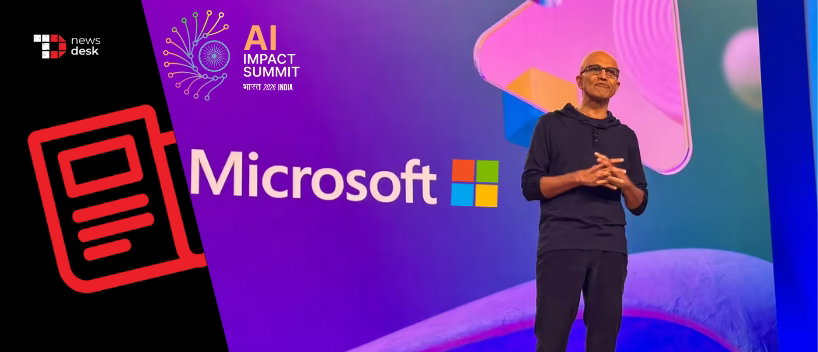
Microsoft said it is on pace to invest approximately $50 billion by the end of the decade to expand artificial intelligence access and infrastructure across the Global South, warning that unequal AI adoption could deepen global economic disparities.
The announcement was made at the India AI Impact Summit in New Delhi, where the company outlined a multi-part strategy aimed at accelerating AI diffusion in developing and emerging economies.
TL;DR
- Microsoft is on pace to invest approximately $50B in AI expansion by 2030.
- Focuses on infrastructure, cloud expansion, skilling, and AI adoption.
- Announced at India AI Impact Summit in New Delhi.
- Warns widening AI gap could deepen economic inequality.
AI Risks Creating A New Global Divide, Microsoft Says
Microsoft Vice Chair and President Brad Smith warned that artificial intelligence is becoming foundational to economic growth and national competitiveness, but access remains uneven.
“We are at risk of creating a new digital divide, this time driven by artificial intelligence,” Smith said.
He emphasized that many countries lack sufficient computing capacity, connectivity, and workforce readiness to fully adopt AI technologies at scale. Without coordinated action, the benefits of AI could remain concentrated in advanced economies.
A Five-Part Strategy To Expand AI Access
Microsoft described the $50 billion initiative as part of a broader five-part program designed to accelerate AI diffusion across the Global South.
The strategy includes building the necessary infrastructure to support AI deployment, expanding cloud and compute capacity, investing in workforce skilling and training initiatives, enhancing multilingual AI capabilities to ensure broader accessibility, and developing mechanisms to measure AI adoption to inform policy decisions.
While Microsoft has not published a detailed budget allocation or regional breakdown, the company positioned the commitment as a long-term effort to support inclusive AI development.
Topics For More Insights
Infrastructure Alone Is Not Enough
Microsoft leadership stressed that infrastructure investment, while essential, is only one component of closing the AI adoption gap.
Smith highlighted the importance of developing skilled talent pipelines and regulatory frameworks that promote innovation while maintaining trust.
“No single company or country can close this gap alone,” he said, underscoring the need for collaboration between governments, private sector players, and educational institutions.
Strategic Context Amid Intensifying AI Investment
The announcement comes as global investment in AI infrastructure accelerates, with technology firms expanding cloud capacity and compute resources worldwide.
Microsoft framed its commitment as both an economic opportunity and a responsibility to ensure that AI’s benefits are more broadly distributed.
“We want AI to be a tool for inclusion, not exclusion,” Smith said.
As artificial intelligence becomes increasingly embedded in productivity, innovation, and public services, access to computing infrastructure, language capabilities, and skilled talent may determine how equitably its advantages are shared.
Microsoft’s $50 billion pledge signals that expanding AI access in developing economies is becoming a central priority in the next phase of global AI growth.
