
Emerging Technology
What Is Knowledge Representation In AI?
Share
Overview
How beautifully driven was the TV show WandaVision? Well, if you haven't yet seen the show based on the Marvel Cinematic Universe, we urge you to watch it - if you're ready for an emotional rollercoaster that is!
The show follows Wanda Maximoff (Scarlet Witch), an Avenger struggling to cope with the loss of Vision, the love of her life. Consumed by her grief, Wanda uses her magical powers to create the Hex, a simulated reality in a small town called Westview.
In this bubble, Wanda designs her dream life, a picturesque world where Vision is alive, she has a family in a perfect fantasy setting. Every character in the town is given a role to play, every event is scripted and every setting tailored to fit Wanda’s preferences.
However, beneath the surface, this elaborate construct is her way of masking the pain. It’s a powerful tale of love and loss and how we sometimes try to escape reality by creating worlds of our own.

Similar to this plotline, our real world also has a fascinating narrative much like the construction of Wanda's Hex. Yes, we're talking about Artificial Intelligence (AI) systems!
You already know that AI is buzzing with excitement and innovation, giving us better self-driving cars and virtual assistants and much more. In fact, AI is reshaping how we interact with technology. However, behind these smart systems lies something fundamental: i.e., knowledge representation.
So, why is knowledge representation so important? Well, it's not just about storing knowledge but ensuring that it delivers meaningful and actionable insights. Thus, in the next few sections, we'll dive deeper into what knowledge representation in AI really means.
However, first, let's answer this: how does a machine 'know' what it knows?
Well, let's answer that by exploring the basics!
What Is Knowledge Representation In Artificial Intelligence?
Knowledge Representation in the context of AI systems is like a cheat sheet for computers that helps them "understand" the world around them. It involves structuring information in a way that can help machines solve real-world challenges and puzzles. Think of it as giving your AI buddy a map to navigate through complex tasks, like diagnosing a medical condition or maybe even beating you at chess!
Here's why it's so important:
-
Facilitates Reasoning And Inference: Just like Wanda Maximoff could control events within the Hex to create her ideal reality, AI uses knowledge representation to make logical decisions that lead to controlled outcomes.
-
Enables Natural Language Processing: Have you ever wondered how Siri or Alexa understands you? It's all about how they represent language knowledge and use it to interact with us.
-
Supports Learning And Adaptation: AI can learn from past experiences, much like how we remember not to touch the hot stove twice because we have that insight stored somewhere.
-
Assists In Decision-Making: AI can weigh options and make choices, kind of like figuring out whether to binge-watch the whole WandaVision series at once or one episode at a time.
Now that we've laid down the basics of how AI "knows" stuff, let's dive into the different types of knowledge that fuel these smart systems!
It's time to explore the kinds of "rules" AI systems use to make sense of the world around them.
Types Of Knowledge In Artificial Intelligence
Let’s explore the different types of knowledge that help AI systems "know" what they know and function!
Declarative Knowledge
Declarative knowledge is the "what" of the knowledge world. This type of knowledge is all about facts, concepts and objects. It's stored in databases or knowledge bases and forms the backbone of AI systems that answer questions and solve problems.
Procedural Knowledge
Procedural knowledge answers the "how" questions. It’s like having a recipe for baking a cake or knowing the steps to solve a Rubik's cube. In AI, this is what drives algorithms to perform tasks, execute actions and solve problems. It’s the "how-to" guide for machines, embedded in their code to make them function like a pro chef in a kitchen.
Meta-Knowledge
Meta-knowledge is the "knowledge about knowledge." It’s understanding which type of knowledge to use in different scenarios. This type of knowledge helps AI systems choose the right strategy or knowledge base for the task at hand, making them adaptable and smart.
Heuristic Knowledge
Heuristic knowledge is like a secret tip for making the best cookies. It’s the "rules of thumb" that come from experience, helping AI systems make educated guesses or quick decisions when time is short. This type of knowledge is crucial in problem-solving where exact answers are elusive.
Structural Knowledge
Structural knowledge is about the connections and relationships between different concepts. Understanding how different parts of a system interact helps AI systems map out complex relationships and solve problems.
Understanding these types of knowledge is essential for developing AI systems that can think, act and learn like humans. It's the foundation that enables AI to function effectively in our complex world.
Now that we've explored the types of knowledge, let's see how these are represented using techniques in AI systems!
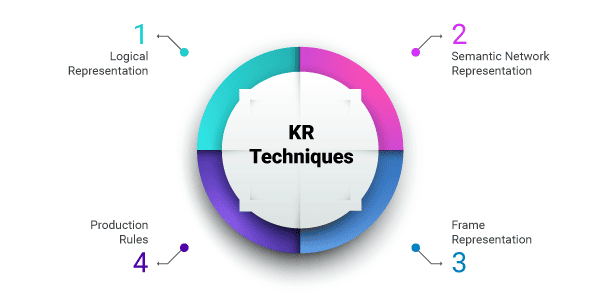
Techniques Of Knowledge Representation
Understanding how AI systems think is like peeking into Vision's brain chemistry (spoiler alert: he is a machine!) So, let's explore some of these techniques and see how they work:
Logical Representation
Think of logical representation as the grammar rules of AI's language. It's like when you play "Simon Says"—you either follow the command or you don't. Similarly, logical representation is all about true or false statements. This technique is super precise, setting clear rules to help AI make decisions without any "uh-oh" moments.
Semantic Networks
Imagine a giant web where each node represents a character from your favorite TV show (we vouch for Wanda folks) and the lines connecting them are their relationships (like how Vision is to Wanda). That's a semantic network! It helps AI understand how different concepts are linked, like "Wanda is a Witch," "Witch use Magic," and so on. This method is great for organizing ideas in a way that makes sense to both humans and machines.
Frames
Frames are like the themes of Wanda's hex. When AI encounters a situation, it pulls up a frame—like a character profile with stats, skills and inventory—to understand what's happening. This helps AI deal with common scenarios efficiently, without reinventing the wheel every time.
Production Rules
Picture a flowchart for baking cookies: "If the dough is too sticky, add flour." Production rules are just like that. They tell AI what to do in specific situations, making decision-making straightforward just like following the next step in a recipe.
Ontologies
Ontologies are alkin to encyclopedias for AI, organizing knowledge into diverse categories and subcategories to create a detailed map for AI to show how different ideas and concepts fit together. This is especially useful for complex AI systems where understanding the relationships between each data point is crucial.
This representation of knowledge makes information usable, accessible and understandable, both for AI systems and the humans who interact with them. Thus, these techniques form the backbone of how AI systems think and learn!
While these techniques are revolutionary, they aren’t without challenges. In the next section, we will explore the obstacles that make knowledge representation a complex yet fascinating field to tackle.
Challenges In Knowledge Representation
Every powerful system has its hurdles and knowledge representation in AI is no exception. Let’s unpack some of the key challenges:
Balancing Expressiveness With Computational Efficiency
Imagine trying to fit a whole library of books into a single backpack. AI faces the challenge of balancing expressiveness and efficiency as its systems need to represent vast and complex knowledge without becoming too slow or cumbersome.
Handling Incomplete Or Uncertain Knowledge
Ever tried to finish a puzzle with missing pieces? That's what AI deals with when handling incomplete knowledge. AI systems often need to make decisions based on partial information, like a detective solving a case with only one clue.
This is where the debate between AI and Human Intelligence gets interesting. Can AI really think like humans when it doesn't have all the facts?
Ensuring Scalability Of Knowledge Bases
Think of knowledge bases as the brain of an AI system. As AI learns more, its brain needs to grow without becoming a tangled mess—like trying to expand a city without causing traffic jams. In fact, a report by BitBuild mentions that 85% of AI projects fail to deliver on their promises, highlighting issues like unclear objectives and data quality problems.
Integrating Knowledge From Various Diverse Sources
Integrating diverse knowledge into AI must blend various types of information into a coherent whole. It's a bit like making a smoothie with all your favorite fruits and hoping it doesn't taste like a science experiment gone wrong! Frustrating right?

Just as chefs perfect their recipes, AI continues to refine its methods of knowledge representation. This balance of creativity and precision is what makes AI fascinating and challenging.
Now that we’ve explored the challenges, let’s look at how knowledge representation is applied in real-world AI systems and the incredible transformations it drives.
Applications Of Knowledge Representation
Knowledge representation offers applications for all sorts of tasks that require AI's massive brainpower. Here's a quick overview:
Expert Systems
Ever wished you could have a doctor or financial advisor in your pocket? Expert systems make this dream a reality. They use knowledge representation to offer advice or make decisions in specialized fields like medicine or finance. These systems are powered by declarative knowledge, which involves facts and information, much like how a trivia master knows all the answers.
Natural Language Processing
Imagine chatting with a robot that gets your likes, dislikes and preferences. Well, that's Natural Language Processing (NLP) leveraging knowledge representation to understand and generate outputs in human language, making chatbots and translators smarter.
Robotics
Robots aren't just limited to sci-fi anymore—they're doing real work, with knowledge representation helping them make decisions, navigate and interact with their environments. It's like giving a robot a map and a compass, plus a bit of common-sense!
Knowledge representation is an unsung hero, quietly powering AI systems that make our lives easier, smarter and just a bit more futuristic. Who knew that behind every smart AI system is a clever bit of data juggling?
As AI continues to evolve, knowledge representation will improve, opening up new possibilities and challenges. So, what’s next in this exciting field?
Let's explore!
Future Directions In Knowledge Representation
In the rapidly evolving world of AI, merging knowledge representation with machine learning is a natural fit. This integration allows AI to learn from data while understanding context and meaning, paving the way for systems that predict actions and understand motivations.
A 2024 survey from arXiv.org of over 2,700 AI researchers found that while 68.3% believe superhuman AI is more likely to have good outcomes than bad, 38–51% estimate at least a 10% chance of catastrophic events, including human extinction.
AI’s ability to handle common-sense reasoning—like knowing not to water plants during a rainstorm—is still a challenge. Future models aim to capture everyday logic, bridging the gap between human intuition and machine reasoning.
Another key focus is improving interoperability among AI systems. By creating universal frameworks, systems can share and collaborate seamlessly.
Ethical considerations in knowledge encoding are also becoming critical. Embedding guidelines to prevent biases and ensure fairness will make AI more trustworthy in decision-making.
The future of knowledge representation is about creating AI that’s not just smarter but more human-like in understanding and reasoning. These advancements will shape how AI interacts with the world, blending technical innovation with ethical responsibility.
Wrapping It Up!
Knowledge representation in AI is like giving your computer a brainy map to navigate the world. It's all about making sure that inteligent systems can think like us, using facts, rules and logic. Whether it's diagnosing a new illness or planning the next move in a game of chess, AI systems demand a solid foundation of knowledge.
Sure, there are challenges like ensuring the AI system doesn't get its wires crossed with too much data—but that's exactly what keeps the AI wizards busy.
As AI continues to grow and learn, who knows what amazing feats it will achieve next? One thing's for sure: knowledge representation will be right at the heart of it all, guiding the way like a trusty GPS.
So, next time you chat with a chatbot or marvel at a robot's skills, remember that it's all thanks to the magic of knowledge representation!
Frequently Asked Questions
What Is Knowledge Representation In AI?
Knowledge representation in AI is like making a map of information that computers can understand. It helps AI systems answer questions and solve problems by organizing facts about the world in a way that machines can use.
Why Do We Need Knowledge Representation In AI?
We need knowledge representation in AI to help computers think and make decisions like humans. It allows AI to understand language, make plans, learn from experiences and solve problems.
What Are Some Types Of Knowledge Representation In AI?
Some types of knowledge representation in AI include declarative knowledge, which deals with facts; procedural knowledge, which involves how to do things; and structural knowledge, which shows how different ideas are connected.
Thu, Dec 19, 2024

Enjoyed what you've read so far? Great news - there's more to explore!
Stay up to date with the latest news, a vast collection of tech articles including introductory guides, product reviews, trends and more, thought-provoking interviews, hottest AI blogs and entertaining tech memes.
Plus, get access to branded insights such as informative white papers, intriguing case studies, in-depth reports, enlightening videos and exciting events and webinars from industry-leading global brands.
Dive into TechDogs' treasure trove today and Know Your World of technology!
Disclaimer - Reference to any specific product, software or entity does not constitute an endorsement or recommendation by TechDogs nor should any data or content published be relied upon. The views expressed by TechDogs' members and guests are their own and their appearance on our site does not imply an endorsement of them or any entity they represent. Views and opinions expressed by TechDogs' Authors are those of the Authors and do not necessarily reflect the view of TechDogs or any of its officials. While we aim to provide valuable and helpful information, some content on TechDogs' site may not have been thoroughly reviewed for every detail or aspect. We encourage users to verify any information independently where necessary.
AI-Crafted, Human-Reviewed and Refined - The content above has been automatically generated by an AI language model and is intended for informational purposes only. While in-house experts research, fact-check, edit and proofread every piece, the accuracy, completeness, and timeliness of the information or inclusion of the latest developments or expert opinions isn't guaranteed. We recommend seeking qualified expertise or conducting further research to validate and supplement the information provided.
Loading comments...