
Artificial Intelligence
Google Wants To Stop AI Hallucinations At The Source With Its New Knowledge Catalog
Updated on Fri, Apr 24, 2026
Share
The company has introduced the Google Cloud Knowledge Catalog, an evolution of Dataplex that’s designed to act as a real-time context engine for enterprise AI agents.
Instead of forcing agents to interpret fragmented datasets, conflicting definitions, and outdated metadata, Google wants to give them a governed layer of business context that helps them retrieve accurate information and execute tasks without guesswork.
TL;DR
- Google Cloud is transforming Dataplex into a new Knowledge Catalog for enterprise AI agents
- It aggregates metadata across Google Cloud, third-party platforms, and enterprise apps
- New enrichment tools use Gemini to extract meaning from structured and unstructured data
- Google is introducing semantic search and governance controls to reduce hallucinations
- Gemini Enterprise’s Deep Research Agent is already being powered by the platform
Traditional data catalogs were largely built for technical teams managing tables, schemas, and infrastructure. That model is increasingly proving inadequate in the age of AI agents, where systems need deeper business context to operate effectively.
According to Google, agents often fail because they don’t understand business semantics or data relationships. That can lead to hallucinations, slower response times, and stale outputs.
The new Knowledge Catalog aims to fix that by creating a centralized layer that continuously aggregates, enriches, and retrieves enterprise knowledge.
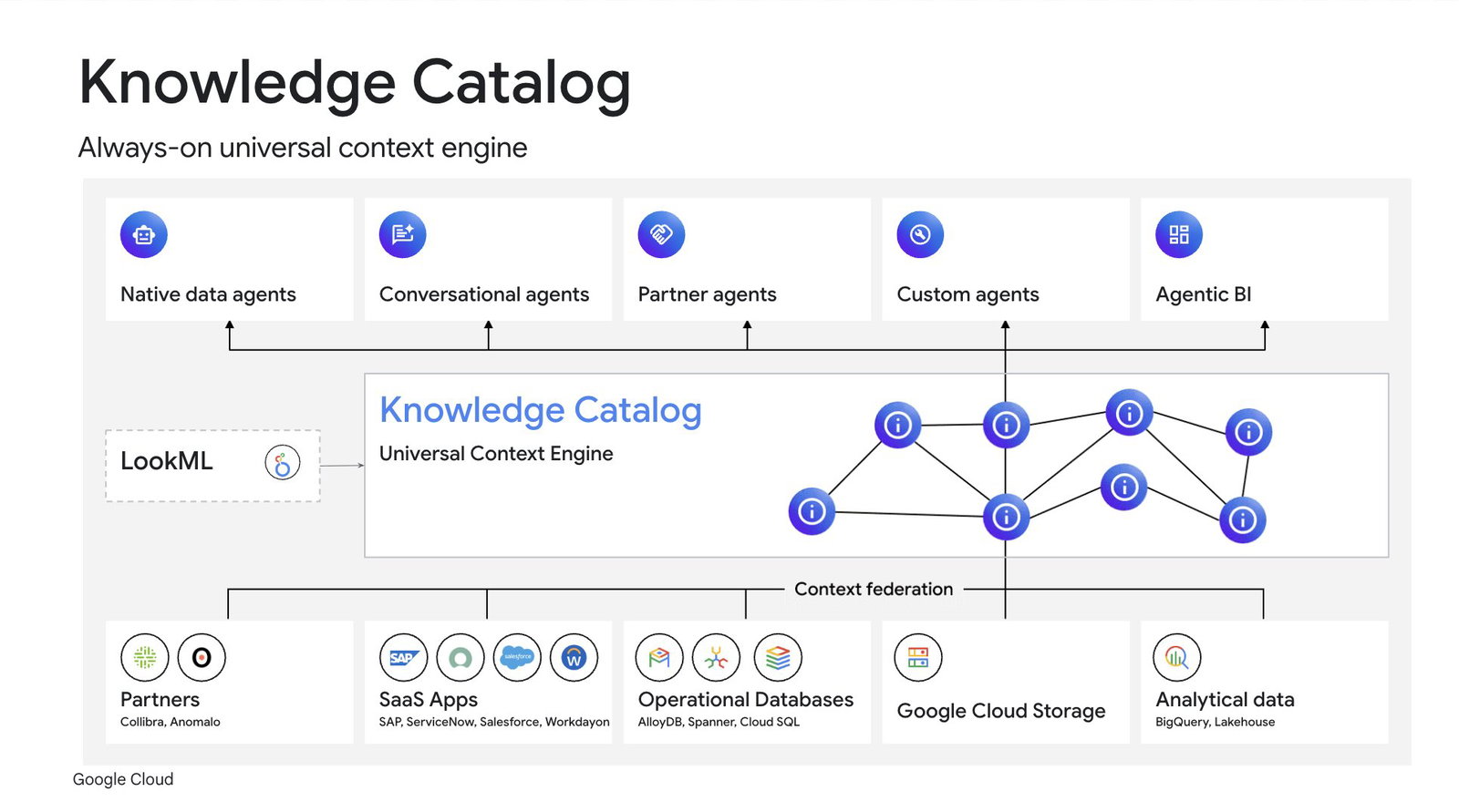
Google Cloud Aggregates Enterprise Data Into A Single Source Of Truth
Google’s first major focus is aggregation.
The platform now pulls metadata from services such as BigQuery, AlloyDB, Spanner, Cloud SQL, Firestore, and Looker. It also connects with third-party platforms including Atlan, Collibra, Datahub, Ab Initio, and Anomalo.
Google is also expanding beyond data systems through a new enterprise connectivity layer that links operational platforms such as Palantir, Salesforce Data360, SAP, ServiceNow, and Workday.
This means enterprises can unify business logic across systems that have historically remained disconnected.
To strengthen that effort, Google introduced a new LookML Agent that can read strategy documents and automatically generate business-ready semantic models.
It’s also launching BigQuery Measures, which embeds reusable business logic directly into SQL workflows, ensuring calculations remain consistent across teams and AI systems.
Meanwhile, Google says its generally available data products package datasets with governance controls, intent definitions, and service-level agreements, making them more reliable for production AI deployments.
Google Uses Gemini To Enrich Unstructured Data For AI Agents
Google’s second pillar focuses on enrichment, where the company moves beyond manual metadata tagging.
Its new Smart Storage and Object Context API automatically tags and enriches files stored in Google Cloud Storage as soon as they are uploaded.
For more complex datasets, Google is integrating Gemini to extract metadata from unstructured content and identify relationships between entities.
The company says this allows organizations to build pipelines that automatically map business relationships hidden inside documents, files, and raw content.
It’s also introducing automated context curation tools that generate natural language descriptions, business glossaries, and verified SQL patterns.
That matters because one of the biggest causes of AI failure is agents inventing logic or creating incorrect joins between datasets.
Google says its semantic guardrails are meant to prevent exactly that.
Google Brings Search-Like Precision To Enterprise AI Retrieval
Once enterprise context is built, Google believes search becomes the most critical layer.
Its high-precision semantic search system uses technology inspired by Google Search to help AI agents retrieve relevant information in real time with sub-second latency.
The company says this helps agents move faster while reducing the chances of pulling incorrect data. Search results are also tied to source permissions, ensuring agents only access data they are authorized to view.
Google is also adding measurable evaluation frameworks that allow enterprises to test how well their context systems perform over time. That turns AI deployment into a more measurable engineering process rather than an experiment.
The company says one of the earliest examples of this in action is Gemini Enterprise’s Deep Research Agent, which now uses the Knowledge Catalog to combine live business data, internal documents, and web research.
Google claims that tasks that previously took weeks of manual work can now be completed in minutes.
Topics For More Insights
- Google’s Big AI Bet Just Got Real At Cloud Next 2026, Here Are Day 1's Key Reveals
- Google Introduces Virgo Network For Large-Scale AI Training!
- Google Introduces Workspace Intelligence To Power Agentic Work Across Gmail, Docs, Drive, Chat And More
- Google Launches Gemini Enterprise Agent Platform To Power Scalable Enterprise AI Agents!
- Google Unveils Eighth-Generation TPUs With Two New Chips Built For The Agentic AI Era
- Google Wants AI Agents To Stop Just Thinking & Start Doing With Its New Agentic Data Cloud
Bloomberg Media is already using Google's Knowledge Catalog to bring trusted context to its agents.
“By unifying Bloomberg Media’s enterprise metadata and business context through the Knowledge Catalog, we successfully launched our Data Access AI Agent," said William Anderson, CTO, Bloomberg Media.
"This internal solution empowers stakeholders across the organization to intuitively explore our data lake, translating complex business inquiries into instant, AI-driven narratives. Crucially, by grounding our AI in trusted institutional context, we ensure confidence in the accuracy and quality of every insight generated."
This is just one of many customers reaping the benefits of Knowledge Catalog, says Google.
First published on Fri, Apr 24, 2026

Liked what you read? That’s only the tip of the tech iceberg!
Explore our vast collection of tech articles including introductory guides, product reviews, trends and more, stay up to date with the latest news, relish thought-provoking interviews and the hottest AI blogs, and tickle your funny bone with hilarious tech memes!
Plus, get access to branded insights from industry-leading global brands through informative white papers, engaging case studies, in-depth reports, enlightening videos and exciting events and webinars.
Dive into TechDogs' treasure trove today and Know Your World of technology like never before!
Disclaimer - Reference to any specific product, software or entity does not constitute an endorsement or recommendation by TechDogs nor should any data or content published be relied upon. The views expressed by TechDogs' members and guests are their own and their appearance on our site does not imply an endorsement of them or any entity they represent. Views and opinions expressed by TechDogs' Authors are those of the Authors and do not necessarily reflect the view of TechDogs or any of its officials. While we aim to provide valuable and helpful information, some content on TechDogs' site may not have been thoroughly reviewed for every detail or aspect. We encourage users to verify any information independently where necessary.
Loading comments...