
Cloud
Google Wants AI Agents To Stop Just Thinking & Start Doing With Its New Agentic Data Cloud
Updated on Thu, Apr 23, 2026
Share
The company unveiled its new Agentic Data Cloud, an AI-native architecture designed to help autonomous agents reason, make decisions, and execute tasks using enterprise data. Google says traditional data infrastructure was built for human-scale analytics, not fleets of AI agents that need real-time access to trusted information.
That mismatch often creates governance gaps, unreliable outputs, fragmented reasoning, and rising operational costs. Google’s latest push aims to fix that by turning enterprise data platforms into what it calls a “System of Action.”
TL;DR
- Google launched Agentic Data Cloud to help enterprises deploy autonomous AI agents at scale
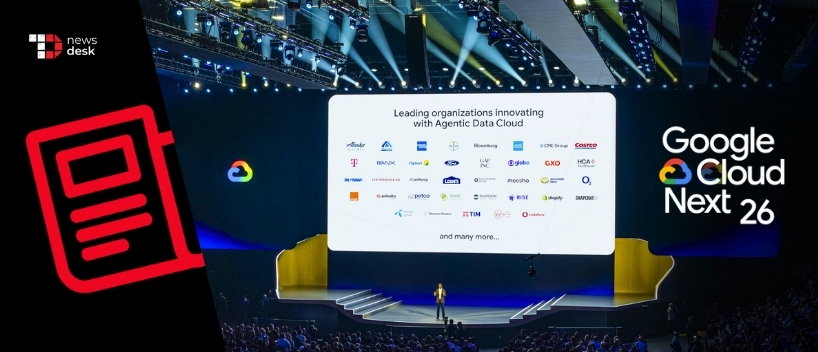
- Vodafone, American Express, and Virgin Voyages are already using agentic systems in production
- Google introduced a new Knowledge Catalog to improve AI context and accuracy
- New developer tools aim to help teams build and manage AI agents faster
- A cross-cloud lakehouse is designed to eliminate enterprise data silos
Vodafone, American Express, And Virgin Voyages Are Already Using It
Google used real-world customer deployments to show that agentic AI is already moving beyond experimentation.
Vodafone has launched hundreds of AI agents to help maintain uninterrupted customer service operations, a move Google says could save the telecom giant millions of euros annually.
American Express is shifting a core on-premises data warehouse and hundreds of production applications to BigQuery as it looks to scale trusted agentic commerce capabilities.
Virgin Voyages has deployed more than 1,000 specialized AI agents. One of those agents reportedly reduced mass itinerary rebooking times from six hours to just 11 minutes.
These examples formed the backbone of Google’s broader pitch that agentic AI requires entirely new infrastructure layers.
Google Built Three Core Layers For Its Agentic Data Cloud
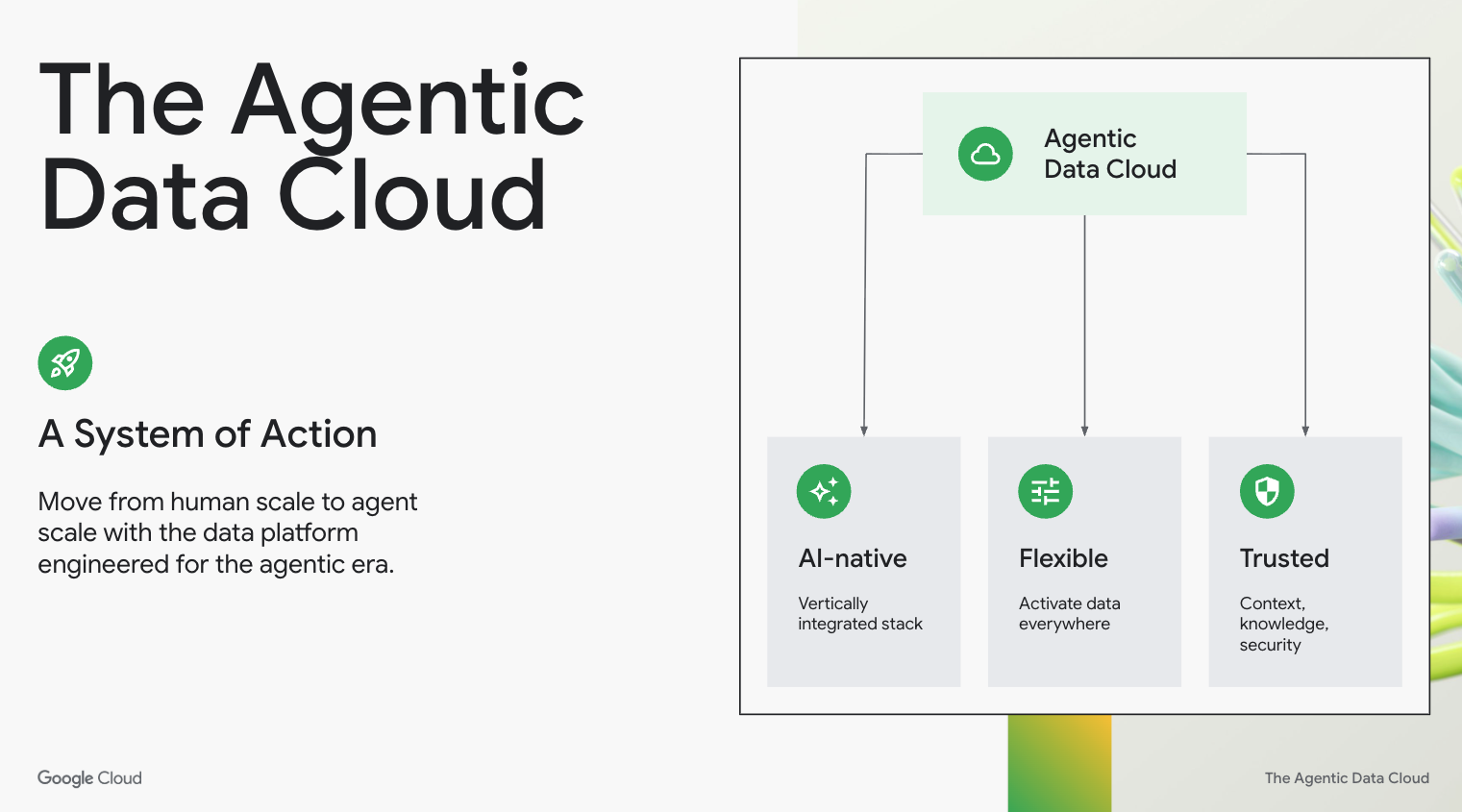
Google said its Agentic Data Cloud is built around three major innovation pillars.
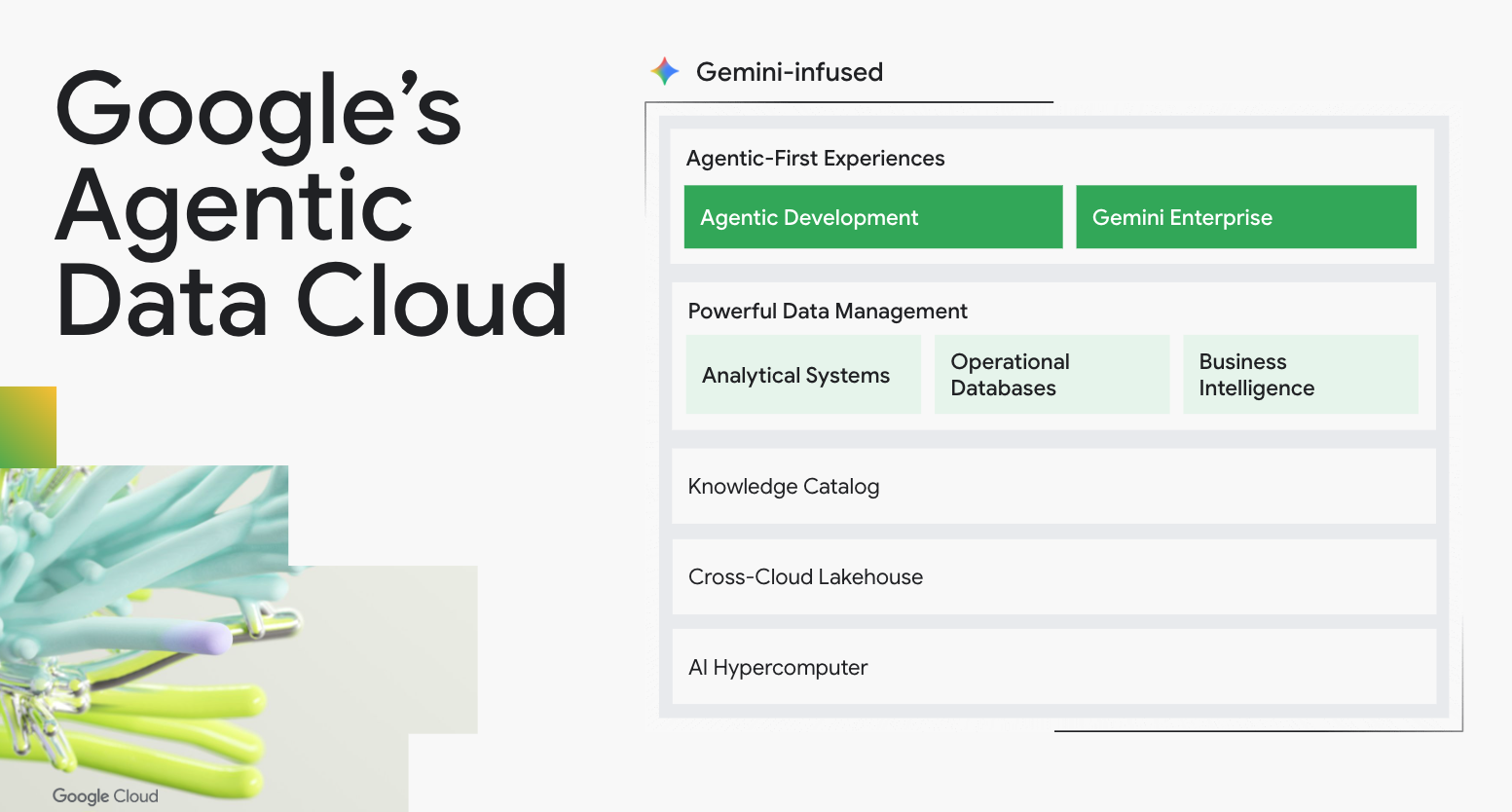
The first is a universal context engine that gives AI agents access to trusted business context, helping improve decision-making accuracy.
The second focuses on agentic-first practitioner experiences, where developers and data teams shift from manually managing infrastructure to orchestrating fleets of AI agents.
The third is an AI-native cross-cloud lakehouse built to connect fragmented enterprise environments and eliminate data silos.
Together, Google believes these three layers create the infrastructure required for enterprise-scale autonomous systems.
How Google’s Knowledge Catalog Works
At the center of Google’s universal context engine is its newly upgraded Knowledge Catalog, formerly known as Dataplex Universal Catalog.
The system aggregates business context from Google Cloud services and third-party platforms including Palantir, Salesforce Data360, SAP, ServiceNow, and Workday. Through Google’s lakehouse architecture, external data assets are automatically mapped into the Knowledge Catalog.
Google is also introducing LookML Agent in preview, which can generate business semantics from strategy documents. BigQuery Measures, also in preview, embeds business logic directly into the platform.
The second layer is continuous enrichment.
Google says the platform analyzes usage logs across organizations to understand how businesses actually use their data. It also extends this to unstructured datasets.
When files are uploaded to Google Cloud Storage, Smart Storage can automatically tag and enrich images, with PDF support expected soon. The platform can also use Gemini to generate missing schemas and map relationships between datasets.
The final layer is search and retrieval.
Google said enterprise search must balance speed, relevance, security, and scale. Its hybrid search stack combines semantic search, lexical matching, and machine learning-based ranking.
It also includes access-control-aware search, ensuring agents can only retrieve data they are authorized to access.
That same infrastructure powers Google’s Deep Research Agent, which can conduct multi-step reasoning across BigQuery datasets, internal documents, and web assets.
Google Wants Developers To Become AI Agent Managers
Google also introduced the Google Cloud Data Agent Kit in preview, which integrates directly into tools developers already use, including VS Code, Gemini CLI, Codex, and Claude Code.
Rather than forcing teams to adopt new workflows, Google says the kit embeds agent capabilities into existing environments while automatically selecting tools such as dbt, Apache Spark, and Apache Airflow.
The platform can scale to petabytes without moving data. It also includes the same capabilities used in Google’s own native agents.
Its Data Engineering Agent can build complex pipeline transformations while enforcing governance rules.
Its Data Science Agent automates model training workflows across BigQuery Dataframes and Serverless Apache Spark.
Its Database Observability Agent acts as a continuous monitoring layer that identifies infrastructure issues and executes remediation tasks.
Topics For More Insights
- Google Expands Distributed Cloud At Next ’26 To Bring Gemini AI On-Prem, Edge, And Air-Gapped Environments
- Google Introduces Virgo Network For Large-Scale AI Training!
- Google Introduces Workspace Intelligence To Power Agentic Work Across Gmail, Docs, Drive, Chat And More
- Google Unveils Eighth-Generation TPUs With Two New Chips Built For The Agentic AI Era
- Google Launches Gemini Enterprise Agent Platform To Power Scalable Enterprise AI Agents!
Google Wants To Eliminate Cross-Cloud Data Bottlenecks
Google’s final focus area targets one of enterprise AI’s biggest challenges, siloed infrastructure.
Its new cross-cloud lakehouse integrates Cross-Cloud Interconnect and Apache Iceberg REST Catalog to enable low-latency access across AWS, Azure, and Google Cloud environments.
The company is also introducing bi-directional federation for Databricks Unity Catalog, Snowflake Polaris, and AWS Glue Data Catalog.
Google also announced Spanner Omni, which allows businesses to run Google’s database engine across cloud providers, on-premise systems, and local environments.
With AI agents expected to take on larger workloads, Google is making it clear that enterprise AI infrastructure needs to evolve quickly, and it wants to be at the center of that transition.
First published on Thu, Apr 23, 2026

Liked what you read? That’s only the tip of the tech iceberg!
Explore our vast collection of tech articles including introductory guides, product reviews, trends and more, stay up to date with the latest news, relish thought-provoking interviews and the hottest AI blogs, and tickle your funny bone with hilarious tech memes!
Plus, get access to branded insights from industry-leading global brands through informative white papers, engaging case studies, in-depth reports, enlightening videos and exciting events and webinars.
Dive into TechDogs' treasure trove today and Know Your World of technology like never before!
Disclaimer - Reference to any specific product, software or entity does not constitute an endorsement or recommendation by TechDogs nor should any data or content published be relied upon. The views expressed by TechDogs' members and guests are their own and their appearance on our site does not imply an endorsement of them or any entity they represent. Views and opinions expressed by TechDogs' Authors are those of the Authors and do not necessarily reflect the view of TechDogs or any of its officials. While we aim to provide valuable and helpful information, some content on TechDogs' site may not have been thoroughly reviewed for every detail or aspect. We encourage users to verify any information independently where necessary.
Loading comments...