
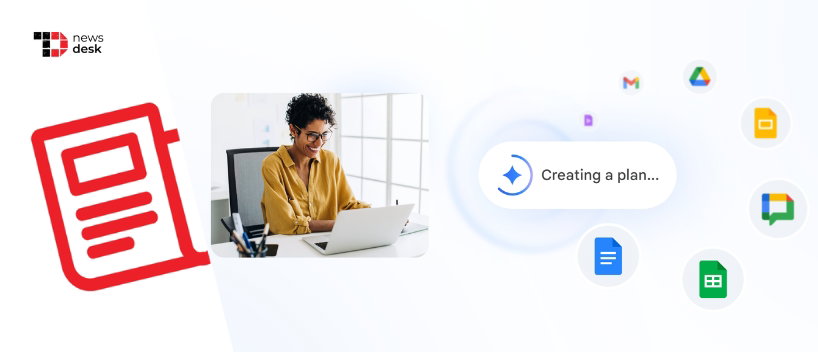
Google is pushing deeper into enterprise AI productivity with the launch of Workspae Intelligence, a new AI layer designed to give Gemini a real-time understanding of users’ work across Gmail, Docs, Sheets, Slides, Drive, Calendar, and Chat.
Announced at Google Cloud Next 2026, the feature aims to move Google Workspace beyond isolated AI prompts and toward agentic work, where AI understands ongoing projects, collaborators, documents, conversations, and organizational context automatically.
TL;DR
- Google launched Workspace Intelligence at Cloud Next 2026.
- It gives Gemini real-time awareness across Gmail, Drive, Docs, Calendar, Chat, and Sheets.
- AI can now understand projects, teams, files, and workflows automatically.
- New features include AI-generated presentations, spreadsheet automation, inbox assistance, and smarter document creation.
- Admins get granular controls over what enterprise data Gemini can access.
Google said Workspace Intelligence acts as a semantic layer that understands relationships between people, projects, files, meetings, and communications happening across an organization.
According to Google, the platform does not simply search documents, it understands how work is connected. In its official announcement, Google said Workspace Intelligence bridges the gap between Workspace apps, active projects, collaborators, and organizational knowledge to power agentic work.
This marks a major shift in how generative AI tools operate inside productivity software. Previously, Gemini could assist users only when explicitly prompted. Now, it is designed to understand context from emails, meetings, presentations, chats, spreadsheets, and files with less manual setup.
Google highlighted several use cases across its productivity suite. In Docs, users can generate fuller drafts using business context already available in Workspace. In Sheets, users can create and manage complex tables through natural language prompts. In Slides, Gemini can create editable presentations while preserving company branding and structure.
Drive is also getting more contextual AI search, helping users surface files and insights faster. Gmail, meanwhile, is receiving AI assistance aimed at helping users prioritize communication and streamline workflows.
Google also emphasized privacy and enterprise governance, a critical point as businesses remain cautious about how AI systems access internal information. The company said admins will be able to choose exactly what Workspace data Gemini can access, giving enterprises tighter control over sensitive files, messages, and collaboration data.
The launch comes as competition in enterprise productivity AI continues to intensify. Microsoft is expanding Copilot across Microsoft 365, while OpenAI, Anthropic, and Salesforce are all advancing their own enterprise AI and workflow automation strategies.
At Cloud Next 2026, Google also said more than 75% of Google Cloud customers are using AI products, and over 330 customers now process more than one trillion tokens annually through Google’s AI infrastructure. That suggests growing enterprise demand for AI systems that go beyond simple text generation and into operational understanding.
With Workspace Intelligence, Google is betting that the future of workplace software will not revolve around standalone apps, but around AI systems that understand how work connects across an organization.
