

Artificial Intelligence
Google Introduces Virgo Network For Large-Scale AI Training!
Updated on Thu, Apr 23, 2026
Share
TL;DR
- Google introduced Virgo Network at Google Cloud Next 2026, a large-scale data center fabric for AI workloads.
- It connects up to 134,000 AI chips with higher bandwidth, lower latency, and better performance.
- The system uses a multi-layer design with fault isolation and real-time monitoring for stable large-scale AI training.
Google has introduced Virgo Network, a new large-scale data center networking system designed specifically for the demands of modern AI workloads. The company says traditional network designs are struggling to keep up with challenges like bandwidth limitations, latency spikes, and congestion caused by distributed AI training across multiple data centers.
Virgo Network is built to address these challenges by connecting AI chips across locations into a unified system that functions like a single “campus-as-a-computer.” This approach allows thousands of chips to work together more efficiently, improving coordination during both training and real-time AI inference.
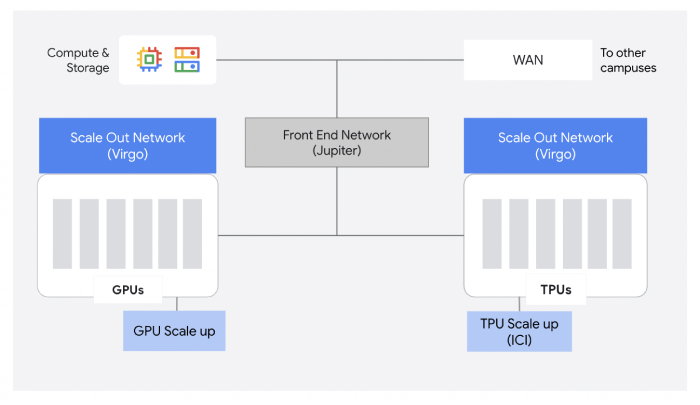
Virgo Network introduces a multi-layer architecture that separates different types of data traffic. It includes specialized layers for communication within clusters, across data centers, and between compute and storage systems. This structure is designed to reduce bottlenecks and improve overall system performance at scale.
The system can connect up to 134,000 AI chips and deliver up to 47 petabits per second of bandwidth. It also offers up to 4x higher per-chip performance compared to previous generations, along with around 40% lower latency and makes AI processing faster and more predictable.
Topics For More Insights:
Reliability is another key focus. The system uses fault isolation, real-time monitoring, and automated detection of slow or failing components to prevent disruptions from affecting large-scale training jobs. These features help maintain stability even when individual hardware issues occur within the network.
With Virgo Network, Google is aiming to strengthen the foundation that powers next-generation AI systems. As AI models continue to scale rapidly, the company is betting that rethinking the underlying network architecture will be just as important as improving the models themselves.
First published on Thu, Apr 23, 2026

Liked what you read? That’s only the tip of the tech iceberg!
Explore our vast collection of tech articles including introductory guides, product reviews, trends and more, stay up to date with the latest news, relish thought-provoking interviews and the hottest AI blogs, and tickle your funny bone with hilarious tech memes!
Plus, get access to branded insights from industry-leading global brands through informative white papers, engaging case studies, in-depth reports, enlightening videos and exciting events and webinars.
Dive into TechDogs' treasure trove today and Know Your World of technology like never before!
Disclaimer - Reference to any specific product, software or entity does not constitute an endorsement or recommendation by TechDogs nor should any data or content published be relied upon. The views expressed by TechDogs' members and guests are their own and their appearance on our site does not imply an endorsement of them or any entity they represent. Views and opinions expressed by TechDogs' Authors are those of the Authors and do not necessarily reflect the view of TechDogs or any of its officials. While we aim to provide valuable and helpful information, some content on TechDogs' site may not have been thoroughly reviewed for every detail or aspect. We encourage users to verify any information independently where necessary.
Loading comments...