
Artificial Intelligence
Google Launches SynthID Website To Detect AI-Generated Images, Videos And Audio For Everyone
Updated on Thu, Oct 8, 2026
Share
AI-generated content is becoming harder to distinguish from reality, and Google wants to make identifying it easier.
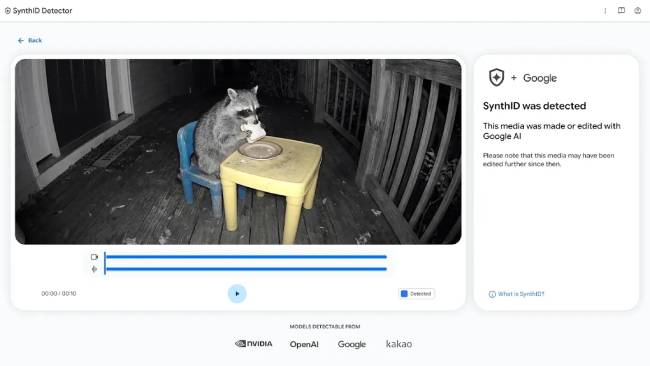
Google has opened its SynthID verification website to everyone, allowing users to check images, videos, and audio for AI-generated content. The move expands access to a detection tool previously available to select professionals, although its effectiveness still has limitations.
TL;DR
- Google has launched public access to its SynthID verification website for checking AI-generated images, videos, and audio.
- The tool was previously available to select journalists, media professionals, and researchers.
- Google says its verification technology already handles 1 million requests daily.
- SynthID identifies compatible AI watermarks, but detection tools cannot reliably identify every piece of AI-generated media.
Google Opens SynthID AI Content Detection Website To Everyone
Google has opened its SynthID verification platform, making it accessible through SynthID.com for anyone looking to check whether digital media was generated using artificial intelligence (AI).
The tool was initially introduced to select journalists, researchers, and media professionals for testing during Google I/O 2025. Now, the company is extending access beyond those groups.
Interestingly, the website supports a wide range of file formats, allowing users to verify different types of media through the same platform.
These include JPG, JPEG, PNG, BMP, WEBP, AVIF, HEIC, HEIF, TIFF, TIF, and GIF images. For videos, it supports MP4, MOV, and WEBM, while audio compatibility includes WAV, MP3, OGG, FLAC, AAC, and M4A.
The expansion comes as AI-generated media becomes increasingly convincing, making verification tools particularly relevant for anyone dealing with potentially synthetic content.
Google SynthID Uses Invisible Watermarks Across Gemini, Veo And Other AI Tools
First introduced in 2023, SynthID works by embedding invisible digital watermarks into AI-generated content, allowing compatible detection systems to recognize the markers.
Google uses the technology across several of its AI models, including Nano Banana for images, Veo for videos, and Lyria for audio generation.
The watermarking system also extends to Google products such as Gemini, Flow, ProducerAI, and Vids.
For instance, TechDogs previously covered how Google Vids uses SynthID watermarks to identify AI-generated videos, highlighting its role in improving transparency around synthetic media.
Interestingly, SynthID isn't limited to Google's own ecosystem.
OpenAI, NVIDIA, and Kakao also support the technology, while Apple is reportedly preparing to introduce support. OpenAI additionally offers its own verification platform for checking content.
Google has already integrated SynthID verification into its Gemini application and Chrome browser, making the standalone website another way to access the technology.
The company says users currently submit approximately 1 million content verification requests every day.
Topics For More Insights
Google SynthID Faces Limitations In Detecting AI-Generated Content
Despite expanding access, SynthID shouldn't be mistaken for a universal AI detector.
The platform relies on compatible watermarking technology, meaning an unsuccessful verification cannot establish that an image, video, or audio clip was created by a human.
Microsoft and Meta have developed their own approaches to AI content watermarking and verification, although such detection systems have occasionally failed to identify content produced by their developers' own models.
This limitation matters as AI content labeling becomes increasingly relevant across digital platforms.
Google's public SynthID rollout makes watermark verification more accessible, but identifying AI-generated media remains an imperfect process.
First published on Thu, Oct 8, 2026

Enjoyed what you've read so far? Great news - there's more to explore!
Stay up to date with the latest news, a vast collection of tech articles including introductory guides, product reviews, trends and more, thought-provoking interviews, hottest AI blogs and entertaining tech memes.
Plus, get access to branded insights such as informative white papers, intriguing case studies, in-depth reports, enlightening videos and exciting events and webinars from industry-leading global brands.
Dive into TechDogs' treasure trove today and Know Your World of technology!
Disclaimer - Reference to any specific product, software or entity does not constitute an endorsement or recommendation by TechDogs nor should any data or content published be relied upon. The views expressed by TechDogs' members and guests are their own and their appearance on our site does not imply an endorsement of them or any entity they represent. Views and opinions expressed by TechDogs' Authors are those of the Authors and do not necessarily reflect the view of TechDogs or any of its officials. While we aim to provide valuable and helpful information, some content on TechDogs' site may not have been thoroughly reviewed for every detail or aspect. We encourage users to verify any information independently where necessary.
Loading comments...