
Google is turning Vids into a more complete AI video creation platform with Gemini Omni Flash, personal avatars that look and sound like users, and prompt-based editing that can transform existing footage without forcing creators to start again.
TL;DR
- Google Vids users can create account-linked personal avatars using their face and voice.
- Gemini Omni Flash generates clips from text and reference images, while supporting step-by-step edits.
- Generated clips carry an invisible SynthID watermark.
- Personal avatars launch in English for eligible users aged 18 and above, with regional restrictions.
Google Vids is getting two major artificial intelligence upgrades that could make workplace and marketing video production less dependent on cameras, studios, actors, and traditional editing workflows.
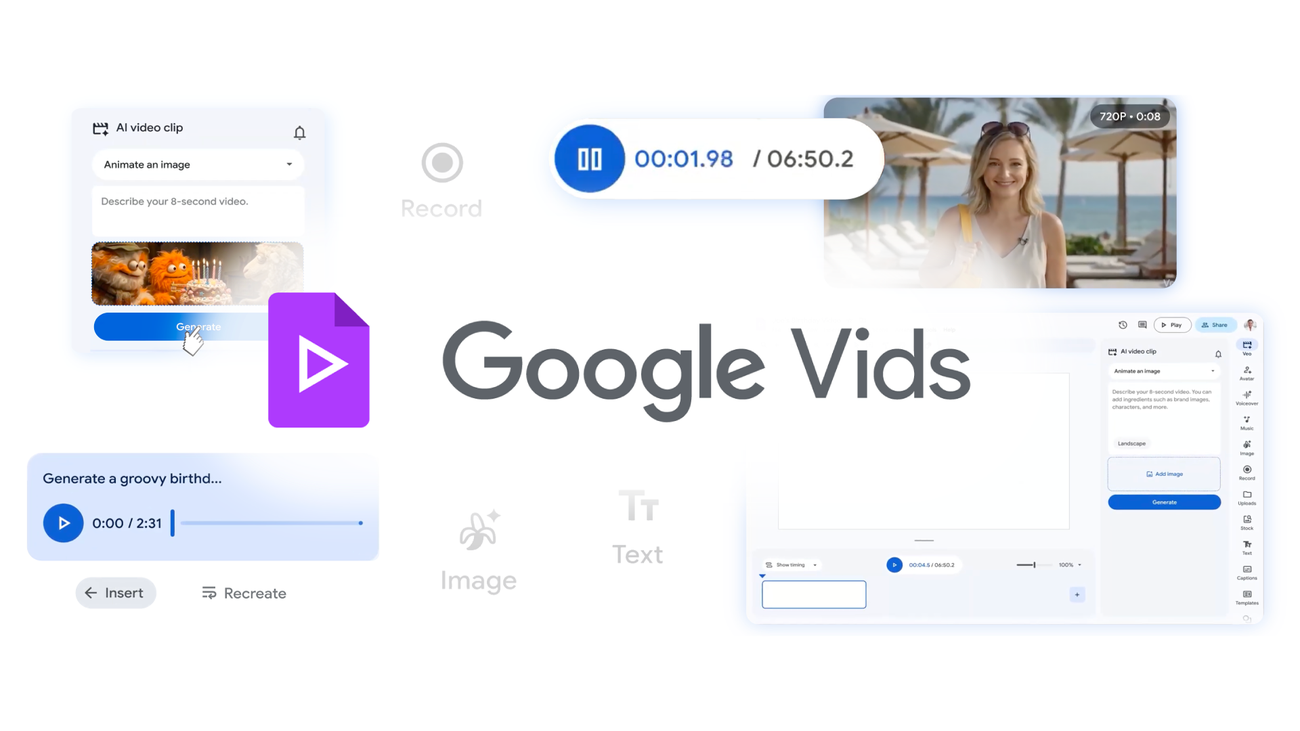
The first is personal avatars. Eligible users can complete a secure capture and verification process connected to their Google Account, recording their face and voice to create a digital version of themselves. Once created, the avatar can be selected inside Vids and instructed to deliver a written script.
Google positions the feature for company updates, training videos, website content, social media clips, customer welcome messages, advertising concepts, and early storyboards. It also gives Workspace administrators the ability to enable or disable personal avatars at the domain level.
“Think of Gemini Omni like Nano Banana, but for video,” said Justin Luk, Product Manager for Google Vids, while announcing the integration.
Google Vids Adds Conversational Video Editing
The second upgrade brings Gemini Omni Flash directly into Vids. Users can describe a scene in natural language, add reference images such as photographs or sketches, and ask the model to combine those inputs into a generated video.
Omni also supports conversational, step-by-step editing. This means creators can ask Vids to improve lighting, remove background clutter or unwanted sounds, change colors, swap locations, adjust camera angles, update on-screen text, revise voiceovers, or apply a new visual style without rebuilding the entire clip.
Google says Omni Flash improves text rendering, physics, and realism compared with earlier video models. The company is pitching the feature as a way for businesses and marketers to repurpose existing assets, create multiple campaign variations, refresh old explainers, and test creative concepts faster.
The update arrives as Google Vids gains traction beyond its original role as an AI-assisted workplace presentation tool. Google says more than 7 million people now use Vids each month, while users have created millions of videos on the platform over the past year.
Google Adds Avatar Safeguards And SynthID
Google is also adding safeguards around the new tools. Personal avatars are restricted to the verified account holder’s likeness, and access is limited to users aged 18 or older with English set as their primary language. At launch, personal avatars are unavailable in the European Economic Area, Switzerland, and the United Kingdom.
Every video generated with Gemini Omni includes an imperceptible SynthID watermark that can identify the clip as AI-generated. Google says this is intended to improve transparency as realistic avatars and AI-edited footage become easier to produce.
Topics for more insights:
The rollout began for Rapid Release domains on July 16, 2026, with Scheduled Release domains following from August 5. Availability spans eligible Google Workspace business, enterprise, education, nonprofit, and add-on plans, along with Google AI Pro and Ultra subscriptions.
With personal likeness, multimodal generation, and natural-language editing now combined in one service, Google Vids is moving closer to an all-in-one production tool and into more direct competition with specialist AI video platforms such as HeyGen, Synthesia, Captions, and D-ID.
