
After years of rivalry and speculation, Apple and Google have announced a landmark AI partnership that will see Google’s Gemini models power Apple’s upcoming Apple Intelligence platform (including a major upgrade to Siri).
The agreement, described as multi-year and non-exclusive, marks one of the most surprising collaborations in the tech industry’s recent history, aligning two long-time competitors to advance AI innovation on a global scale.
Here's what the partnership entails.
TL;DR
- Apple has signed a multi-year deal with Google to integrate Gemini AI models into its Apple Foundation Models and Siri.
- The collaboration aims to deliver advanced reasoning, language, and multimodal capabilities on Apple devices while maintaining Apple’s strict privacy standards.
- Apple Intelligence features, including the revamped Siri, are expected to launch later in 2026.
- Elon Musk and privacy experts have voiced concerns over the partnership’s competitive and privacy implications.
Apple Teams Up With Google’s Gemini For AI Upgrade
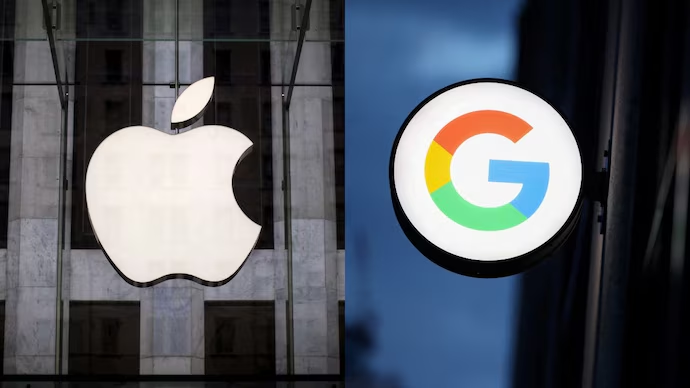
Apple has chosen Google’s Gemini AI models as the foundation for its next-generation Apple Intelligence features (a platform spanning Siri, on-device intelligence, and contextual assistance).
According to both companies, Apple will utilize Gemini’s Large Language Models (LLMs) to enhance Siri’s conversational depth, reasoning, and real-world context capabilities.
The deal also involves Google Cloud infrastructure, which will handle select AI computations in Apple’s Private Cloud Compute environment.
Both firms described the partnership as non-exclusive, allowing Apple to continue developing and deploying its own models alongside Google’s technology.
In a rare joint statement, Apple said, “After careful evaluation, we determined that Google’s technology provides the most capable foundation for Apple Foundation Models, and we’re excited about the innovative new experiences it will unlock for our users.”
Google added, “These models will help power future Apple Intelligence features, including a more personalized Siri coming this year.”
Balancing Power And Privacy
Apple’s hallmark has always been privacy, and that stance continues with this collaboration. The company emphasized that all personalized processing would remain on-device or within its secure Private Cloud Compute, ensuring that Gemini’s access to user data remains strictly limited.
A Google spokesperson reiterated this, stating, “Apple Intelligence will continue to run on Apple devices and Private Cloud Compute while maintaining Apple’s industry-leading privacy standards.”
This approach blends the performance of Gemini’s advanced models with Apple’s privacy architecture, a move many analysts have described as a balanced fusion of scalability and user control.
Topics For More Insights
Industry Reactions And Competitive Impact
The announcement triggered significant reactions across the tech ecosystem. Alphabet’s shares rose over 1%, pushing Google’s parent company past a $4 trillion market capitalization milestone, an indicator of investor confidence in Google’s AI leadership.
For Apple, the deal is seen as a strategic move to close the generative AI gap that has widened in recent years. Siri, once a pioneer in voice assistance, has lagged behind offerings from OpenAI, Amazon, and Anthropic. The integration of Gemini could help Apple reclaim its edge in user-facing AI experiences.
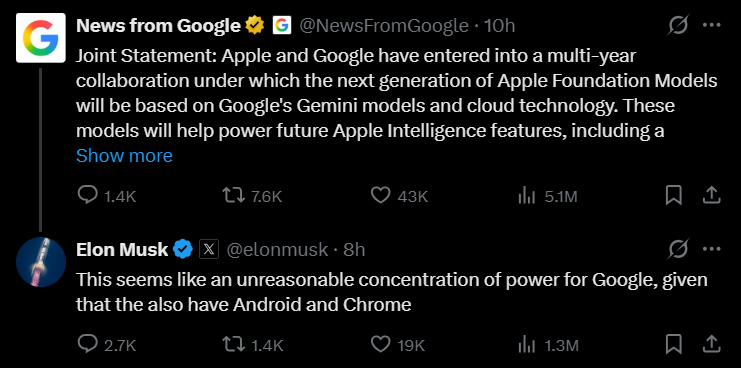
However, not all reactions were positive. Tesla and xAI CEO Elon Musk criticized the collaboration, warning that the partnership could give Google too much power and raising concerns about long-term competitive risks in AI.
Despite skepticism from some corners, analysts describe Apple’s move as a vote of confidence in Google’s AI capabilities and a pragmatic step toward delivering meaningful AI improvements faster than Apple could achieve alone.
A New Era For Siri And Apple Intelligence
The upcoming AI overhaul promises a deeply re-engineered Siri experience that can reason, summarize, and understand context more effectively (bridging the gap between human interaction and machine precision).
Industry watchers expect the upgrade to arrive later in 2026 as part of Apple’s next major OS cycle, coinciding with the wider rollout of Apple Intelligence across iPhone, iPad, and Mac devices.
Beyond user experience, the partnership underscores a broader trend, where once-bitter rivals are now cooperating to accelerate progress in the era of generative AI, where speed of innovation increasingly outweighs traditional competition.
As one analyst summarized, “This deal is less about rivalry and more about survival in an AI-dominated future.”
