
Artificial Intelligence
What Is Decision 3.0? Inside The Open Multimodal Decision Model Family
Share
TL;DR
As AI systems become more complex, the ability to evaluate information and choose the next action is becoming just as important as generating content. That's where Decision 3.0 enters the picture, bringing a new approach to how AI makes decisions.
-
Decision 3.0 is an open-weight multimodal AI model family developed by the vLLM Semantic Router team, designed for structured decision-making rather than lengthy text generation.
-
The model family includes six variants, ranging from approximately 0.6 billion to 27 billion parameters, offering different options for AI classification and decision-making workloads.
-
Decision 3.0 supports text, images, and videos, enabling AI systems to evaluate different types of information and return structured, probability-based answers.
-
Unlike traditional generative LLMs, Decision 3.0 focuses on three decision formats: Choice, Yes/No, and Score, making it useful for classification, routing, and prioritization tasks.
-
Available on Hugging Face under the Apache 2.0 license, Decision 3.0 offers developers an open-weight foundation for building AI-powered workflows, although real-world reliability still requires careful evaluation.
Introduction
Remember The Matrix, when Neo faces one of the most iconic choices in movie history? Morpheus offers him two pills: red or blue. One reveals the truth about reality, while the other lets him return to his familiar world.
Despite the mystery surrounding both options, the moment comes down to one thing: making a decision.
Now, imagine if artificial intelligence approached decisions with similar clarity. Instead of generating lengthy explanations, what if it could simply evaluate the available information, weigh the possibilities, and identify the most appropriate answer?
That's the idea behind Decision 3.0.
Developed by the vLLM Semantic Router team, Decision 3.0 is a family of open-weight multimodal AI models designed to evaluate information and produce structured, probability-based decisions.
Supporting text, images, and videos, these models aim to make AI-powered classification, routing, and decision-making more efficient. So, what is Decision 3.0, how does it work, and why could it change the way businesses use AI?
Let's follow the red pill and find out!
What Is Decision 3.0?
Decision 3.0 is an open-weight family of multimodal decision models. Unlike conventional generative AI systems, these models focus on evaluating information against predefined questions and returning probabilities for possible answers.
The vLLM SR Decision 3.0 release includes six models, ranging from approximately 0.6 billion to 27 billion parameters. They are available under the Apache 2.0 license, allowing developers to access, modify, and deploy the models under its terms.
The family builds on Qwen-based architectures and extends decision-making capabilities across multiple input formats.
Its three primary decision types are:
-
Choice: Select the most appropriate option from several possibilities.
-
Yes/No: Determine whether a particular condition is satisfied.
-
Score: Evaluate an input against a defined rating scale.
For example, an AI-powered insurance system could assess a submitted claim, identify its category, determine whether required documents are present, and assign a review priority.
Instead of generating paragraphs explaining these decisions, the model returns structured answers with associated probabilities.
This approach makes Decision 3.0 particularly relevant for applications requiring consistent, machine-readable outputs.
However, understanding its value requires looking at how the underlying decision process works.
How Does Decision 3.0 Work?
Decision 3.0 follows a decision-oriented inference process that separates interpreting information from generating natural-language responses.
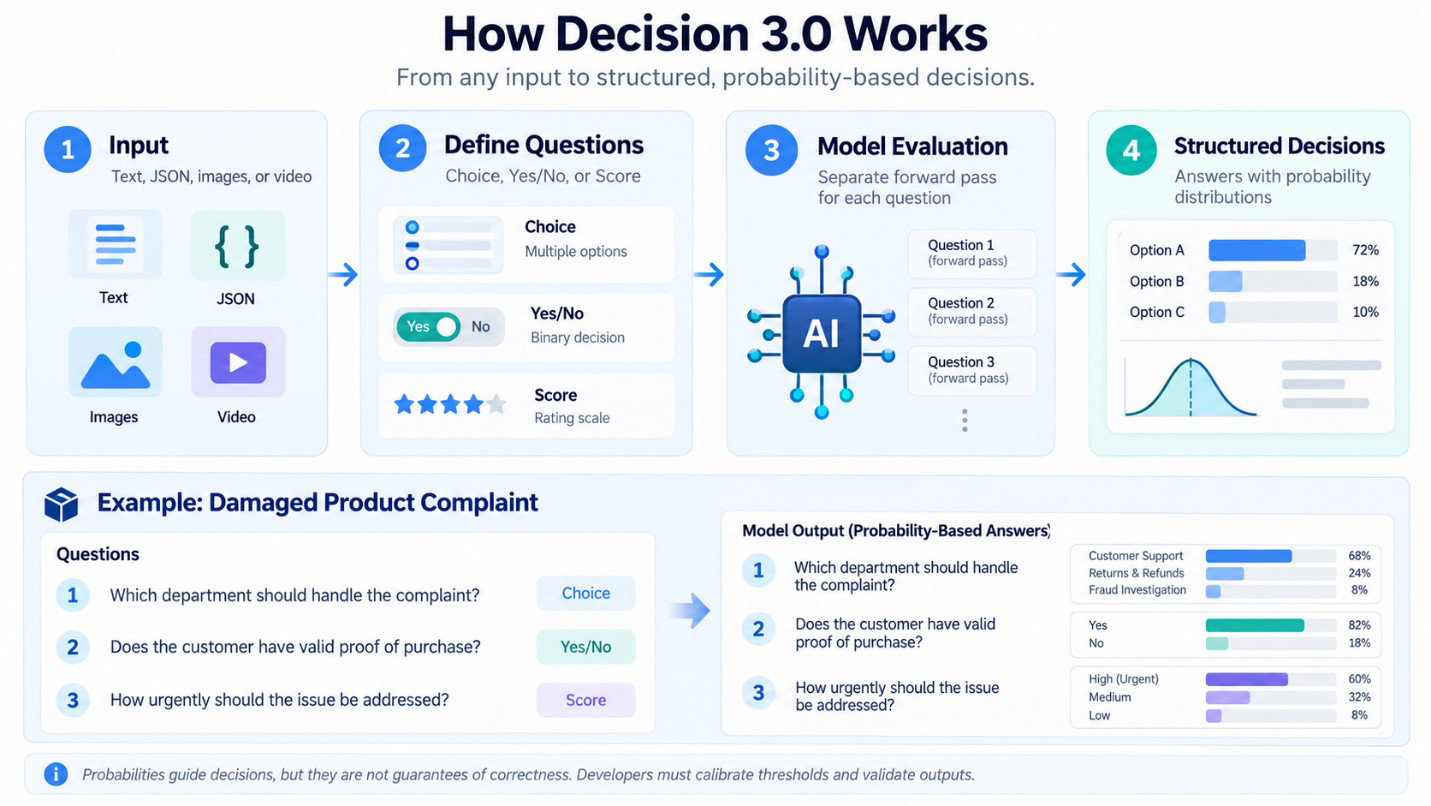
Here's how the process works.
-
Input: Text, JSON, images, or video
-
Define Questions: Choice, Yes/No, or Score
-
Model Evaluation: Separate forward pass for each question
-
Structured Decisions: Answers with probability distributions
Let us understand the decision process.
Suppose an online retailer receives a complaint about a damaged product.
The system could ask Decision 3.0 three questions simultaneously:
-
Which department should handle the complaint?
-
Does the customer have valid proof of purchase?
-
How urgently should the issue be addressed?
The model evaluates each question against the supplied information. Although multiple questions can be submitted in one request, each receives its own forward pass.
The resulting probabilities help downstream applications select appropriate actions.
Importantly, these probabilities should not automatically be treated as guarantees of correctness. Developers must assess calibration, establish suitable thresholds, and account for incorrect classifications.
This distinction becomes significant when comparing Decision 3.0 with conventional generative models.
How Is Decision 3.0 Different From Standard Generative LLMs?
Traditional LLMs are primarily designed to predict and generate sequences of tokens. They can classify information, but often require carefully structured prompts and additional processing to extract usable answers.
Decision 3.0 approaches the task differently.
| Feature | Decision 3.0 | Standard Generative LLMs |
| Primary Purpose | Structured decision-making | Generating and interpreting content |
| Output | Answers and probabilities | Text or other generated content |
| Decision Format | Choice, Yes/No, Score | Prompt-dependent |
| Multimodal Support | Text, JSON, images, videos | Varies by model |
| Integration | Designed for machine-readable decisions | Often require output formatting or parsing |
| Typical Applications | Routing, classification, prioritization | Chatbots, writing, coding, reasoning |
The distinction isn't that generative models cannot make decisions. Many already support structured outputs and classification workflows. Instead, Decision 3.0 specializes in producing decision scores without generating explanatory text.
That specialization could reduce unnecessary processing in applications where the desired output is already known.
While Decision 3.0 takes a different approach from traditional LLMs, its flexibility goes beyond how it processes information. The model family also offers multiple configurations designed to accommodate different computational needs and use cases.
Let's unfold the models that make up the Decision 3.0 family.
Exploring The Six Models In The Decision 3.0 Family
One notable aspect of Decision 3.0 is its range of model sizes.
Rather than offering a single large model, the developers provide six configurations suited to different computational requirements.
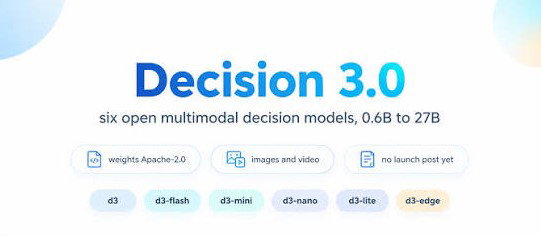
| Model | Approximate Parameter Count |
| d3-edge | 0.6B |
| d3-lite | 0.9B |
| d3-nano | 2B |
| d3-mini | 5B |
| d3-flash | 8B |
| d3 | 27B |
The flagship d3 open-weight foundation model provides the family's largest configuration, with approximately 26.09 billion parameters, including its vision encoder. Smaller variants offer developers alternatives when memory consumption, infrastructure costs, or response time are priorities.
For instance, a lightweight deployment might use d3-edge for simpler classification tasks, while more demanding multimodal workloads could benefit from d3 or d3-flash. However, a smaller parameter count does not automatically guarantee better performance or lower deployment costs. Hardware, input complexity, and workload characteristics remain important considerations.
With six models offering different capabilities and computational requirements, the Decision 3.0 family provides options for a variety of AI workloads. However, model size alone doesn't tell the whole story. How well do these models actually perform? Let's look at what the benchmarks deliver across different applications.
Where Can Decision 3.0 Be Used?
Decision 3.0's multimodal capabilities make it potentially useful across several business workflows.
-
Intelligent AI Model Routing
Within a vLLM Semantic Router environment, decision models can help identify the most appropriate AI model for a request. A basic factual question might be assigned to a lightweight model, while a complex reasoning task could be routed to a more capable system.
This could help organizations balance computational costs and response quality. -
Customer Support Automation
Businesses can use structured classification to categorize complaints, detect escalation requirements, and prioritize support tickets. When users attach screenshots or receipts, the multimodal capability can provide additional context for classification.
-
Document And Visual Assessment
Decision 3.0 can evaluate information presented in images alongside textual instructions. Potential applications include document verification workflows, visual categorization, and identifying whether submitted materials meet specified criteria.
-
AI Safety And Content Moderation
Decision models could support automated screening by assigning scores to content against defined policies. However, sensitive moderation decisions require careful threshold testing, human oversight, and safeguards against classification errors.
-
Video-Based Classification
With video input support, developers can build systems that identify predefined activities or conditions in short clips. The flagship model processes sampled video frames rather than continuously analyzing every frame, making this distinction important for applications involving fast-moving events.
These examples demonstrate how specialized decision models could complement broader AI systems instead of replacing them.
Beyond its practical applications, Decision 3.0 is also accessible to developers looking to experiment.
How Can Developers Access Decision 3.0 On Hugging Face?
Developers interested in experimenting with Decision 3.0 on Hugging Face can access the model weights through the vLLM-sr organization. The models support integration through Hugging Face Transformers, while vLLM Semantic Router provides a dedicated serving approach.
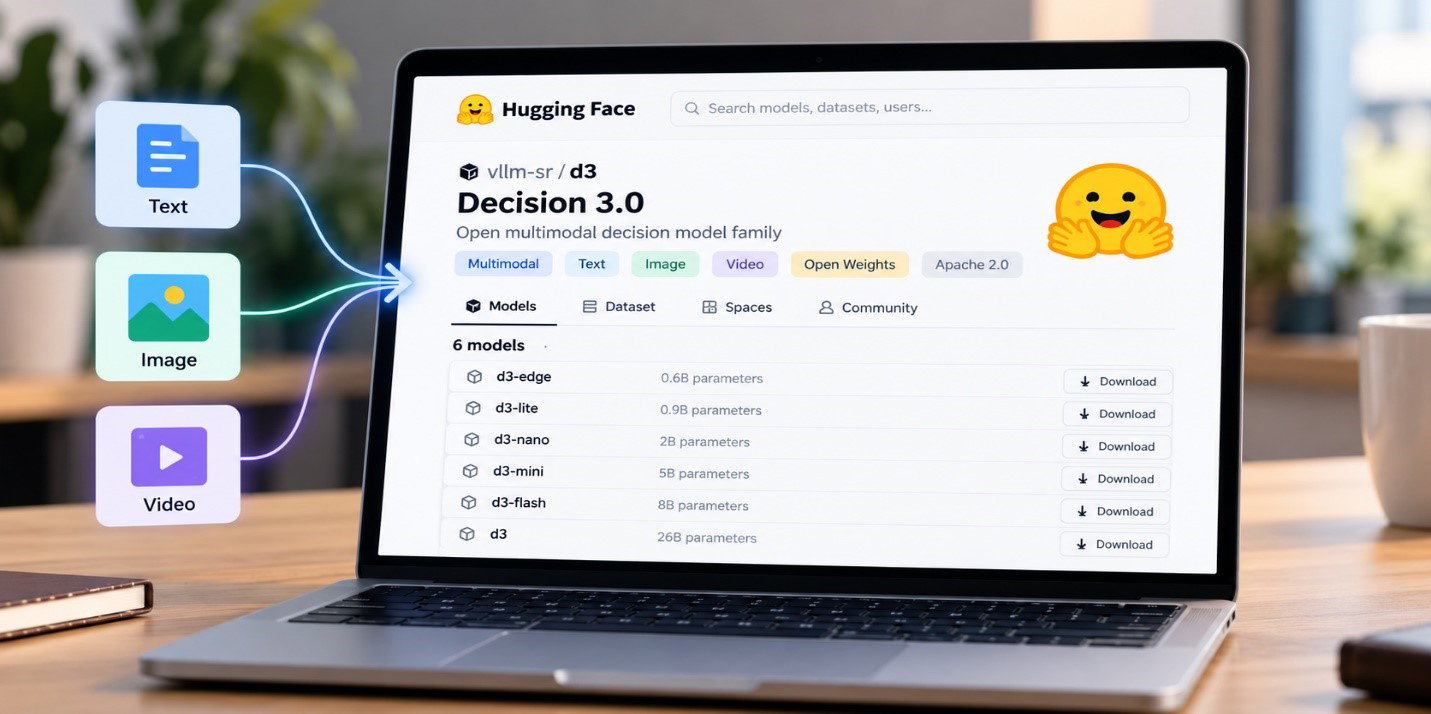
The model-loading process uses custom Python code through trust_remote_code=True, which developers should review before execution. The dedicated Decision 3.0 serving mode is also available through the development channel rather than a stable release at the time of launch.
Organizations should additionally test memory requirements, latency, probability calibration, and compatibility with their existing systems before production deployment. Open weights improve accessibility, but implementing a dependable decision-making pipeline still requires engineering and operational oversight.
While Decision 3.0's availability on Hugging Face makes it accessible to developers, its real potential lies in how businesses put these models to work. As enterprises increasingly rely on AI for complex workflows, could specialized decision models become an essential part of their AI infrastructure?
What Does Decision 3.0 Mean For The Future Of Enterprise AI?
Decision 3.0 highlights a shift toward specialized AI systems that perform specific tasks rather than relying exclusively on general-purpose language generation. As enterprises deploy more AI agents and automated workflows, many interactions will involve classification, routing, prioritization, and selecting actions.
These tasks don't always require a conversational response. A multimodal decision model can serve as one component within a larger AI architecture, handling structured evaluations while generative models focus on reasoning, content creation, and user interactions.
Topics For More Insights:
The potential advantages include more predictable output formats, flexible deployment options, and reduced dependence on text-generation pipelines for routine decisions. Nevertheless, organizations must continue addressing model reliability, decision transparency, security, and human accountability.
After all, producing a confident probability is not the same as making a correct business decision.
Conclusion
Decision 3.0 represents an interesting development in the growing ecosystem of specialized AI models. By combining open weights, multimodal understanding, and probability-based outputs, the vLLM Semantic Router team has introduced a family designed around a practical objective: helping AI systems make structured decisions without unnecessary text generation.
Its six model configurations, support for images and video, and reported benchmark improvements make it worth exploring for developers building routing, classification, and automation systems. Whether Decision 3.0 becomes a widely adopted component of enterprise AI infrastructure will depend on independent evaluations, deployment maturity, and real-world performance.
For now, it illustrates an important direction in AI development: the future may involve models that know not only what to say, but how to select the next action.
Frequently Asked Questions
What Is Decision 3.0 And How Does It Work?
Decision 3.0 is a family of open-weight multimodal AI models that evaluate text, structured data, images, and videos against predefined questions. It uses choice, yes/no, and scoring formats to return structured answers with probabilities instead of generating text.
Can Decision 3.0 Replace Traditional Large Language Models?
Not entirely. Decision 3.0 is designed for classification and structured decision-making, while generative LLMs support broader tasks such as writing, coding, and conversational reasoning. Both can work together within enterprise AI applications.
Is Decision 3.0 Free To Use For Commercial Applications?
The Decision 3.0 models are released under the Apache 2.0 license, which permits commercial use subject to license conditions. Organizations must still account for computing infrastructure, implementation costs, and applicable compliance requirements.
Wed, Oct 14, 2026

Liked what you read? That’s only the tip of the tech iceberg!
Explore our vast collection of tech articles including introductory guides, product reviews, trends and more, stay up to date with the latest news, relish thought-provoking interviews and the hottest AI blogs, and tickle your funny bone with hilarious tech memes!
Plus, get access to branded insights from industry-leading global brands through informative white papers, engaging case studies, in-depth reports, enlightening videos and exciting events and webinars.
Dive into TechDogs' treasure trove today and Know Your World of technology like never before!
Disclaimer - Reference to any specific product, software or entity does not constitute an endorsement or recommendation by TechDogs nor should any data or content published be relied upon. The views expressed by TechDogs' members and guests are their own and their appearance on our site does not imply an endorsement of them or any entity they represent. Views and opinions expressed by TechDogs' Authors are those of the Authors and do not necessarily reflect the view of TechDogs or any of its officials. While we aim to provide valuable and helpful information, some content on TechDogs' site may not have been thoroughly reviewed for every detail or aspect. We encourage users to verify any information independently where necessary.
Loading comments...