
Media and Entertainment
The Netflix Sophomore Slump: Why Netflix Is Losing Its Viewers For The Second Seasons
Share
TL;DR
-
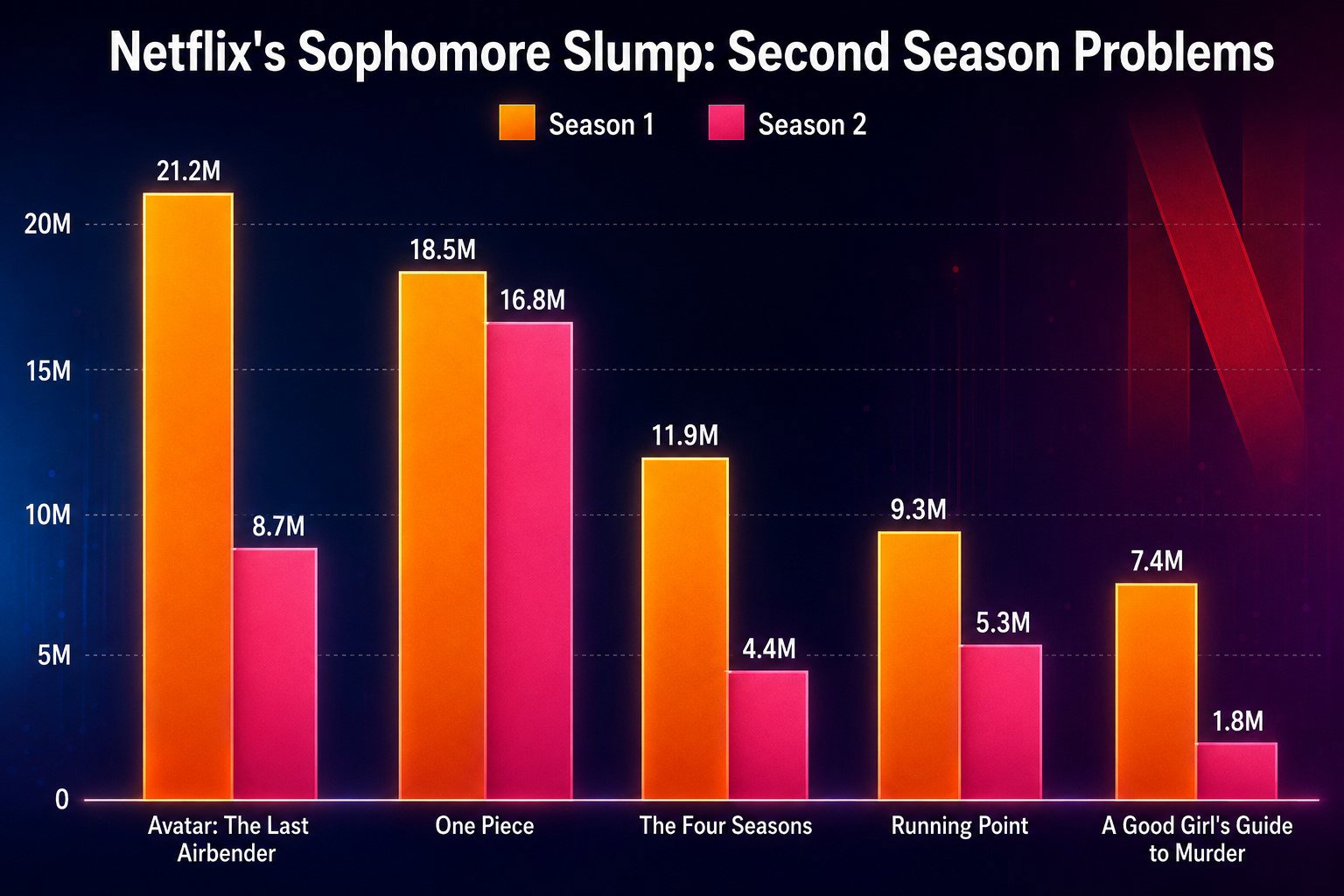
Netflix's top original series are losing between 30% and 76% of their audience from season one to season two, as per a report from TheWrap.
-
Long, unpredictable gaps between seasons, sometimes stretching past two or three years, make it easy for viewers to lose the thread.
-
The streaming platform's all-at-once binge model creates a quick burst of buzz that fades fast, unlike weekly releases that sustain conversation.
-
The OTT leader’s subscriber-first business model rewards flashy new shows over returning ones, since renewals don't move the subscriber needle the same way.
-
Shows like Avatar: The Last Airbender, A Good Girl's Guide to Murder, and The Four Seasons are among the hardest hit.
-
Critics say Netflix's lack of a defined brand identity, unlike HBO or Apple TV+, makes it harder to keep audiences emotionally invested season over season.
Introduction
Stranger Things? Squid Game? Money Heist? Bridgerton? The Queen’s Gambit?
Which TV show drew you to Netflix?
Maybe it was something from the streaming giant’s early years? House of Cards? Orange Is the New Black? Narcos? Or were you a Netflix fan after it launched its "Watch Now" instant streaming feature in 2007? Or all the way back from its formative DVD-by-mail service days?
Whichever it is, you’re clearly interested in what’s going on with Netflix, or you wouldn’t be here, would you? Also, we appreciate you ignoring the fact that we ignored Netflix’s wide movie selection, which was done for the sake of today’s topic.
Netflix has enjoyed a straight shot to the top of the streaming giants’ chart, capturing pole position with around 325 million subscribers. Netflix, you better watch out because JioHotstar isn’t far behind with its 300 million subscribers.
However, while Netflix revels in its unprecedented rise in popularity and success, it is undergoing a strange phenomenon where its shows’ second seasons aren’t being appreciated as much as the first.
The reason isn’t weak plots, bad direction, or sloppy acting, but dwindling viewer interest coming from a wide range of reasons.
So, why aren’t people coming back for a second helping of the Netflix cake? Let’s explore!
The Netflix Sophomore Slump
Netflix is facing confusing times. Users are abandoning TV series in their second season. We’re not talking about a few people who saw the first season and said, “Meh, it’s not for me.”
It’s a full-blown, large-scale case of abandonment of new series that Netflix is producing, after gaining fame and traction in the first season but facing significant viewer losses in the second.
This phenomenon is being dubbed as Netflix’s “Sophomore Slump.”
To save you from a trip to your dictionary, the term sophomore refers to a student in their second year of high school, college, or university, or another four-year educational program. It is also used to refer to the second season of a professional athlete or the second project of a music album, film, or, in this case, a TV show.
Call it what you want, but this Netflix sophomore slump is turning into one of streaming's biggest talking points, and even Netflix's own executives don't have a clean answer for it yet.
Let’s take a detailed look at what the slump is about.
PS: If you’re reading this, you made it to the sophomore headline of this article!
What Is Netflix’s Slump About?
Sequels are never as good as the original.
You might have heard this phrase being used by people unhappy with how a movie’s sequel turns out. And they might have a case, especially as far as movies are concerned.
It’s like this: usually a movie gets picked up for a second installment because the first one did well at the box office and producers want to milk the cash cow. However, quite often the sequel’s success depends upon whether the writers had planned for one or not. Otherwise, they just end up with bizarre plotlines, shoddy dialogues, and rushed releases.
That’s for movies. For TV shows, the multi-iteration formula works. At least, it did, back when shows were written keeping multiple seasons in mind.
Modern-day shows are picked up for one season and are renewed if they perform.
This is one error in Netflix’s ways that’s causing its second-season snag AKA sophomore slump. Various other factors are causing this, which even Netflix executives are studying and hope to resolve soon.
However, until the change transpires, the streaming giant has a season 2 viewership crisis on its hands, and we’re going to study why!
Why Is Netflix Losing Viewers In The Second Season?
Why do streaming series lose momentum in season 2, and why does Netflix seem to have it worse than most? The answer to this question is a bit too complicated to explain in simple terms.
The Netflix second season slump isn't down to one single cause. It's a mix of scheduling, business incentives, and a platform still figuring out its own identity.
Long, Unpredictable Gaps Between Seasons
The biggest culprit is time.
Netflix shows regularly go two to three years between seasons; that was the case for both Avatar: The Last Airbender and One Piece. When a show returns after that long, viewers need to reacquaint themselves with the plot before they can even enjoy the new episodes.
Entertainment editor Tamara Fuentes summed up the fatigue this creates, saying, "A lot of people are feeling like, 'Why am I going to put time into something if I'm going to have to wait forever?'" She added that even devoted Bridgerton fans have told her they meant to catch up, then simply forgot.
Netflix has also quietly canceled nine shows after their first season alone this year, which does little to build confidence that sticking around for a second season is worth the wait.
Split Releases Leave Viewers Confused
Releasing Part A and Part B of the same season separately creates chaos.
It asks viewers to keep track of a story across multiple release dates instead of just diving in whenever they're ready, and not everyone has the patience for that kind of homework.
Stranger Things Season 5's finale rolled out across Thanksgiving, Christmas, and New Year's Eve, a strategy that keeps a show in the cultural conversation longer but demands a lot of patience from casual viewers.
Some viewers wait for every part to drop before starting, then forget the show exists by the time it's fully out. It happens to me all the time, which is why I have a mountain of unseen shows I feel too embarrassed to begin now.
The All-At-Once Binge Release Model
Unlike networks or rivals that release weekly, Netflix drops entire seasons in one go.
That creates a short, intense spike of hype that fades almost as fast as it arrives, leaving little room for word-of-mouth to build.
Media analyst Evan Shapiro described the effect bluntly by pointing to Netflix's shift toward being "the McDonald's of streaming." As per Shapiro, viewers are loyal to individual shows, not platforms, and if a series gets buried under a pile of new content, audiences will simply move on to something that doesn't leave them waiting.
A Subscriber-First, Not Retention-First Business Model
Here's the uncomfortable truth for Netflix's returning shows: renewals don't attract new subscribers the way debut seasons do.
If a viewer already signed up because of a show's first season, Netflix has already made its money. That means marketing muscle tends to go toward the next shiny new title instead.
This dynamic played out with The Boroughs, a Duffer Brothers-produced series that spent four weeks on Netflix's global Top 10, racked up over 20.8 million hours viewed, and scored 97% on Rotten Tomatoes.
It was still canceled. As media studies professor Myles McNutt put it, how Netflix defines success remains "the eternal question we don't have an answer to."
Netflix's Missing Brand Identity
Other platforms have carved out a clear identity:
-
HBO leans into prestige dramas
-
Apple TV+ dives into niche but polished originals
-
Amazon's Prime Video focuses on young-adult hits.
-
Paramount+ brings broad action fare.
Netflix, by comparison, functions more like an everything-for-everyone catalog, which makes it harder for any single returning show to stand out from the flood of new releases around it.
McNutt argued that Netflix is "very good at making one-season hit shows and not very good at making multiple-season hit shows," a distinction that becomes a real problem as scripted content struggles harder than ever to cut through the noise.
What Weekly Streamers Are Getting Right
Why Netflix is suffering from a perpetual sophomore slump becomes clearer when you look at what's working elsewhere.
-
HBO Max's The Pitt saw Season 2 viewership run roughly 50% higher than Season 1 in its first 90 days, helped by a weekly rollout that let buzz build over time.
-
Apple TV+'s Severance saw its Season 2 finale post a 29% jump over the previous high, racking up 6.4 billion streaming minutes in the US during its run.
-
Peacock's The Traitors and Love Island USA have both grown their audiences with every subsequent season.
The common thread across all of them is pacing that keeps a show in the conversation rather than dumping it all at once. That's exactly what a real streaming retention strategy looks like, and it's the piece Netflix hasn't quite cracked yet.
So, that’s what the slump is all about, but which TV shows are affected by Netflix’s second season slump?
Which TV Shows Are Affected By The Netflix Sophomore Slump?
The Netflix viewership drop has hit some of the platform's biggest recent titles.
-
Avatar: The Last Airbender saw viewership fall by nearly 60% between seasons.
-
A Good Girl's Guide to Murder posted the steepest decline of the bunch at 76%.
-
The Four Seasons dropped by at least 40%.
-
Running Point also saw a 40% hit.
-
A Man on the Inside had it worst of all; its first season landed at the top of Netflix's global Top 10, while its second season didn't crack the list at all.
-
One Piece saw the mildest decline of the group and still scored a perfect 100% on Rotten Tomatoes for its second season.
-
Beef returned with an entirely new cast and story as an anthology, making its numbers harder to compare directly to its first outing.
So, the shows are struggling, but what's the industry actually saying about it?
What Are People Saying About Netflix’s Viewership Drop?
It’s always best to get feedback from end users.
“It’s because having a master's degree in business and solely relying on an algorithm to tell you what to do doesn’t make you a creative [person],” said renowned actor DJ Qualls in a comment on a post on Instagram.
“Y’all cancelling crowd favorites for no reason, that’s why,” chimed in artist and song architect Rex Wesley in a comment on the same post.
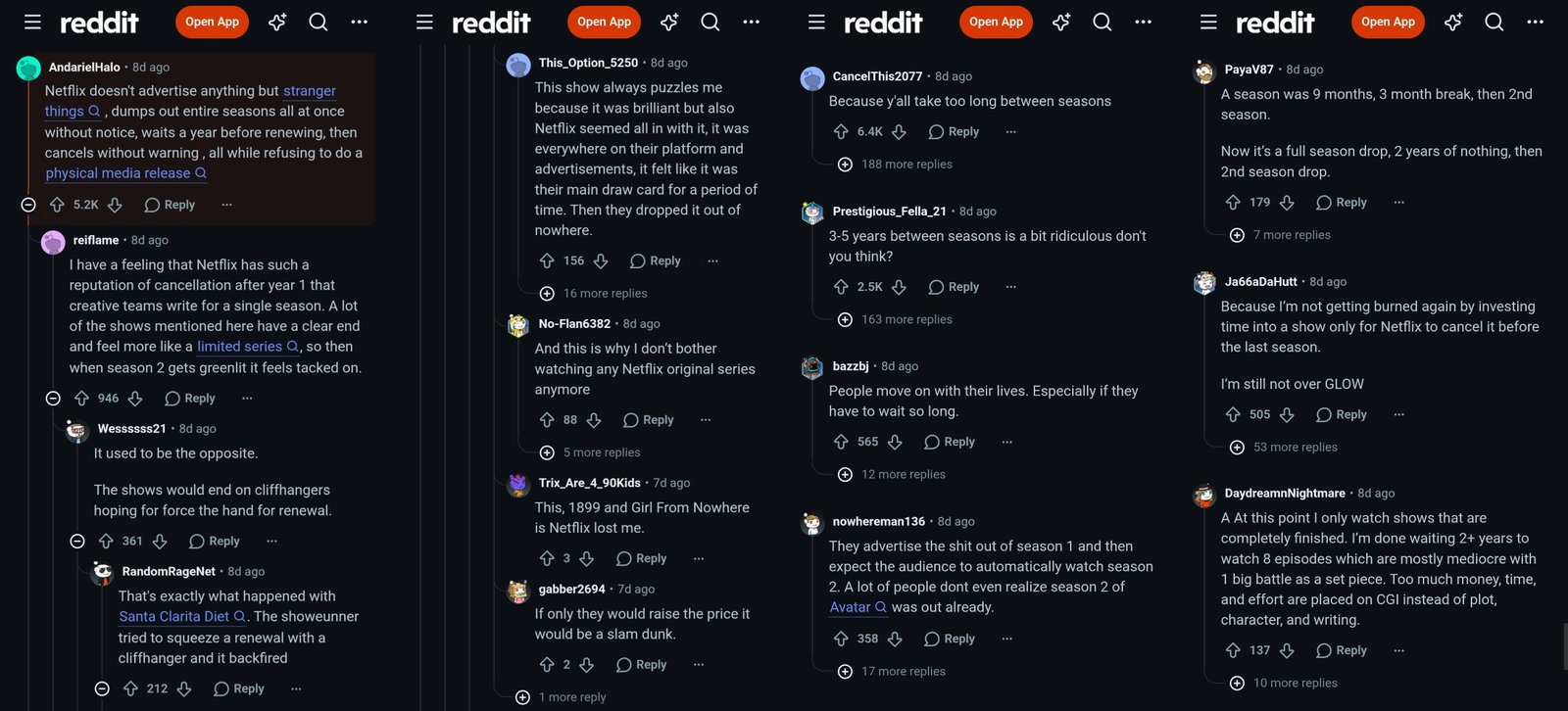
Meanwhile, Redditors didn’t hold back.
“Netflix doesn't advertise anything but stranger things, dumps out entire seasons all at once without notice, waits a year before renewing, then cancels without warning, all while refusing to do a physical media release,” said AndarielHalo.
“Not only that, but Netflix cancels almost every one of their shows after 1 season anyway. So, the writers for these shows make sure to finish up the plot lines with the understanding they may only get 1 season,” wrote user RGJ587.
Social media is filled with more comments, complaints, and theories of why we’ve witnessed Netflix’s sophomore slump.
While Netflix itself hasn't confirmed a fix, Chief Content Officer Bela Bajaria addressed the platform's release approach directly at a press event, saying, “We are being really intentional, thoughtful and trying to not be set in one way of doing it.”
Whether that confidence holds up over the next few release cycles is the real test.
Topics For More Insights
- Could Netflix’s VOID AI Be The Future Of AI Video Editing And Filmmaking?
- Texas Attorney General Sues Netflix For Allegedly Tracking Users And Addicting Children!
- Amazon Joins Netflix And Disney With TikTok-Like Clips On Prime Video To Help Users Find Shows Faster!
- Netflix Acquires InterPositive To Enhance Filmmaking With AI!
Conclusion
Netflix's second seasons are struggling, not because the shows are worse, but because long gaps, binge releases, and a subscriber-first playbook are working against them. Rivals with weekly rollouts are proving there's a better way to keep audiences hooked. Until Netflix adjusts its approach, don't be surprised if fewer people show up for round two. Until then, it's less Netflix and Chill, more Netflix and Forget.
Frequently Asked Questions
Is Netflix Canceling More Shows Because Of The Sophomore Slump?
Netflix has ramped up cancellations after first seasons, having already axed nine shows this year alone. While the platform hasn't officially linked this to declining second-season viewership, the pattern suggests Netflix is increasingly cautious about investing further in shows that don't show strong renewal potential right out of the gate.
Does Stranger Things Or Bridgerton Suffer From The Same Second-Season Drop?
Both remain exceptions to the trend so far. Stranger Things and Bridgerton have retained strong followings across multiple seasons, likely helped by their status as Netflix's closest equivalents to tentpole franchises. That said, Stranger Things concluded its run in a way some viewers found unsatisfying, which could affect appetite for any future spinoffs.
Are Other Streaming Services Experiencing A Similar Sophomore Slump?
Season-over-season viewership drops happen across the industry to some degree; Peacock's Poker Face, for instance, saw a similar fade before its cancellation. However, platforms with weekly release models, like HBO Max and Apple TV+, have generally seen second seasons hold steady or grow, suggesting Netflix's binge-first strategy makes it more vulnerable to this pattern than most.
Tue, Jul 14, 2026

Enjoyed what you read? Great news – there’s a lot more to explore!
Dive into our content repository of the latest tech news, a diverse range of articles spanning introductory guides, product reviews, trends and more, along with engaging interviews, up-to-date AI blogs and hilarious tech memes!
Also explore our collection of branded insights via informative white papers, enlightening case studies, in-depth reports, educational videos and exciting events and webinars from leading global brands.
Head to the TechDogs homepage to Know Your World of technology today!
Disclaimer - Reference to any specific product, software or entity does not constitute an endorsement or recommendation by TechDogs nor should any data or content published be relied upon. The views expressed by TechDogs' members and guests are their own and their appearance on our site does not imply an endorsement of them or any entity they represent. Views and opinions expressed by TechDogs' Authors are those of the Authors and do not necessarily reflect the view of TechDogs or any of its officials. While we aim to provide valuable and helpful information, some content on TechDogs' site may not have been thoroughly reviewed for every detail or aspect. We encourage users to verify any information independently where necessary.
Loading comments...