

Artificial Intelligence
UN Partners With Google To Launch AI-Ready Data Platform To Make Worldwide Statistics Easier To Access
Updated on Fri, Sep 18, 2026
Share
The United Nations has partnered with Google to launch the UN System Data Commons, an open, AI-ready platform that brings official global statistics into one searchable resource for people, researchers, developers, and AI agents.
Built on Google’s open-source Data Commons technology, the platform supports natural-language searches and the Model Context Protocol (MCP), allowing AI systems to connect directly with authoritative UN datasets instead of relying solely on information generated from their training data.
TL;DR
- The UN System Data Commons brings statistics from multiple UN organizations into one AI-ready platform.
- It supports natural-language searches and MCP access for AI agents.
- Twenty-six UN entities are participating, with 80% of UN statistical datasets targeted for inclusion by 2027.
- The project comes as UNICEF research found leading AI models struggled to reliably answer questions involving development statistics.
UN And Google Make Global Statistics AI-Ready
According to Google, the UN System Data Commons connects statistics that previously existed across separate UN organizations, formats, and systems into what the company describes as an AI-ready knowledge graph.
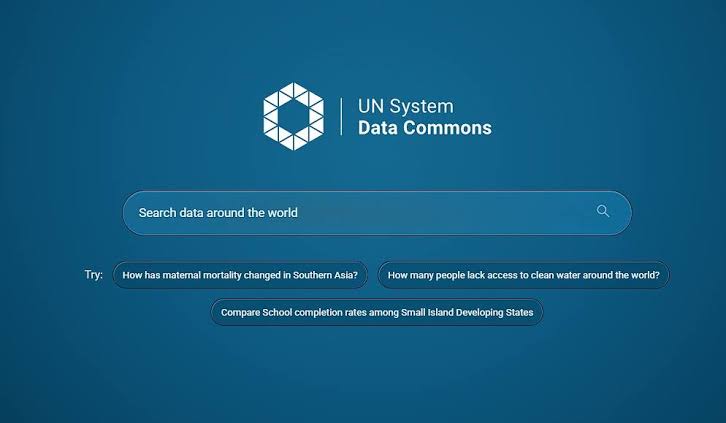
The platform automatically links metrics, geographic boundaries, timelines, and related datasets, allowing users to explore relationships between information without manually combining multiple spreadsheets and databases. Users can also ask questions in everyday language and receive relevant statistics and interactive visualizations.
TechCrunch reported that the platform replaces the older UNData portal, which largely required users to navigate statistics through a traditional database interface. At launch, data from nearly 20 UN entities was available, while 26 entities had committed to participating in the initiative.
Official remarks from the UN Secretary-General added another indication of the platform’s scale, saying almost 44 million data points were already available at launch through the new system.
The UN and Google aim to expand the platform further over the coming year, with a target of making 80% of statistical datasets available across the UN system accessible through Data Commons by 2027.
Why Does The UN Want Its Data Ready For AI Agents?
The launch comes as people increasingly use generative AI systems to search for statistics, even though such systems can still produce inaccurate or inconsistent answers.
TechCrunch reported details from a UNICEF benchmark covering more than 133,000 responses generated by six AI models from OpenAI, Anthropic, and Google. The models achieved an average accuracy score of just 21.2% when answering questions involving global development indicators.
Around three in five responses reportedly failed to provide a usable number at all. Even when the same model produced a number when asked the same question again roughly two days later, it returned the same figure only about half the time. UNICEF said the research remains a working paper and has not yet been peer-reviewed.
LiveMint also highlighted the UNICEF benchmark while pointing to one of the new platform’s more important features: provenance. Statistics retrieved through the system can be traced back to their underlying UN source, giving users a way to check where an AI-generated answer obtained its figures.
“We are orders of magnitude more advanced in scale, scope, and flexibility,” Shantanu Mukherjee, acting director of the UN Statistics Division, told TechCrunch while discussing the platform.
MCP Lets AI Agents Work Directly With UN Statistics
A key component of the system is support for Model Context Protocol, an open standard that enables AI applications and agents to connect with external tools and data sources.
Google said AI agents connected to the UN System Data Commons can retrieve authoritative statistics across different domains and use them to assemble charts, graphs, infographics, and draft written analysis.
Topics for more insights:
In one demonstration reported by TechCrunch, an AI system was asked to examine the impact of the U.S. President’s Emergency Plan for AIDS Relief in Africa. It identified UN indicators including HIV infections, AIDS mortality, and life expectancy, before bringing the information together into an infographic.
However, connecting AI to authoritative data does not eliminate the risk of incorrect interpretation.
Prem Ramaswami, Head of Data Commons at Google, cautioned that “a human should always review the outputs before citing or publishing them.”
Google.org Backs The Data Commons Infrastructure
Google.org provided $2 million in capacity-building funding and technical assistance to help establish the platform’s core infrastructure, according to TechCrunch and LiveMint.
The platform runs through a UN-governed instance, with Google working toward a model where the UN can eventually maintain, operate, and scale the system independently. Google’s own announcement said its support is being provided through Google.org to the UN Foundation.
Pluang similarly highlighted the involvement of 26 UN entities and the goal of bringing 80% of UN statistical datasets onto the platform by 2027.
For users, the biggest change is straightforward: instead of hunting through separate UN databases for individual statistics, the new platform aims to make trusted global data searchable in one place while also giving AI systems a standardized way to retrieve it.
First published on Fri, Sep 18, 2026

Enjoyed what you read? Great news – there’s a lot more to explore!
Dive into our content repository of the latest tech news, a diverse range of articles spanning introductory guides, product reviews, trends and more, along with engaging interviews, up-to-date AI blogs and hilarious tech memes!
Also explore our collection of branded insights via informative white papers, enlightening case studies, in-depth reports, educational videos and exciting events and webinars from leading global brands.
Head to the TechDogs homepage to Know Your World of technology today!
Disclaimer - Reference to any specific product, software or entity does not constitute an endorsement or recommendation by TechDogs nor should any data or content published be relied upon. The views expressed by TechDogs' members and guests are their own and their appearance on our site does not imply an endorsement of them or any entity they represent. Views and opinions expressed by TechDogs' Authors are those of the Authors and do not necessarily reflect the view of TechDogs or any of its officials. While we aim to provide valuable and helpful information, some content on TechDogs' site may not have been thoroughly reviewed for every detail or aspect. We encourage users to verify any information independently where necessary.
Loading comments...