
Manufacturing Technology
UK, China & More Countries Turn To Robots Amid The World Humanoid Robot Games
Updated on Mon, Aug 18, 2025
Share
It’s not just big metal arms moving objects around; robots are now going ultra-miniature, coming in a wide range of shapes and sizes.
However, one of the more popular shapes and sizes when it comes to robot designs is that of human beings—and such robots are called humanoid robots.
In addition to being designed to help around the house, humanoid robots are being used for a variety of purposes, which include hospitality, healthcare, manufacturing, and more. Some of them can even complete multiple tasks, earning the title of Polyfunctional Robots.
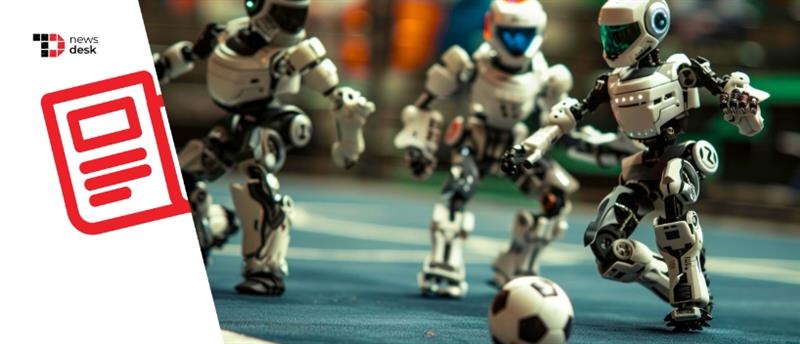
Humanoid robots are even participating in sports!
The first-ever World Humanoid Robot Games was held in Beijing, China—commencing on Friday, August 15, and concluding on Sunday, August 17.
The 3-day event, which is also widely called the robots’ Olympics, witnessed massive participation, spanning more than 500 humanoid robots across 280 teams—192 representing universities and 88 private enterprises—hailing from 16 countries such as the United States, Japan, Germany, Brazil, and China.
Entry tickets were sold for between 128 to 580 yuan ($17.83 to $80.77).
Here, robots from companies such as Unitree Robotics, Fourier Intelligence, Booster Robotics, X-Humanoid, and more, competed in twenty-six sports events, including athletics, basketball, kickboxing, football, track and field, table tennis, and martial arts, as well as activities such as dancing, sorting medicines, handling materials, cleaning, and more.
Across the event, the robots bumped into each other, toppled each other, and randomly collapsed during the football matches, running events, and other activities—while also dazzling the attendees and manufacturers.
However, this was the idea of the event—testing the decision-making capabilities, motor skills, coordination, efficiency, operability, and other aspects of robots, to help manufacturers optimize their real-life applications across factories and homes.
“We come here to play and to win. But we are also interested in research,” said Leipzig University of Applied Sciences’ Max Polter, who was a member of HTWK Robots football team from Germany. “You can test a lot of interesting new and exciting approaches in this contest. If we try something and it doesn't work, we lose the game. That's sad but it is better than investing a lot of money into a product which failed.”

Recently, China also conducted the world's first humanoid robot half-marathon—albeit (hilariously) rescheduled—where twenty-one robots competed against each other as well as thousands of humans.
Even Chinese humanoid startup AgiBot got into the act by operating a warehouse dedicated to observing robots’ movements and performance of various activities, including folding t-shirts, making sandwiches, opening doors, and more.
The idea is to collect mountains of data that can be used to train and optimize humanoid robots.
“Just imagine that one day in our own robot factory, our robots are assembling themselves,” said Yao Maoqing, a partner at AgiBot.
All this comes from the Chinese government’s push to become the undisputed leader of the global robotics sector by 2027—something American companies recognized a while ago.
As such, companies are turning to humanoid robots to transform the manufacturing industry by assisting in various operations, as well as taking over complete processes.
However, in this case, it’s not just humanoid robots that will help—general robotics comes into play here.
In the U.K., an AI-powered robotic arm has been making frames from timber for homes and commercial buildings—spanning walls, floors and roofs—in a factory in Oxfordshire, England.
“We're seeing more major housebuilders and small and medium-sized builders embracing timber as a way to ... overcome the skills and carbon challenge,” said Alex Goodfellow, CEO of Donaldson Timber Systems (DTS).
The automated process saves DTS time, effort, and money, using a more sustainable material than bricks, stone, and concrete, allowing the company to make panels for around 100 homes a week.
Overall, it cuts the time needed to build a single home by approximately 10 weeks. This plays well with the British government’s plan to build 300,000 new homes a year.
At the same time, the Royal Navy’s prototype robotic submarine XV-Excalibur provided a sneak peek into what the future might hold. Swimming in the waters of HMNB Devonport in Plymouth, England, the submarine was being controlled from a command center in Australia—10,000 miles away.
Essentially, the innovation it exhibited could one day allow companies and governments to easily control not just general robots—such as machines, drones, submarines, and more—but also humanoid robots from great distances.
Do you think such robots could help businesses and governments innovate more effectively? Do you think China’s current initiatives will help it take the lead in the global humanoid robot industry?
Let us know in the comments below!
First published on Mon, Aug 18, 2025

Liked what you read? That’s only the tip of the tech iceberg!
Explore our vast collection of tech articles including introductory guides, product reviews, trends and more, stay up to date with the latest news, relish thought-provoking interviews and the hottest AI blogs, and tickle your funny bone with hilarious tech memes!
Plus, get access to branded insights from industry-leading global brands through informative white papers, engaging case studies, in-depth reports, enlightening videos and exciting events and webinars.
Dive into TechDogs' treasure trove today and Know Your World of technology like never before!
Disclaimer - Reference to any specific product, software or entity does not constitute an endorsement or recommendation by TechDogs nor should any data or content published be relied upon. The views expressed by TechDogs' members and guests are their own and their appearance on our site does not imply an endorsement of them or any entity they represent. Views and opinions expressed by TechDogs' Authors are those of the Authors and do not necessarily reflect the view of TechDogs or any of its officials. While we aim to provide valuable and helpful information, some content on TechDogs' site may not have been thoroughly reviewed for every detail or aspect. We encourage users to verify any information independently where necessary.
Loading comments...