
Anthropic helped define premium AI through careful writing, advanced coding, long-running agents, reusable Skills, and MCP-powered connections.
Now, OpenAI is packaging many comparable capabilities into a broader ecosystem that may be easier for businesses to understand, adopt, and price.
The result is not a clear defeat for Claude. It is a growing challenge for Anthropic to explain why customers should pay a premium while navigating multiple plans, usage limits, credits, seats, resets, and consumption charges.
TL;DR
- OpenAI launched GPT-5.6 Sol, Terra, and Luna as one clearly positioned model family.
- ChatGPT Work, Skills, plugins, connected apps, and MCP integrations bring professional workflows into one ecosystem.
- Sol substantially undercuts Claude Fable 5 at standard short-context API rates.
- Claude remains highly competitive in coding, reasoning, long-running agents, and MCP maturity.
How OpenAI Turned Claude’s Strongest Differentiators Into One Broader AI Ecosystem
Claude built much of its identity around capabilities that felt more deliberate and specialized than those of a general-purpose chatbot.
Its appeal included thoughtful writing, long-context reasoning, repository-scale coding, computer use, Claude Cowork, Claude Code, Agent Skills, and MCP connections to external tools and data.
OpenAI has not invented those concepts, particularly MCP or reusable Skills. Its competitive move is combining similar building blocks across ChatGPT, Codex, connected apps, Skills, and installable plugins designed for wider workplace adoption.
ChatGPT Work strengthens that strategy by acting across apps and files, staying with projects for hours, and turning goals into completed slides, spreadsheets, documents, Sites, reports, and other deliverables.
OpenAI’s Plugin Directory, which replaced the App Directory on July 9, 2026, adds another distribution layer. Plugins can package Skills, apps, app templates, external data, actions, and repeatable workflows, making complex capabilities easier to discover and activate without requiring teams to assemble every component themselves.
Why GPT-5.6 Sol, Terra, And Luna Create A Clearer Model Buying Decision
The GPT-5.6 lineup gives OpenAI a simple three-level model ladder.
Sol targets frontier reasoning, complex coding, research, computer use, and demanding agentic work. Terra balances capability and cost for everyday professional tasks, while Luna focuses on fast, efficient, high-volume workloads.
The advantage is not merely that OpenAI offers three models. It presents them as one current-generation family with distinct roles, allowing businesses to match intelligence and cost to different workloads without reorganizing processes around unrelated products or older model generations.
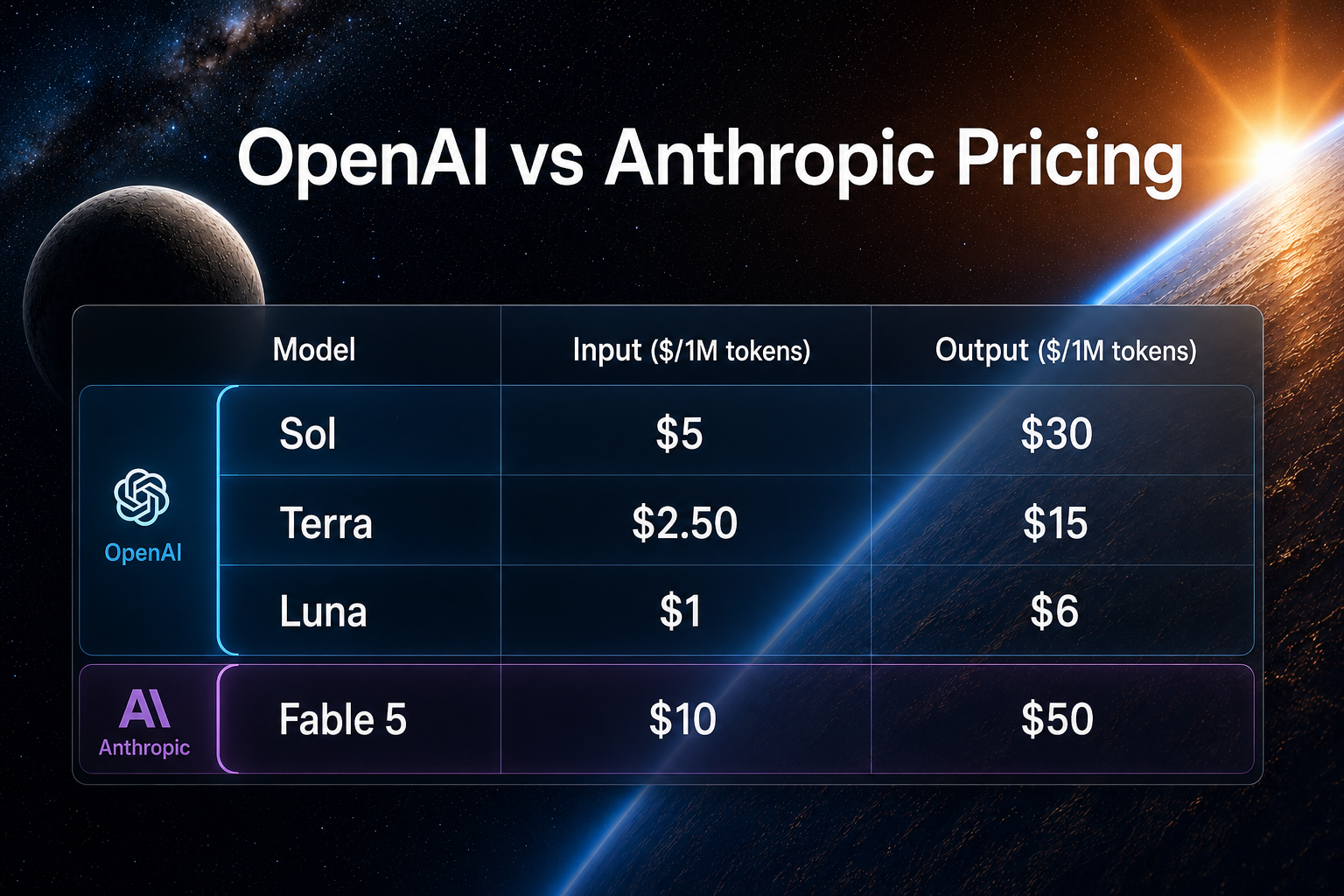
At standard short-context API rates, Sol costs $5 per million input tokens and $30 per million output tokens. Terra costs $2.50 and $15, while Luna costs $1 and $6.
Those figures require context. OpenAI charges differently for long-context, Batch, and Priority processing, and it is not cheaper than every Anthropic model at every tier.
The strongest direct comparison is Sol against Claude Fable 5, which costs $10 per million input tokens and $50 per million output tokens.
Can GPT-5.6 Sol Match Claude Fable 5 Without Matching Its Price?
An independent evaluation scored GPT-5.6 Sol at 59 points on its overall Intelligence Index, compared with 60 for Claude Fable 5.
The same evaluation found that Sol delivered approximately similar intelligence at around one-third of Fable 5’s measured cost per task. Sol also scored 80 on the Coding Agent Index when used through Codex.
However, Fable 5 retained the lead in the evaluation’s overall intelligence ranking and broader knowledge-work assessment. That distinction matters because the competitive argument is not that OpenAI wins every benchmark.
Instead, OpenAI is offering near-frontier performance at a significantly lower flagship API price while connecting the model to a larger product ecosystem.
Why Claude’s Plans, Limits, And Credits Make Premium Access Harder To Explain
Anthropic includes Claude Code, Cowork, and other capabilities within several paid plans, so it would be inaccurate to suggest that every feature is billed separately.
The complexity comes from how sustained access is structured.
Individual users can choose Claude Pro at $20 monthly, Max 5x at $100, or Max 20x at $200. Session limits reset every five hours, paid users may face weekly allowances, and customers who exhaust included capacity can activate credits and continue at standard API rates.
Team plans also separate Standard and Premium seats by price and capacity. New Enterprise plans charge seat fees while billing actual usage separately at standard API rates.
Fable 5 made these moving parts more visible. The model launched on June 9, 2026, was suspended on June 12 following US export controls affecting foreign-national access, and returned globally on July 1 after the restrictions were lifted.
Anthropic initially included Fable 5 within up to 50% of weekly usage limits for eligible plans through July 7. That deadline moved to July 12 and then July 19, 2026. Once the included allowance is exhausted, users must switch models or continue through separately billed credits.
Topics For More Insights
- OpenAI Launches GPT-5.6 Sol, Terra And Luna Globally
- OpenAI ChatGPT Finance Tools: Features, Benefits, And What Users Need To Know
- Fidji Simo Steps Down as OpenAI’s No. 2, Leaving a Leadership Gap Before a Possible IPO
- OpenAI Launches ChatGPT Work To Turn Prompts Into Finished Business Projects
- OpenAI Launches GPT-Live Voice Models That Listen And Speak At The Same Time
Anthropic Still Has Strong AI Advantages, But OpenAI Has A Packaging Advantage
Claude remains highly competitive in repository-scale coding, long-running agents, complex reasoning, specialized professional workflows, careful writing, and enterprise controls.
Anthropic also retains deeper credibility around MCP, which it created as an open standard for connecting AI applications with external tools, systems, data, and actions.
OpenAI’s challenge to Anthropic is therefore less about eliminating Claude’s strengths and more about making comparable capabilities broader, cheaper in key comparisons, and easier to buy under one familiar brand.
Anthropic wrote much of the premium AI playbook. OpenAI is now turning several of those chapters into an increasingly accessible bundle, leaving Anthropic with a difficult question: how long can technical differentiation defend premium positioning when packaging becomes part of the product?
