
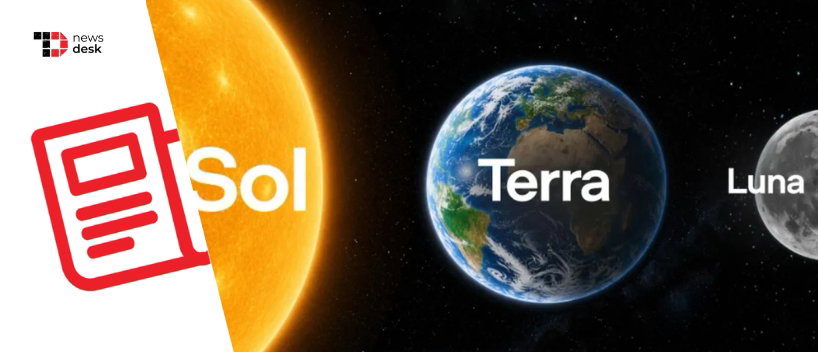
OpenAI has launched the GPT-5.6 model family for general availability following a limited preview, introducing flagship model Sol, balanced everyday model Terra, and cost-efficient model Luna across ChatGPT, Codex, and the OpenAI API.
The launch gives users and developers three capability tiers designed to balance performance, speed, reasoning depth, and operating costs. OpenAI said the models began rolling out globally on July 9, 2026.
TL;DR
- GPT-5.6 Sol, Terra, and Luna are generally available across ChatGPT, Codex, and the OpenAI API.
- Sol is the flagship model, Terra targets everyday work at a lower cost, and Luna prioritizes speed and affordability.
- API pricing begins at $1 per million input tokens for Luna.
- OpenAI has introduced new reasoning, tool-calling, multi-agent, caching, and safety capabilities.
What Do Sol, Terra And Luna Offer?
GPT-5.6 Sol is positioned as OpenAI’s most capable model for complex professional work, long-horizon analysis, coding, browsing, science, computer use, and cybersecurity. Terra provides a balance of capability, speed, and cost for everyday work, while Luna is the fastest and most affordable member of the family.
OpenAI reported that Sol achieved 92.2% on BrowseComp using its Ultra configuration and 62.6% on OSWorld 2.0. It also scored 64.6% on SWE-Bench Pro and 94.6% on GPQA Diamond, although benchmark results may not directly represent performance in every production environment.
The models introduce additional reasoning options. The Max setting allocates more processing effort to difficult tasks, while Ultra can coordinate multiple agents working concurrently before combining their findings into one response.
Developers can access all three models through the OpenAI API. Programmatic Tool Calling allows GPT-5.6 to write and run in-memory programs that coordinate tools and process intermediate results, while a multi-agent capability is initially available in beta.
How Much Does GPT-5.6 Cost?
GPT-5.6 Sol costs $5 per million input tokens and $30 per million output tokens. Terra is priced at $2.50 for input and $15 for output, while Luna costs $1 for input and $6 for output.
OpenAI has also introduced more predictable prompt caching, including explicit cache breakpoints and a minimum cache lifetime of 30 minutes. Cache writes are charged at 1.25 times the uncached input rate, while cache reads continue to receive a 90% cached-input discount.
Topics For More Insights
Who Can Access GPT-5.6?
Eligible ChatGPT users can access Sol through medium and higher reasoning settings, while Sol Pro is positioned for demanding tasks and long-running workflows. Terra and Luna are available through selected work surfaces, Codex, and the OpenAI API, depending on the user’s plan.
Free and Go users receive Terra in Codex, while Plus, Pro, Business, and Enterprise users can access Sol, Terra, and Luna. The three models are also available to developers through the OpenAI API.
OpenAI’s system card classifies the GPT-5.6 family as High capability in cybersecurity and biological and chemical risk, but below its Critical cybersecurity threshold. The company said the launch uses layered safeguards, model-level protections, and real-time monitoring designed to support broader deployment.
The release gives OpenAI a wider model portfolio for organizations that need to choose between maximum capability and lower operating costs. It also reinforces the company’s focus on agentic workflows, complex knowledge work, software engineering, scientific research, and defensive cybersecurity.
