
Artificial Intelligence
OpenAI Hires Head Of AI Safety While Naware Uses Technology For Chemical-Free Weed Control
Updated on Mon, Dec 29, 2025
Share
OpenAI says it’s working to make the system better at spotting signs of emotional distress and connecting users with real-world support. With this, OpenAI is stepping up, looking for a new executive to lead its efforts in tracking and preparing for emerging AI risks.
TL;DR
-
OpenAI is hiring a Head of AI Preparedness to manage growing AI safety and risk concerns.
-
AI’s real-world impact is under scrutiny, especially around mental health and security.
-
Naware uses tech and steam for chemical-free weed control, cutting health and environmental risks.
-
From AI to lawn care, tech is shifting toward safer, responsible innovation.
OpenAI Hires Head Of AI Preparedness For Safety And Risks
CEO Sam Altman shared the news on X, explaining that AI models are “starting to present some real challenges.” He pointed to both the “potential impact of models on mental health” and systems that are “so good at computer security they are beginning to find critical vulnerabilities.”
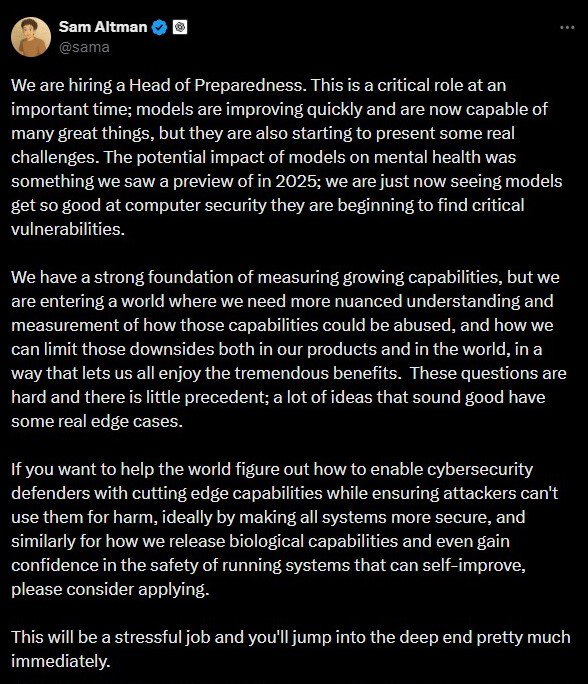
Altman invited people ready to transform. “If you want to help the world figure out how to enable cybersecurity defenders with cutting edge capabilities while ensuring attackers can’t use them for harm… please consider applying.”
The role, Head of Preparedness, comes with a $555,000 salary plus equity and focuses on implementing OpenAI’s preparedness framework. This framework tracks AI developments that could cause “new risks of severe harm,” whether it’s an immediate threat like phishing attacks or something more extreme, like biological or nuclear risks.
OpenAI created its preparedness team in 2023, but within a year, former Head Aleksander Madry shifted focus to AI reasoning, and other safety leaders also left or changed roles. The company recently updated its framework, saying it may “adjust” safety rules if a competitor releases a high-risk AI model without similar protections.
This new position makes it clear that OpenAI sees AI safety as a top priority. With technology advancing so quickly, the company wants a leader who can stay ahead of risks and ensure AI is developed in a safe and responsible way.
Just as OpenAI is tackling the risks of advanced AI, startups like Naware are using technology to make everyday life safer and smarter with chemical-free lawn care.
Topics for more insights
Naware Uses Tech And Steam For Chemical-Free Weed Control
Weed control isn’t something most people think twice about. It’s usually handled with a spray tank, a routine schedule, and a lot of chemicals. As concerns around health and environmental impact keep surfacing, a small startup is taking a default approach that leans more on technology than toxins.
Founded by Mark Boysen, Naware startup is working on a chemical-free way to kill weeds using steam and smart sensing. The idea traces back to Boysen’s personal experience. Growing up in North Dakota, he saw family members fall ill, something his family believed could be linked to chemicals in the local groundwater. That experience pushed him to explore safer alternatives.
Early experiments explored cutting-edge ideas, including drones fitted with a 200-watt laser. While technically promising, the fire risk made it impractical. After months of testing and prototyping, Boysen found that steam was the most reliable solution when paired with precise detection.
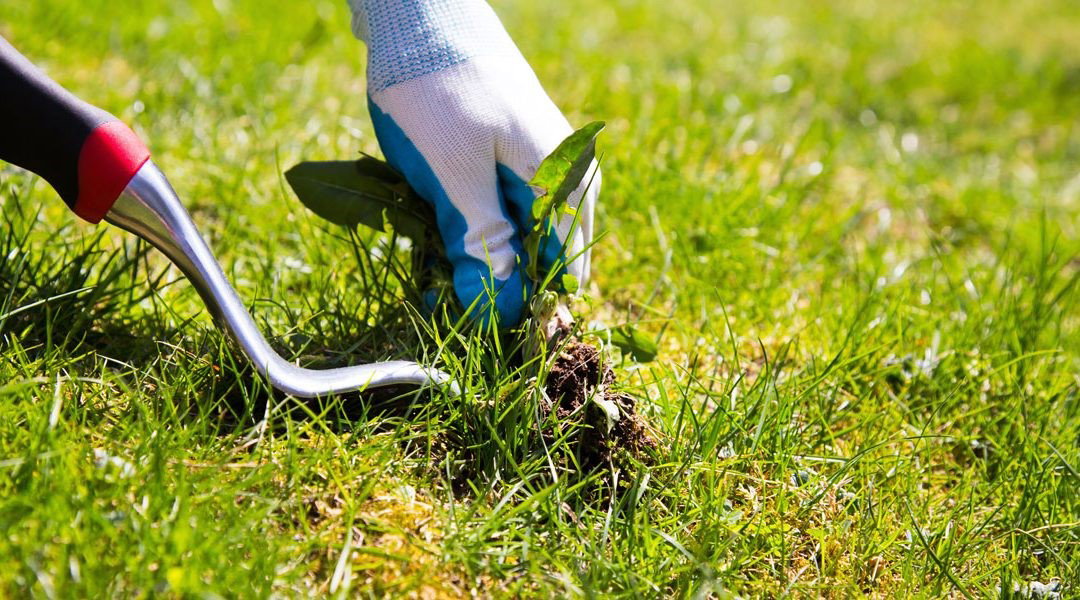
Today, Naware’s system works while equipment is already moving across lawns and fields. Using sensing and software-driven detection, it identifies weeds mixed in with grass and targets them with steam. The technology can be mounted on mowers, tractors, or ATVs, allowing crews to keep their existing workflows while adding a new layer of automation.
Getting to this point wasn’t straightforward. Early tests relied on basic garment steamers ordered online, hardly industrial tools. “They’re not real industrial,” Boysen said. “And so there’s a lot of research helping to develop that, to get to the point of: ‘How do we make this effective and make it repeatable so it can scale?’”
Naware is now running paid pilots and focusing on customers like golf courses and sports facilities. Boysen says the savings can add up quickly, estimating customers could save “anywhere from $100,000 to $250,000 on chemicals alone,” while also cutting labor tied to spraying.
Interest is building beyond early users. “We’re in discussions with $5 billion companies that do equipment manufacturing that are interested in our product,” Boysen said.
For now, the company is self-funded, but fundraising is next. Boysen is confident about what comes after. “I’ve got to deliver the promise that I can kill weeds, and it’s effective. And we’ll make it work. I’m not concerned about that.”
While Naware is growing, it’s showing how technology can make a real difference in everyday tasks. By using smart sensing and automation to remove weeds without chemicals, the startup is changing how lawns and fields are managed, making it safer, more cost-effective, and more efficient.
As we think about the role of technology in our lives, from powerful AI systems to everyday tools like lawn care, these questions become more important.
First published on Mon, Dec 29, 2025

Enjoyed what you've read so far? Great news - there's more to explore!
Stay up to date with the latest news, a vast collection of tech articles including introductory guides, product reviews, trends and more, thought-provoking interviews, hottest AI blogs and entertaining tech memes.
Plus, get access to branded insights such as informative white papers, intriguing case studies, in-depth reports, enlightening videos and exciting events and webinars from industry-leading global brands.
Dive into TechDogs' treasure trove today and Know Your World of technology!
Disclaimer - Reference to any specific product, software or entity does not constitute an endorsement or recommendation by TechDogs nor should any data or content published be relied upon. The views expressed by TechDogs' members and guests are their own and their appearance on our site does not imply an endorsement of them or any entity they represent. Views and opinions expressed by TechDogs' Authors are those of the Authors and do not necessarily reflect the view of TechDogs or any of its officials. While we aim to provide valuable and helpful information, some content on TechDogs' site may not have been thoroughly reviewed for every detail or aspect. We encourage users to verify any information independently where necessary.
Loading comments...