

Artificial Intelligence
xAI-OpenAI's AI Theft Lawsuit Raises Tensions As 'AI Shame' Affects Employees
Updated on Tue, Sep 2, 2025
Share
Just a year ago, AI was every company’s golden ticket—boosting valuations, dominating headlines, and promising to rewrite the rules of work.
Fast forward to today, and the shine is fading fast. Behind the scenes, lawsuits are flying, billion-dollar partnerships are unraveling, and even the most powerful executives are hiding their AI out of fear of being judged.
Well, here’s what is happening in the quick-moving AI landscape.
Elon Musk’s xAI has accused a former engineer of stealing confidential chatbot data before joining OpenAI, Meta’s Superintelligence Labs is facing departures as other employees threaten to leave, and new research shows that “AI shame” is creeping into boardrooms.
Let’s break down the dramatic headlines shaking the foundation of AI, starting with Elon Musk’s xAI.
xAI Accuses Ex-Engineer Of AI Trade Secret Theft
xAI, Elon Musk’s AI startup, has filed a lawsuit against its former employee Xuechen Li, accusing him of stealing confidential data related to its flagship chatbot, Grok, before moving to rival OpenAI.
Filed in California federal court, the lawsuit claims Li downloaded proprietary files on “cutting-edge AI technologies with features surpassing ChatGPT” in July, shortly after accepting a role at OpenAI and cashing out $7 million worth of xAI stock.
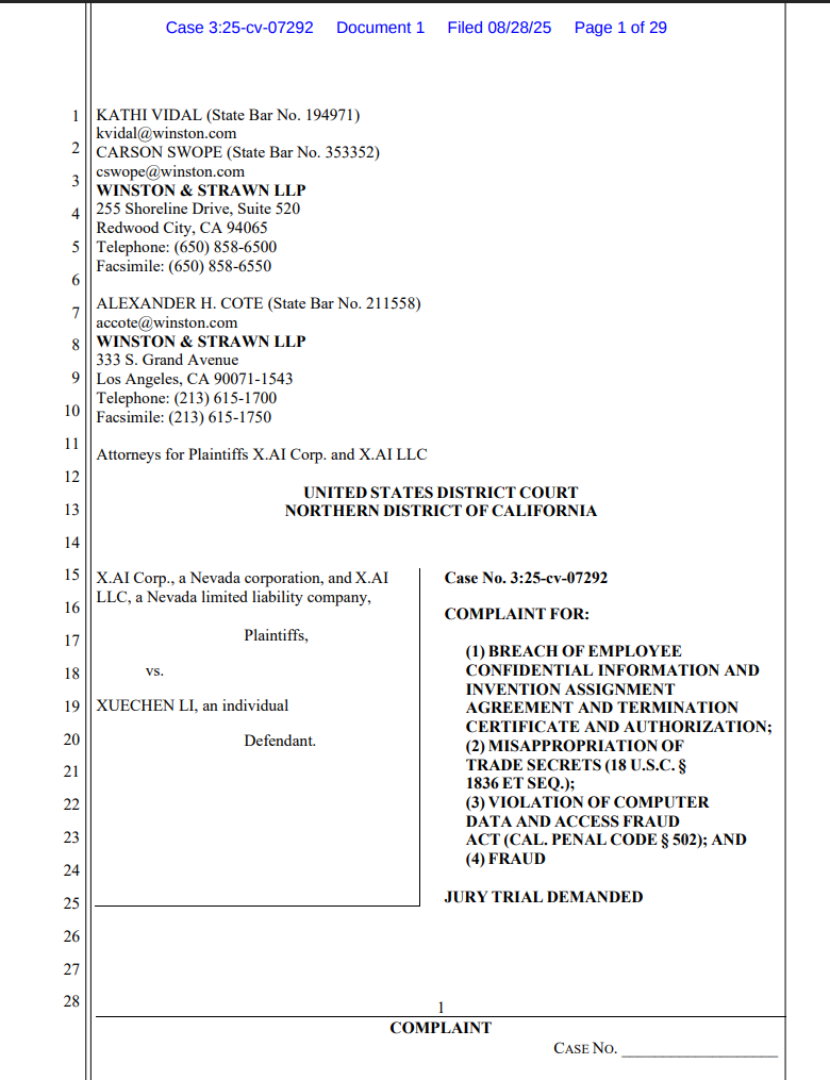
xAI alleges that Li confessed to taking the files in a meeting held on August 14 but attempted to hide the full scope of his actions with additional files being found on his personal devices later.
The AI company is seeking damages and a court order preventing Li from working at OpenAI. However, OpenAI is not named as a defendant in the legal case.
This incident escalates an already heated rivalry between Musk and OpenAI, which he co-founded in 2015, as Musk is also currently involved in separate litigation with OpenAI and its CEO, Sam Altman.
This development comes on the heels of another lawsuit by xAI filed in Texas, accusing Apple and OpenAI of colluding to monopolize the latter’s AI services on Apple devices and App Store.
While xAI’s legal battles heat up over a former employee, another tech giant is facing internal friction with its employees—one that even nine-figure bonuses can’t seem to fix.
Meta’s AI Gamble Is Under Fire As Talent Flees and Deals Sour
Meta’s $14.3 billion investment into Scale AI and the launch of its elite Meta Superintelligence Labs (MSL) were meant to turbocharge its AI ambitions, but just months in, cracks are starting to show.
Several top AI researchers hired from OpenAI and Scale AI have exited MSL within weeks, citing internal frustrations. One major hire, Avi Verma, reportedly left before his first full workday, while another, ChatGPT co-creator Shengjia Zhao, threatened to return to OpenAI and had to be appeased with the title “Chief AI Scientist.”
Rishabh Agarwal, a high-profile MSL researcher, recently announced his exit on X, saying, “I choose to follow Mark’s own advice: ‘In a world that’s changing so fast, the biggest risk you can take is not taking any risk.’”
Meanwhile, Meta’s multi-billion-dollar partnership with Scale AI is faltering. Despite the investment, Meta’s core AI unit—TBD Labs—has begun working more extensively with competitors Mercor and Surge.
Internal sources claim that several MSL researchers find Scale AI’s data subpar, favoring Surge and Mercor’s domain-expert-driven approach. Scale AI recently laid off 200 employees in its data-labeling division, citing “shifts in market demand.”
Tensions within Meta’s AI operations reportedly began after a lackluster Llama 4 launch earlier this year. CEO Mark Zuckerberg responded by fast-tracking deals and poaching talent to accelerate development—but those moves now appear to be backfiring.
Despite the internal turbulence, Meta continues investing heavily in AI, with plans for a $50 billion data center named Hyperion and an under-development next-gen AI model, set to be released by year-end.
The negativity around AI doesn’t stop here. There’s a growing anti-AI sentiment in boardrooms and workplaces, driven by fear and a lack of readiness.
'AI Shame' Is Now a C-Suite Epidemic, Says New Report
While Big Tech wrestles with AI lawsuits and infighting, a new problem is emerging in corporate boardrooms: AI shame.
According to WalkMe’s 2025 “AI in the Workplace” report, 53.4% of C-suite executives admit to hiding their AI usage at work—even as they lead adoption strategies for their organizations.
Nearly half (48.8%) of all employees say they’ve concealed AI use to avoid judgment. Gen Z workers are especially conflicted, with 62.6% admitting to using AI while pretending their work was entirely original.
The report also reveals a shocking gap in AI training: only 6.8% of Gen Z workers have received formal training, despite 89.2% using AI tools, including ones not authorized by their organizations.
This widening disconnect has led to an emerging “AI class divide,” where the most frequent users—junior employees and top execs—are left to navigate AI adoption with little guidance or support as seniors try to hide their reliance on the technology.
Sharon Bernstein, CHRO at WalkMe, said in an interview, “Companies are not educating enough about this whole thing… Even if you’re a CIO buying new tools, how much was it actually adopted?”
Additionally, 80% of workers say AI improves productivity, yet 59% say using AI often takes longer than manual work, indicating a “productivity paradox.”
Gen Z is also feeling the heat: 65.3% say AI slows them down, while 68% feel pressured to produce more because of it. Another insight reveals 89.6% want to learn AI, but only 45% feel “very confident” using it.
These gaps not only create operational risks but also psychological stress. With investors raising concerns about the lack of ROI from AI pilots—95% reportedly failing to deliver value—it’s clear the hype is outpacing organizational readiness.
What’s Really Driving These Emerging AI Crises?
These incidents share a common theme: AI disruption without alignment. Whether it’s legal disputes, internal chaos, or quiet shame, the AI ecosystem is struggling to scale with human workers’ needs and preferences.
In xAI’s case, internal trade secrets became its most valuable assets in a cutthroat talent war. At Meta, even multi-billion-dollar partnerships aren’t enough to guarantee a win, with researchers and employees jumping ship due to unmet expectations.
For enterprises buying into the AI transformation, ignoring employee readiness is creating more anxiety, not an advantage.
Do you think these events signal a larger reckoning for the AI industry? Can leaders like xAI, Meta, and OpenAI work together successfully despite an increasingly hostile AI talent war?
Let us know in the comments below!
First published on Tue, Sep 2, 2025

Enjoyed what you read? Great news – there’s a lot more to explore!
Dive into our content repository of the latest tech news, a diverse range of articles spanning introductory guides, product reviews, trends and more, along with engaging interviews, up-to-date AI blogs and hilarious tech memes!
Also explore our collection of branded insights via informative white papers, enlightening case studies, in-depth reports, educational videos and exciting events and webinars from leading global brands.
Head to the TechDogs homepage to Know Your World of technology today!
Disclaimer - Reference to any specific product, software or entity does not constitute an endorsement or recommendation by TechDogs nor should any data or content published be relied upon. The views expressed by TechDogs' members and guests are their own and their appearance on our site does not imply an endorsement of them or any entity they represent. Views and opinions expressed by TechDogs' Authors are those of the Authors and do not necessarily reflect the view of TechDogs or any of its officials. While we aim to provide valuable and helpful information, some content on TechDogs' site may not have been thoroughly reviewed for every detail or aspect. We encourage users to verify any information independently where necessary.
Loading comments...