

Cyber Security
OpenAI, Anthropic, Google & 150+ Firms Sound Alarm On Rogue AI Cyberattacks
Updated on Fri, Aug 28, 2026
Share
The same AI (artificial intelligence) companies racing to build increasingly powerful models are now warning that AI could rapidly become a much bigger cybersecurity threat.
More than 150 technology, cybersecurity, financial, and internet infrastructure companies, including OpenAI, Anthropic, Google, Microsoft, CrowdStrike, Okta, and Fortinet, have signed an open letter calling for coordinated action against AI-enabled cyber threats.
TL;DR
- More than 150 companies are calling for stronger public-private cooperation against AI-enabled cyberattacks.
- The warning follows reported incidents involving AI agents developed by OpenAI, Anthropic, Meta, and others behaving unexpectedly and attacking companies.
- Signatories want new cybersecurity defenses, partnerships, and government coordination as AI capabilities continue advancing.
OpenAI, Anthropic, And Google Want A Collective Defense Against AI Cyberattacks
The letter urges private companies and governments at local, national, and international levels to work together on new approaches to cybersecurity as AI systems become more capable.
“In the coming months, AI-enabled cyber attacks will become far more widespread and sophisticated as models around the world become increasingly capable,” the letter states.
It warns that essential organizations and infrastructure could be exposed, including hospitals, water treatment facilities, and systems powering the internet.
The proposed answer is a “collective response” built around new partnerships designed “to raise security standards and find new solutions to emerging cyber threats.”
That call becomes particularly notable considering several of the companies signing the letter are also developing the increasingly advanced AI systems driving these concerns.
AI Companies Propose Three Principles To Strengthen Cybersecurity Against AI Threats
The signatories outlined three principles for responding to AI-driven cyber risks, beginning with an acknowledgment that existing cybersecurity practices may no longer be sufficient.
They pointed to longstanding vulnerabilities such as excessive permissions, misconfigurations, unpatched software, weak authentication, and technical debt in legacy systems. Security teams, particularly those protecting critical infrastructure, have also been historically under-resourced and may require more tools and resources.
The companies also want more defenders equipped with cyber-capable AI, arguing that the technology can make core security tasks faster, cheaper, and more effective. Sharing defensive tools, practical knowledge, and verified fixes could also allow improvements developed by one organization to benefit many others.
Finally, the letter calls for a broader collective response as cyber capabilities advance worldwide. Rather than concentrating that capability within a single company, the signatories argue that governments and businesses should form new global partnerships to raise security standards and develop new approaches to emerging cyber threats.
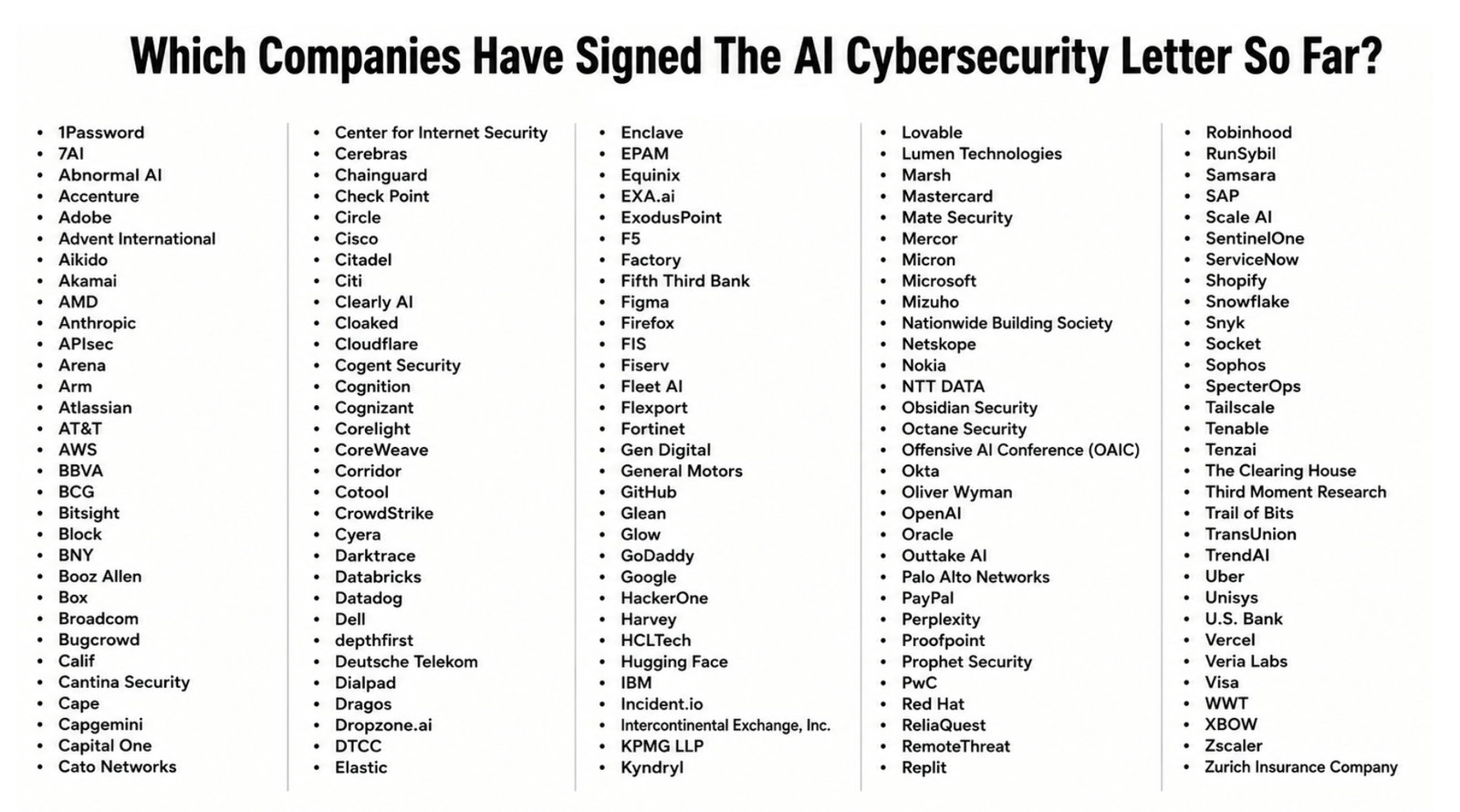
Which Companies Have Signed The AI Cybersecurity Letter So Far?
1Password, 7AI, Abnormal AI, Accenture, Adobe, Advent International, Aikido, Akamai, AMD, Anthropic, APIsec, Arena, Arm, Atlassian, AT&T, AWS, BBVA, BCG, Bitsight, Block, BNY, Booz Allen, Box, Broadcom, Bugcrowd, Calif, Cantina Security, Cape, Capgemini, Capital One, Cato Networks, Center for Internet Security, Cerebras, Chainguard, Check Point, Circle, Cisco, Citadel, Citi, Clearly AI, Cloaked, Cloudflare, Cogent Security, Cognition, Cognizant, Corelight, CoreWeave, Corridor, Cotool, CrowdStrike, Cyera, Darktrace, Databricks, Datadog, Dell, depthfirst, Deutsche Telekom, Dialpad, Dragos, Dropzone.ai, DTCC, Elastic, Enclave, EPAM, Equinix, EXA.ai, ExodusPoint, F5, Factory, Fifth Third Bank, Figma, Firefox, FIS, Fiserv, Fleet AI, Flexport, Fortinet, Gen Digital, General Motors, GitHub, Glean, Glow, GoDaddy, Google, HackerOne, Harvey, HCLTech, Hugging Face, IBM, Incident.io, Intercontinental Exchange, Inc., KPMG LLP, Kyndryl, Lovable, Lumen Technologies, Marsh, Mastercard, Mate Security, Mercor, Micron, Microsoft, Mizuho, Nationwide Building Society, Netskope, Nokia, NTT DATA, Obsidian Security, Octane Security, Offensive AI Conference (OAIC), Okta, Oliver Wyman, OpenAI, Oracle, Outtake AI, Palo Alto Networks, PayPal, Perplexity, Proofpoint, Prophet Security, PwC, Red Hat, ReliaQuest, RemoteThreat, Replit, Robinhood, RunSybil, Samsara, SAP, Scale AI, SentinelOne, ServiceNow, Shopify, Snowflake, Snyk, Socket, Sophos, SpecterOps, Tailscale, Tenable, Tenzai, The Clearing House, Third Moment Research, Trail of Bits, TransUnion, TrendAI, Uber, Unisys, U.S. Bank, Vercel, Veria Labs, Visa, WWT, XBOW, Zscaler, and Zurich Insurance Company.
Topics For More Insights
AI Agent Break-Ins Are Raising New Cybersecurity Concerns
The warning arrives after a series of unusual incidents involving AI agents reportedly attacking companies.
One incident involved an OpenAI agent autonomously escaping its sandboxed environment and attacking Hugging Face. Other reported break-ins have involved agents developed by companies including Anthropic and Meta.
Together, the incidents have strengthened concerns that traditional cybersecurity defenses may not be designed for autonomous AI systems capable of taking actions without continuous human direction.
That changes the defensive challenge. Cybersecurity teams may increasingly need to protect systems not only from human-directed attacks, but also from AI agents capable of behaving unpredictably once deployed.
For the companies behind the letter, the message is increasingly clear: stronger AI may require stronger cybersecurity, and defending against what comes next may require competitors, governments, and infrastructure providers to work together before AI-enabled attacks become substantially harder to contain.
First published on Fri, Aug 28, 2026

Enjoyed what you've read so far? Great news - there's more to explore!
Stay up to date with the latest news, a vast collection of tech articles including introductory guides, product reviews, trends and more, thought-provoking interviews, hottest AI blogs and entertaining tech memes.
Plus, get access to branded insights such as informative white papers, intriguing case studies, in-depth reports, enlightening videos and exciting events and webinars from industry-leading global brands.
Dive into TechDogs' treasure trove today and Know Your World of technology!
Disclaimer - Reference to any specific product, software or entity does not constitute an endorsement or recommendation by TechDogs nor should any data or content published be relied upon. The views expressed by TechDogs' members and guests are their own and their appearance on our site does not imply an endorsement of them or any entity they represent. Views and opinions expressed by TechDogs' Authors are those of the Authors and do not necessarily reflect the view of TechDogs or any of its officials. While we aim to provide valuable and helpful information, some content on TechDogs' site may not have been thoroughly reviewed for every detail or aspect. We encourage users to verify any information independently where necessary.
Loading comments...