
Meta has launched Muse Spark 1.1, an upgraded multimodal reasoning model designed to write code, fix complex bugs, operate software tools, and execute agentic workflows with less human intervention.
The release also opens Meta’s underlying AI technology to more developers through the new Meta Model API, marking a direct challenge to coding and agent platforms from OpenAI, Anthropic, and Google.
TL;DR
- Muse Spark 1.1 brings stronger coding, computer-use, multimodal, and agentic capabilities.
- US developers can access it through the Meta Model API public preview.
- New accounts receive $20 in credits before usage-based charges apply.
- Meta is pricing access at $1.25 per million input tokens and $4.25 per million output tokens.
Meta Opens Muse Spark 1.1 To Developers
Muse Spark 1.1 is the latest model developed by Meta Superintelligence Labs and a substantial upgrade over the original Muse Spark, which was introduced in April 2026.
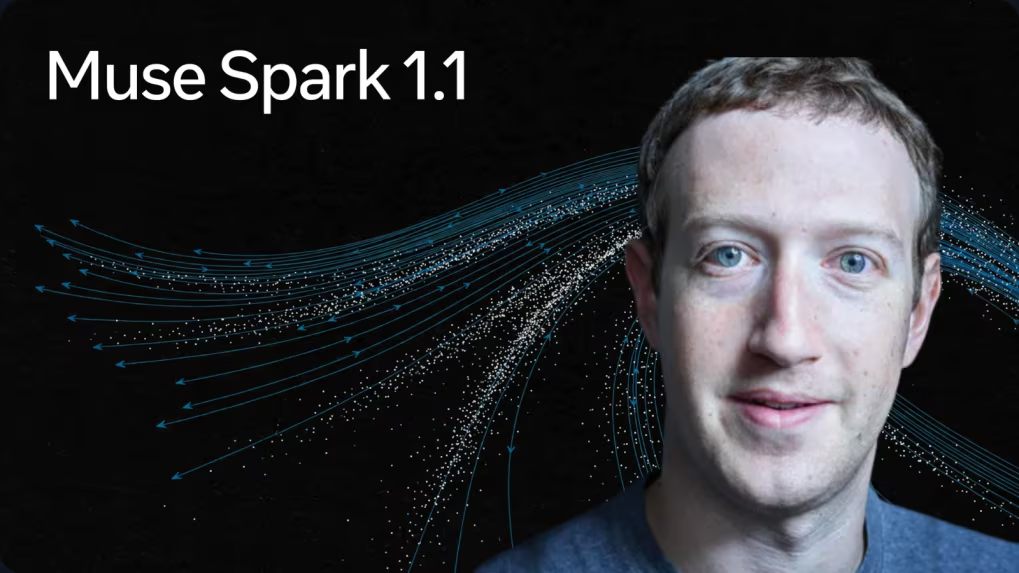
The new model is available in Thinking mode through the Meta AI app and Meta AI website. US developers can also access it through the Meta Model API, which has moved from a private partner trial into public preview.
New API accounts will receive $20 in free credits. After these credits are exhausted, Meta will charge $1.25 per million input tokens and $4.25 per million output tokens.
“Our focus is on delivering strong agentic and multimodal models at very low cost,” said Meta CEO Mark Zuckerberg.
The pricing places Meta above some entry-level models from OpenAI and Anthropic but below more advanced offerings such as Anthropic’s Claude Sonnet 4.6. This signals that affordability and high-volume usage will be central to Meta’s attempt to attract developers.
What Can Muse Spark 1.1 Do?
Meta says Muse Spark 1.1 can diagnose complicated software bugs, implement features in enterprise systems, build web applications, and execute large code migrations.
The model supports popular agentic coding features, including planning modes, goal conditioning, context compaction, subagent delegation, and multi-turn workflows. It can operate as a primary agent that creates a plan and distributes tasks, or as a subagent responsible for completing individual parts of a larger project.
Muse Spark 1.1 also has a one-million-token context window. According to Meta, it can recall actions from earlier stages of long-running work, retrieve relevant information, and compress context while preserving important steps.
Its computer-use capabilities allow it to work across multiple applications and adapt when information or requirements change. Rather than clicking through every action, the model can decide whether writing a script, performing an interface action, or generating a batch of commands is the more efficient approach.
Meta’s coding demonstration showed Muse Spark 1.1 building a chat application, capturing screenshots to identify visible failures, tracing those problems back to the relevant code, implementing fixes, and validating the changes.
A Multimodal Model Built For Agents
Beyond coding, Muse Spark 1.1 can understand text, images, video, audio, and documents. Meta says these capabilities allow the model to combine perception with action, such as inspecting visual information and using it while operating software on a user’s behalf.
“What’s most impressive about Muse Spark is how much it packs into one model,” said Replit CEO Amjad Masad, highlighting its long context window, multimodal support, search, reasoning, coding, structured output, and parallel tool use.
Cline CEO Saoud Rizwan said the combination of tool-use capabilities and pricing makes Muse Spark suitable for running substantial coding workloads at scale.
Meta Enters A Crowded Coding Market
Meta is arriving later than OpenAI and Anthropic, which already offer established coding products and developer-focused models. However, Meta’s distribution across its apps, aggressive pricing, and ability to fund large-scale AI infrastructure could make it a serious competitor.
Topics for more insights:
Muse Spark already powers experiences across Meta AI and has been expanding into WhatsApp, Instagram, Facebook, Messenger, Threads, and Meta’s smart glasses.
The company says more capable models are currently in training. For now, Muse Spark 1.1 represents Meta’s clearest attempt yet to convert its AI investments into a paid developer platform and compete for the growing market surrounding autonomous coding agents.
