
Artificial Intelligence
Meta AI: All You Need To Know About DINO And SAM
Share
Introduction
The scale of that frontier is significant. According to Markets And Markets, the global AI in computer vision market was valued at nearly $20 billion in 2024 and is projected to grow to over $63 billion by 2030.
Demand is accelerating across healthcare, robotics, autonomous vehicles, and defense. The question is no longer whether machines can see. It is whether they can understand what they are looking at, with minimal human guidance, and in environments nobody prepared them for.
Two models sit at the heart of that push: DINO and SAM.
Though they come from the same research ecosystem at Meta AI, they solve different problems and bring different strengths to the table.
Together, they are reshaping what Artificial intelligence can do with visual data. From helping robots navigate disaster zones to mapping deforestation across entire continents, the real-world applications of Meta DINO and Meta SAM are growing fast.
In this article, we will break down what DINO and SAM are, how they work, how they complement each other, and why some of the most ambitious teams in robotics and medical AI are building their systems around them.
So, without further ado, let’s dive in!
TL:DR
-
Meta AI's DINO learns visual features from images without any labelled data, making it faster and cheaper to deploy across industries.
-
SAM, the Segment Anything Model, can isolate any object in any image with pixel-level precision, even objects it has never seen before.
-
Together with Grounding DINO, they form a pipeline that detects and segments objects using nothing but a text prompt.
-
The University of Pennsylvania's PRONTO team is using this pipeline in DARPA's Triage Challenge, deploying robots to assess casualties in simulated disaster zones.
-
Both models are open source, and real-world applications are already expanding into environmental monitoring, medical research, and robotics.
What Is DINO?
DINO stands for Distillation with No Labels. It is Meta AI's approach to self-supervised learning in computer vision, meaning the model learns directly from the structure of images rather than from human-provided annotations.
The mechanism behind it is a student-teacher framework. A large teacher network guides a smaller student model to align representations from different views of the same input, and over time, the student internalizes transferable, semantic features that generalize across varied image domains.
The DINOv2 family was trained on around 142 million diverse images without labels, yielding features robust enough to support tasks from image classification to depth estimation and semantic segmentation, often without any fine-tuning.
The latest iteration, DINOv3, pushes this further still, producing Meta AI's strongest universal vision backbones and enabling breakthrough performance across domains including medical imaging, satellite analysis, and disaster response.
What makes Meta DINO genuinely exciting is its generality. It is not built for one job. It is a visual foundation that other systems can plug into immediately. However, understanding a scene is only half the challenge. The other half is knowing exactly where within that scene to look. That is where SAM comes in.
What Is SAM?
If DINO teaches machines to understand images, SAM teaches them to dissect one. The Segment Anything Model (SAM) is Meta AI's computer vision tool built specifically for image segmentation, which is the task of dividing an image into precise, meaningful regions.
What is SAM? It is a promptable model. Whether given a simple click, bounding box, or text description, it produces high-fidelity, pixel-accurate masks of the relevant regions. A user can point at an object, draw a box around it, or simply describe it, and SAM will isolate it cleanly from everything else in the frame.
What makes the SAM exceptional is its generalization. SAM's architectural design allows it to adjust to new image distributions and tasks seamlessly, even without prior knowledge, a capability referred to as zero-shot transfer. It can accurately segment objects it has never seen before, making it one of the most flexible tools in computer vision today.
SAM 2 extended these capabilities further, adding robust video segmentation and faster real-time performance. That adaptability has widened SAM's use cases, spanning healthcare, robotics, and augmented reality.
DINO and SAM are powerful individually. Together, they become something greater. The next section explains exactly how.
How DINO And SAM Work Together?
DINO and SAM were designed for different jobs, but together, they are a different beast entirely. DINO is the one who studies the whole scene, building a deep understanding of what is present in an image. SAM is the one who picks up the scalpel and isolates exactly what you need, down to the pixel.
The bridge between them is Grounding DINO, an open-vocabulary object detection model that brings language into the mix. Unlike models that map image and text into a shared space, Grounding DINO uses language as a query to detect and localize corresponding visual regions.
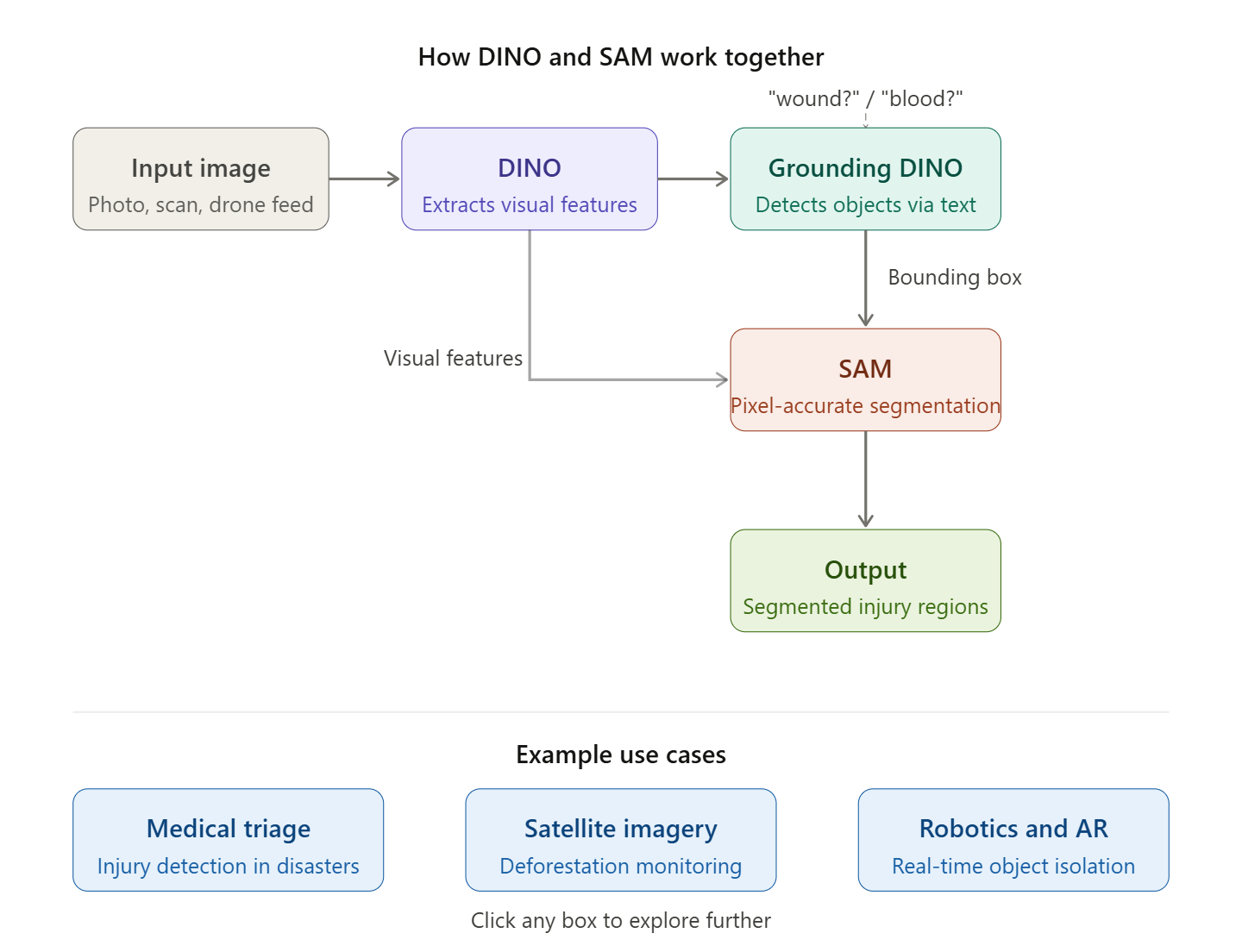
Now imagine putting that pipeline on a robot in the middle of a disaster zone. That is exactly what one university team did.
Real-World Application: Saving Lives With DARPA's Triage Challenge
Triage is one of the oldest practices in emergency medicine. The word itself comes from the French verb "trier," meaning to sort, and the concept dates back to Napoleonic battlefields where medics had to make brutal decisions fast: who gets treated first, who can wait, and who cannot be saved. Centuries later, the core challenge remains the same. In a mass casualty incident, time is everything, and resources are never enough.
The United States Defense Advanced Research Projects Agency (DARPA) announced a three-year challenge to spur innovation, to use stand-off sensors onboard autonomous systems to detect and identify physiological signatures in limited or no-connectivity environments.
Think of a collapsed building, thick with dust and darkness, where a drone needs to find survivors and assess injuries before any human can safely enter.
That is exactly the scenario the University of Pennsylvania's PRONTO team is training for. The team brings together surgeons from Penn Medicine with robotics and computer vision researchers from Penn Engineering and the GRASP lab, combining autonomous aerial and ground robots with Meta AI's DINO and SAM models to perform rapid, non-contact injury assessment.
PRONTO includes several parallel injury classifier pipelines that use SAM and DINO to extract visual features from the robot's images, which are then used to identify injuries via a customized deep neural network.
The full pipeline, as shown in the diagram below, runs across three stages.
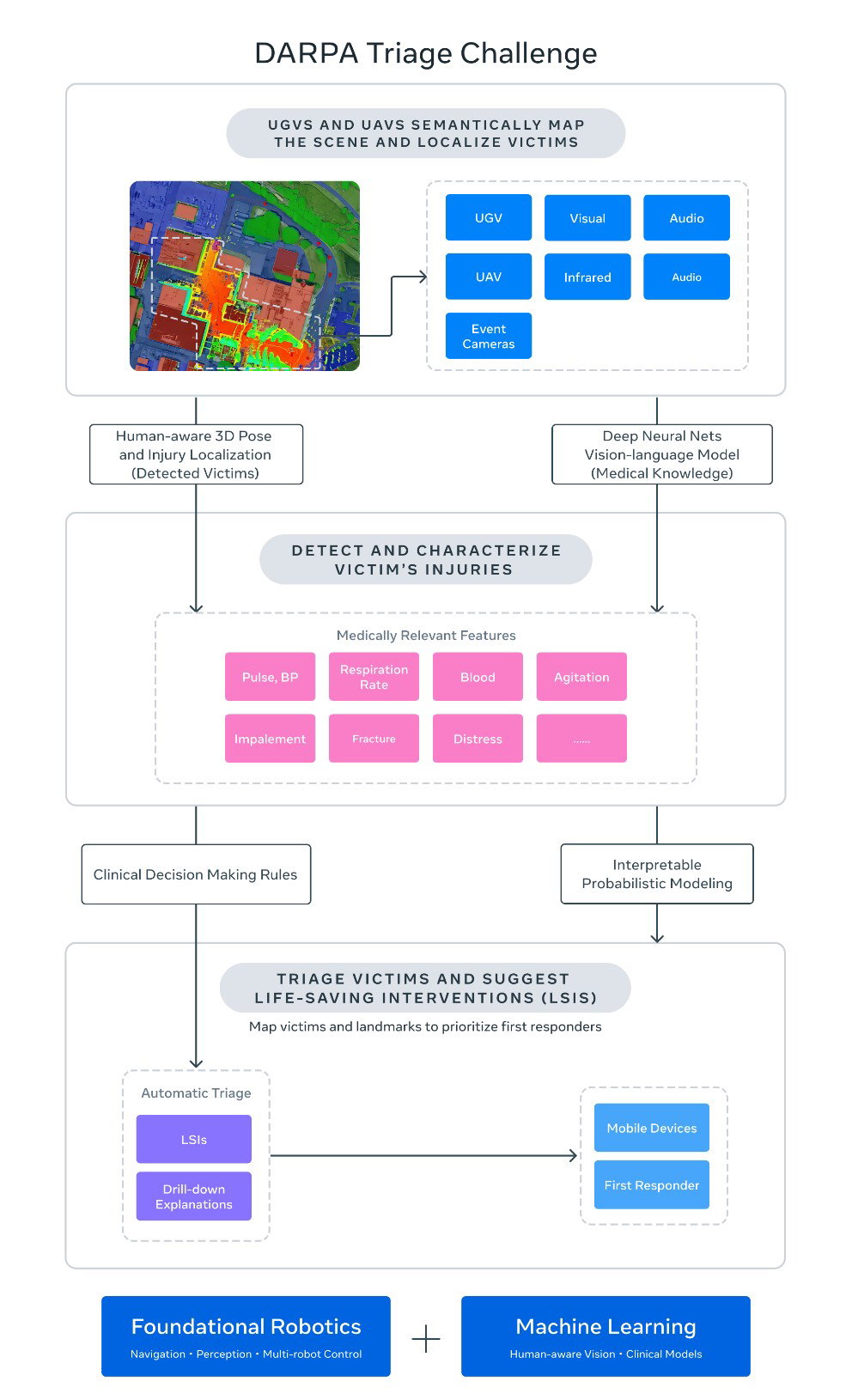
Robots first map the scene and locate victims using a combination of visual, infrared, audio, and event cameras. That data then feeds into injury detection, where the system assesses medically relevant signals like pulse, respiration, blood presence, and fractures, before finally suggesting life-saving interventions directly to first responders on mobile devices.
As Professor Eric Eaton, team lead for PRONTO, puts it: "We are really interested in making this application work in the real world.” He adds, “We are looking to develop technologies that could be useful in saving lives."
Medical triage is just one chapter of a much bigger story, though. DINO and SAM are showing up in places you might not expect.
Applications Of DINO And SAM Beyond Triage
The PRONTO story is compelling, but it is really just a preview of what these models are capable of. Here is where else DINO and SAM are already making an impact:
-
Environmental Monitoring
The World Resources Institute is using DINOv3 to monitor deforestation and support restoration, helping local groups protect vulnerable ecosystems. Mapping forests tree by tree across continents was simply not feasible before DINO made it possible to process satellite imagery without manual annotation.
-
Medical Research
Labelling cellular imagery requires rare expertise and enormous time. DINO sidesteps that bottleneck entirely, opening up the way for foundational cell imagery models and biological discovery, making it possible to compare known treatments with new ones.
-
Robotics And Augmented Reality
SAM has found a natural home here, with multimodal integration now fusing visual input with language and other AI modalities, widening its use cases considerably.
-
Automated Labelling Pipelines
Teams building computer vision datasets use SAM to dramatically speed up annotation, cutting out hours of manual work per image.
What connects all of these is the same core insight. General-purpose vision models, built once and deployed everywhere, are far more powerful than purpose-built tools.
Topics For More Insights
The Open-Source Philosophy And What's Next
One of the most important things about DINO and SAM is not just what they can do. It is a fact that anyone can use them. Meta AI has consistently released both models as open source, making them freely available to researchers, developers, and organizations around the world.
That decision has had a compounding effect. Every team that builds on DINO or SAM generates new insights, new use cases, and new feedback that pushes the models forward. The PRONTO team is a perfect example. In the third phase of the DARPA Challenge, teams will leverage learnings and explore how Meta's latest versions of SAM and DINO can be applied to triage. Real-world deployment is feeding directly back into research.
Meta is releasing DINOv3 with a comprehensive suite of open-sourced backbones under a commercial license, including a satellite backbone trained on MAXAR imagery, along with sample notebooks so the community can start building immediately.
As for what comes next, the trajectory is clear. DINOv3 already outperforms supervised models across a range of tasks, something that would have seemed unlikely just a few years ago. SAM continues to expand into video, multimodal systems, and real-time applications.
The gap between research benchmark and real-world deployment is closing fast. With every new version, the bar for what general-purpose vision AI can achieve moves higher.
Final Thoughts
DINO and SAM started as research projects. Today, they are running on robots in simulated disaster zones, scanning satellite imagery across entire continents, and helping scientists make sense of biological data that no human could label fast enough. That journey from benchmark to real-world deployment is exactly what makes them worth paying attention to.
What Meta AI has built with these two models is not just impressive computer vision technology. It is a new way of thinking about how Artificial intelligence should work. Rather than building narrow tools for specific tasks, DINO and SAM are general-purpose foundations that anyone can build on, adapt, and improve. The open-source commitment means that progress compounds. Every team that uses these models makes the ecosystem smarter.
Once confined to research benchmarks, foundation vision models like DINO and SAM are demonstrating how general-purpose AI can be adapted to meet some of the most urgent challenges in emergency medicine and defense, where every second truly counts.
That is the real story of Meta DINO and SAM. Not just what they can see, but what they make possible.
Frequently Asked Questions
What Is Meta AI's DINO And How Does It Work?
DINO, which stands for Distillation with No Labels, is Meta AI's self-supervised computer vision model that learns visual features directly from images without requiring any human-labelled data. It uses a student-teacher framework where a larger teacher network guides a smaller student model to build rich, generalised visual representations. The latest iteration, DINOv3, is Meta AI's most powerful universal vision backbone yet, capable of handling tasks from image classification to satellite imagery analysis and medical imaging out of the box.
What Is The Segment Anything Model (SAM) And What Makes It Special?
The Segment Anything Model, or SAM, is Meta AI's computer vision model built specifically for image segmentation. What makes SAM exceptional is its ability to segment any object in any image using just a click, a bounding box, or a text description, including objects it has never encountered before. This zero-shot capability makes it one of the most flexible and widely applicable tools in computer vision today, with use cases spanning healthcare, robotics, augmented reality, and automated labelling pipelines.
How Are Meta AI's DINO And SAM Being Used In The Real World?
DINO and SAM are already being deployed in high-stakes real-world applications. The University of Pennsylvania's PRONTO team uses both models in DARPA's Triage Challenge, where autonomous robots assess casualties in simulated disaster zones. Beyond emergency medicine, DINOv3 is being used by the World Resources Institute to monitor deforestation, while SAM is powering robotics and augmented reality systems globally. Both models are open source, meaning researchers and developers worldwide can build on them freely.
Tue, Mar 31, 2026

Liked what you read? That’s only the tip of the tech iceberg!
Explore our vast collection of tech articles including introductory guides, product reviews, trends and more, stay up to date with the latest news, relish thought-provoking interviews and the hottest AI blogs, and tickle your funny bone with hilarious tech memes!
Plus, get access to branded insights from industry-leading global brands through informative white papers, engaging case studies, in-depth reports, enlightening videos and exciting events and webinars.
Dive into TechDogs' treasure trove today and Know Your World of technology like never before!
Disclaimer - Reference to any specific product, software or entity does not constitute an endorsement or recommendation by TechDogs nor should any data or content published be relied upon. The views expressed by TechDogs' members and guests are their own and their appearance on our site does not imply an endorsement of them or any entity they represent. Views and opinions expressed by TechDogs' Authors are those of the Authors and do not necessarily reflect the view of TechDogs or any of its officials. While we aim to provide valuable and helpful information, some content on TechDogs' site may not have been thoroughly reviewed for every detail or aspect. We encourage users to verify any information independently where necessary.
Loading comments...